

Feeding a Pregnant Dog: Increased Needs During Pregnancy and Nursing
A pregnant dog's energy needs barely change in the first weeks; the real rise begins in the last three weeks, when the puppies grow fastest, and peaks during nursing. We explain why small, frequent meals matter, why calcium should stay under veterinary supervision and when to see your veterinary surgeon.
Short answer: Pregnancy in dogs lasts around 63 days, and energy needs rise mainly in the last three weeks, when the puppies grow fastest; during nursing they reach their highest level. Throughout this time, a complete food suited to pregnancy and lactation, small frequent meals and keeping calcium balance under veterinary supervision all matter. Your veterinary surgeon sets the feeding plan.
When should a pregnant dog's diet change?
Pregnancy in dogs lasts around 63 days on average, give or take a few days depending on the mating date. For the first five to six weeks the puppies are still very small and the dam's energy needs do not change noticeably. "Eating for two" at this stage can do more harm than good: a dog that is overfed early in pregnancy can become overweight, and excess weight is associated with more difficult births and post-whelping problems.
The real change begins in the last third of pregnancy, from roughly the sixth week onwards. Most of the puppies' weight gain happens in these final three weeks, and the dam's need for energy, protein and minerals rises in parallel. Weight gain should be gradual throughout pregnancy, with body condition assessed by your veterinary surgeon at regular intervals.
What happens in the dam's body in the last three weeks of pregnancy?
Rising energy needs
The puppies' tissues, the placenta, the uterus and the mammary tissue all develop rapidly at this stage, and all of this requires energy. The dam also lays down limited reserves for whelping and nursing. As a result, energy needs in the last three weeks are clearly higher than before pregnancy. How much higher depends on breed, litter size and the dam's starting condition, which is why a dog-specific plan is needed rather than one standard amount.
A smaller stomach capacity: why small, frequent meals?
The growing uterus takes up more and more space in the abdomen and presses on the stomach. Even though her needs are increasing, the dam may not be able to eat as much in one go as before; large meals can cause discomfort, a feeling of fullness and vomiting. Dividing the daily food into several small meals and choosing an energy-dense food help her meet her increased needs with a smaller volume.
Protein and fat
Protein is the basic building block for the puppies' tissues and for the development of the placenta and mammary glands. Fat raises the energy density of the food and is the most efficient way to meet high energy needs both in late pregnancy and during nursing. Inadequate protein or energy intake can adversely affect the puppies' birth weight and the dam's milk yield.
Vitamins and minerals
B group vitamins such as folate (vitamin B9) are needed for cell division and tissue development, and fat-soluble vitamins such as A, D and E also play a part in developmental processes. However, fat-soluble vitamins can accumulate in the body; excess vitamin A in particular is a risk to the puppies' development during pregnancy. With minerals, especially calcium and phosphorus, the ratio between them matters as much as the amount. In short, "the more, the better" does not apply at this stage.
Why do nutritional needs peak during nursing?
After whelping, the dam's body focuses on milk production. Milk consists of water, protein, fat, lactose, calcium and other minerals, and all of these come from what she eats and from her body reserves. Milk yield increases over the weeks after whelping and usually peaks around the third to fourth week. At this point, energy needs can rise to several times adult maintenance needs depending on litter size; a dam nursing a large litter needs far more food than one nursing one or two puppies.
Loss of weight and body condition in the dam is an important sign that her needs are not being met. Because milk is mostly water, constant access to clean, fresh water is at least as important as food. As the puppies move on to solid food and weaning begins, the dam's needs gradually fall; plan with your veterinary surgeon how and how quickly her food should return to its usual routine.
Why should calcium in pregnant and nursing dogs be managed by a vet?
Calcium is needed for the puppies' skeletal development and for milk production, so many owners think about giving calcium supplements during pregnancy. Yet extra calcium during pregnancy can suppress the hormonal system (the parathyroid hormone response) that mobilises calcium from bone and the gut when the body needs it. When calcium demand rises suddenly with milk production after whelping, this system may not respond quickly enough and blood calcium can drop to dangerous levels. This condition is known as eclampsia (puerperal tetany); it is seen particularly in small breeds and in dams nursing large litters, mostly in the first weeks of nursing, and it needs emergency treatment.
A complete and balanced food suited to pregnancy and lactation contains calcium and phosphorus in an appropriate ratio. Whether extra calcium should be given, and if so when and how, is solely a decision for your veterinary surgeon; if eclampsia is suspected, diagnosis and treatment likewise belong to the vet. Do not start calcium supplements on your own.
How should a pregnant or nursing dog be fed?
- A complete food suited to the life stage: A complete food whose label states it is suitable for growth and reproduction, for gestation and lactation, or for all life stages is formulated for the increased needs of this period. Choose the right food together with your vet.
- Gradual transition: The switch to the new food is usually made in the last third of pregnancy, mixing it with the old food over a few days. Sudden changes of food can upset digestion; your vet decides when to make the switch.
- Small, frequent meals: Dividing the daily amount into several small meals helps a dam who is struggling with the pressure of the uterus to eat comfortably. The meal pattern and amount are set with your vet according to her condition.
- Weight and body condition monitoring: Weighing the dam regularly and having her body condition assessed by your vet allows the feeding plan to be updated when needed.
- Water: Clean, fresh water should always be available; this matters even more during nursing.
- Avoid random supplements: Vitamins and minerals made for people, home-made mixtures or several supplements used together carry a risk of excess, particularly of vitamins A and D and of calcium.
- Home-prepared diets: If a home-prepared diet is being considered during this period, the recipe needs to be formulated by a veterinary surgeon or a veterinary nutritionist; recipes made up by eye rarely meet the needs of pregnancy and nursing.
When should you see a veterinary surgeon?
An early first examination is recommended to confirm the pregnancy, estimate the whelping date and plan her nutrition, with veterinary check-ups continuing throughout pregnancy. Contact your veterinary surgeon without delay if you notice:
- Loss of appetite lasting more than a day, repeated vomiting or diarrhoea
- Restlessness, heavy panting, trembling, muscle twitching, a wobbly gait, high temperature or seizures — these may be signs of eclampsia and are an emergency
- Green, black or bloody vaginal discharge before any puppy is born; no puppy being born despite strong straining, or a prolonged labour
- Redness, hardness, heat or pain in the mammary glands, or a change in the colour or consistency of the milk
- Rapid loss of weight and condition in the dam, or more weight gain than expected
- Puppies that are not gaining weight, cry constantly or do not suckle
Finding the cause of these signs and planning any treatment is your veterinary surgeon's job; diagnosis and treatment belong to the vet. Do not try to manage these signs at home with supplements.
Where does Mallia Pregnant Puppy fit in?
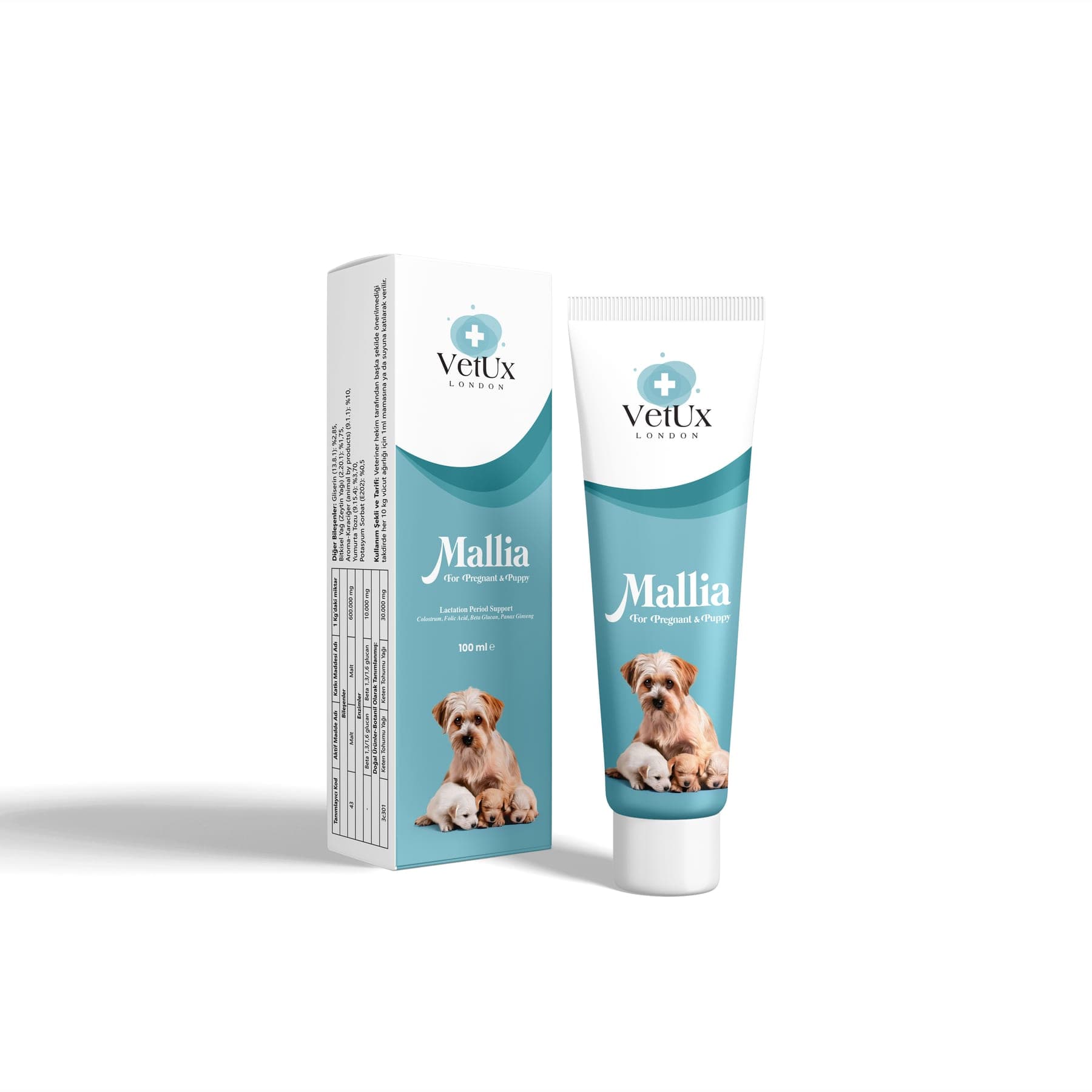
Mallia Pregnant Puppy is a complementary feed in paste form prepared to support the increased nutritional needs of pregnant and lactating dogs; its product record describes it for the period from the last third of pregnancy through to the end of nursing, to be used in consultation with your veterinary surgeon. The formula contains beta glucan 1,3-1,6, L-lysine, vitamin C, Panax ginseng extract, vitamin E, colostrum, folic acid (vitamin B9), echinacea extract, garlic extract and vitamin A; vitamins A, C and E contribute to meeting the increased nutritional demand, while folic acid and L-lysine give nutritional support to the natural processes of tissue development through pregnancy. As a complementary feed, it does not replace a complete food suited to pregnancy and lactation; it accompanies the diet alongside it. The product does not contain calcium; any decision about calcium remains separately with your veterinary surgeon. Whether it should be used for your dog, and how, should be decided by your veterinary surgeon, who assesses the dam's health and her whole diet.
Frequently asked questions
When should I change my pregnant dog's food? Switching to a complete food suited to pregnancy and lactation usually comes into consideration in the last third of pregnancy, when the puppies start growing rapidly. The switch should be gradual, spread over a few days. Your veterinary surgeon decides which food to switch to and when.
Should I give my pregnant dog calcium supplements? Not unless your vet recommends it. Extra calcium during pregnancy can suppress the body's own calcium regulation and is associated with a risk of eclampsia after whelping. A suitable complete food contains calcium in a balanced way; the decision on extra calcium belongs solely to your veterinary surgeon.
Should I feed my dog more from the start of pregnancy? No. Energy needs do not rise noticeably in the first five to six weeks, and overfeeding at this stage can lead to excess weight and a more difficult birth. Needs rise mainly in the last three weeks; your vet adjusts the amount based on body condition monitoring.
My pregnant dog isn't eating close to whelping — is that normal? A drop in appetite shortly before whelping is common. However, if loss of appetite lasts more than a day, or there is vomiting, lethargy, a high temperature or coloured discharge before whelping, contact your veterinary surgeon without delay.
My nursing dog is losing weight — what should I do? Nursing, especially a large litter, demands a great deal of energy, and weight loss may show that the dam's needs are not being met. Consult your vet to review the type and amount of food and the meal pattern; if weight loss comes with lethargy, trembling or changes in the mammary glands, do not wait.
Can I give my pregnant dog vitamins made for people? No. The contents and amounts in human vitamins are not calculated for dogs; those containing vitamins A and D or calcium carry a risk of excess during pregnancy. Consult your veterinary surgeon before starting a pregnant or nursing dog on any supplement.
Can a complementary feed replace a pregnancy food? No. Complementary feeds are not designed to meet daily nutritional needs on their own; they are prepared to be used alongside a complete and balanced food. The basic diet is provided by a complete food suited to the life stage; your vet decides whether a complementary feed is needed.
References
- 1National Research Council (NRC). Nutrient Requirements of Dogs and Cats. Washington, DC: The National Academies Press; 2006.
- 2FEDIAF. Nutritional Guidelines for Complete and Complementary Pet Food for Cats and Dogs. Brussels: FEDIAF European Pet Food Industry Federation; 2021.
- 3Freeman L, Becvarova I, Cave N, et al. WSAVA Nutritional Assessment Guidelines. Journal of Small Animal Practice. 2011;52(7):385-396.
- 4Fontaine E. Food intake and nutrition during pregnancy, lactation and weaning in the dam and offspring. Reproduction in Domestic Animals. 2012;47(Suppl 6):326-330.
- 5Debraekeleer J, Gross KL, Zicker SC. Feeding reproducing dogs. In: Hand MS, Thatcher CD, Remillard RL, Roudebush P, Novotny BJ, eds. Small Animal Clinical Nutrition. 5th ed. Topeka, KS: Mark Morris Institute; 2010.
- 6Drobatz KJ, Casey KK. Eclampsia in dogs: 31 cases (1995–1998). Journal of the American Veterinary Medical Association. 2000;217(2):216-219.
- 7Johnston SD, Root Kustritz MV, Olson PNS. Canine and Feline Theriogenology. Philadelphia: WB Saunders; 2001.
The person best placed to plan your pregnant or nursing dog's nutrition is the one who knows her breed, litter size, condition and health history. Before changing her food or starting calcium or any supplement, consult your veterinary surgeon.
Frequently asked questions
When should I change my pregnant dog's food?
Switching to a complete food suited to pregnancy and lactation usually comes into consideration in the last third of pregnancy, when the puppies start growing rapidly. The switch should be gradual, spread over a few days. Your veterinary surgeon decides which food to switch to and when.
Should I give my pregnant dog calcium supplements?
Not unless your vet recommends it. Extra calcium during pregnancy can suppress the body's own calcium regulation and is associated with a risk of eclampsia after whelping. A suitable complete food contains calcium in a balanced way; the decision on extra calcium belongs solely to your veterinary surgeon.
Should I feed my dog more from the start of pregnancy?
No. Energy needs do not rise noticeably in the first five to six weeks, and overfeeding at this stage can lead to excess weight and a more difficult birth. Needs rise mainly in the last three weeks; your vet adjusts the amount based on body condition monitoring.
My pregnant dog isn't eating close to whelping — is that normal?
A drop in appetite shortly before whelping is common. However, if loss of appetite lasts more than a day, or there is vomiting, lethargy, a high temperature or coloured discharge before whelping, contact your veterinary surgeon without delay.
My nursing dog is losing weight — what should I do?
Nursing, especially a large litter, demands a great deal of energy, and weight loss may show that the dam's needs are not being met. Consult your vet to review the type and amount of food and the meal pattern; if weight loss comes with lethargy, trembling or changes in the mammary glands, do not wait.
Can I give my pregnant dog vitamins made for people?
No. The contents and amounts in human vitamins are not calculated for dogs; those containing vitamins A and D or calcium carry a risk of excess during pregnancy. Consult your veterinary surgeon before starting a pregnant or nursing dog on any supplement.
Can a complementary feed replace a pregnancy food?
No. Complementary feeds are not designed to meet daily nutritional needs on their own; they are prepared to be used alongside a complete and balanced food. The basic diet is provided by a complete food suited to the life stage; your vet decides whether a complementary feed is needed.
This article is for general information only; it does not replace veterinary examination, diagnosis or treatment. VetUx London products are complementary feed. If you have any concern about your companion, please consult your veterinary surgeon.
Share
The formulas matching the nutritional support described above.
Related articles
All articles Nutrition
Do Cats Need Vitamins? When, and Which Vitamin?
A healthy cat on a complete diet usually does not need routine vitamin supplements, and excess fat-soluble vitamins such as A and D carry real risks. We explain cats' specific vitamin needs, when which vitamin may come into consideration and when to see your veterinary surgeon.
 Nutrition
Feeding Pregnant and Nursing Cats: What Changes During Pregnancy?
Why do a pregnant and nursing cat's energy, protein and vitamin needs rise, and what should you watch for at home? Vet. Hek. Metehan Çalıkuşu explains why human vitamins are off-limits and the risk of excess fat-soluble vitamins.
 Nutrition
Kitten Nutrition: Growth, Meal Routines and Transition Periods in the First 12 Months
Kitten nutrition begins with weaning, continues with small, frequent meals and ends with the move to adult food at around 12 months. This article explains the nutritional needs of the growth period, meal routines, gradual food changes and how to follow growth with your vet.