
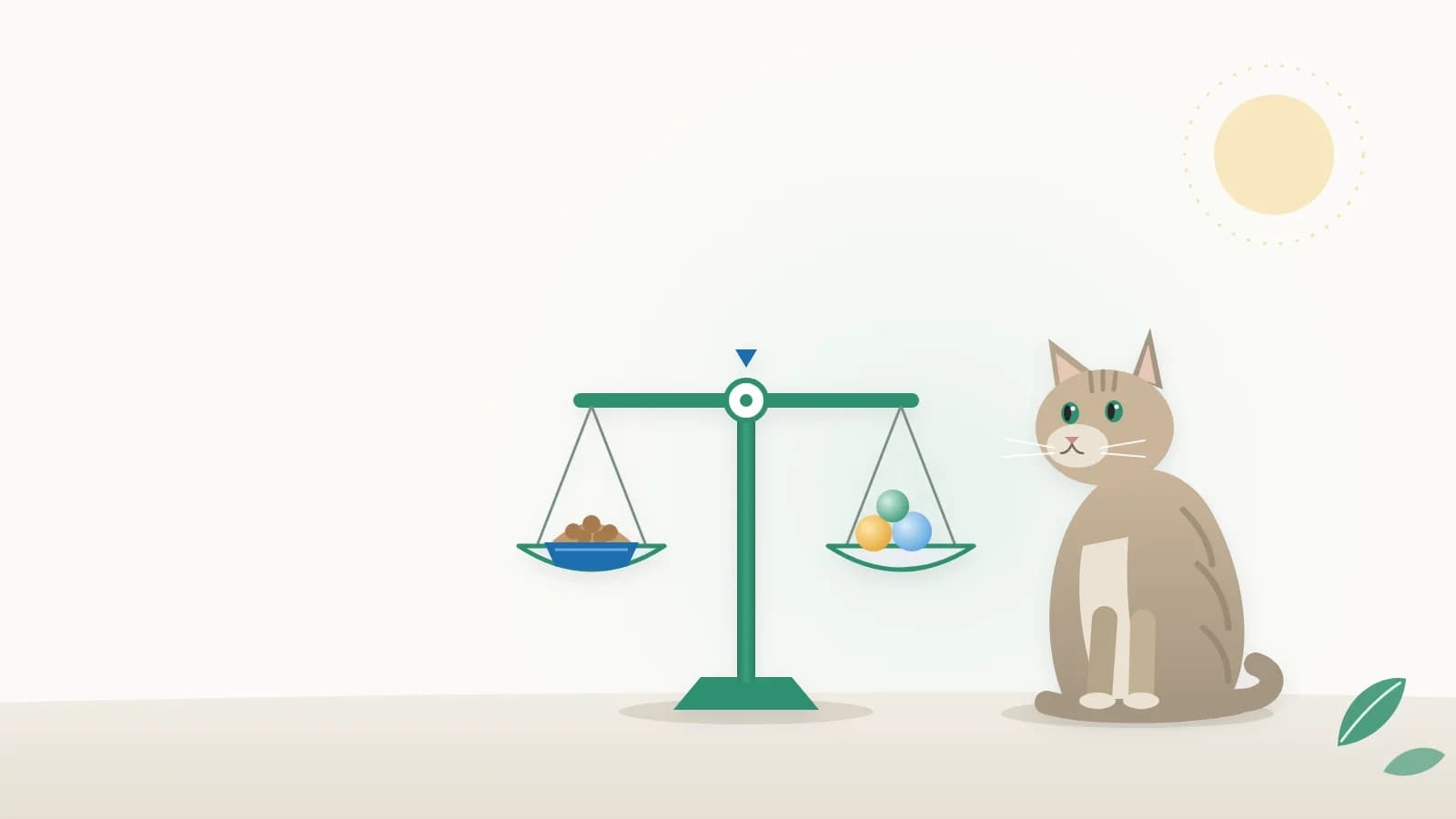
Do Cats Need Vitamins? When, and Which Vitamin?
A healthy cat on a complete diet usually does not need routine vitamin supplements, and excess fat-soluble vitamins such as A and D carry real risks. We explain cats' specific vitamin needs, when which vitamin may come into consideration and when to see your veterinary surgeon.
Short answer: A healthy adult cat fed a balanced diet labelled "complete" usually does not need extra vitamins; the vitamins it requires are already built into the food's formulation. Unnecessary supplementation carries a risk of excess, particularly with the fat-soluble vitamins A and D. Whether a deficiency exists, and which vitamin is needed, is decided by your veterinary surgeon through examination and testing.
Does a cat really need vitamin supplements?
Vitamins are organic compounds the body needs in very small amounts but, for the most part, cannot make in sufficient quantity on its own. For cats, the phrase "small amounts" matters: the requirement is small, yet both too little and too much can cause problems.
Cat foods labelled "complete" are formulated to the minimum and maximum nutrient levels set out in international nutrition guidelines (NRC, FEDIAF). A healthy cat eating an adequate amount of a food appropriate to its life stage is therefore already getting its vitamins from that food. In this situation a vitamin added "just in case" may give the cat nothing new — and for some vitamins it may push total intake above the safe limit.
In short, the right question is not "are vitamins good?" but "does this cat, on this diet, need this vitamin?" The answer comes from your veterinary surgeon, based on the cat's history, its diet and, where needed, blood tests.
What do vitamins do in a cat's body?
Fat-soluble vitamins: A, D, E and K
These vitamins are absorbed together with fat and can be stored in the liver and fatty tissue. Being storable is an advantage — the body can manage for a while even if they are not eaten every day — but the same property means that, when taken in excess, they accumulate and can reach harmful levels.
- Vitamin A: needed for vision (especially in low light), healthy skin and mucous membranes, growth and reproduction.
- Vitamin D: regulates the absorption of calcium and phosphorus from the gut and the balance of these minerals in bone.
- Vitamin E: the main antioxidant defending cell membranes against oxidative damage; the requirement rises as dietary unsaturated fat (for example fish oil) increases.
- Vitamin K: needed for normal blood clotting; part of it is also produced by gut bacteria.
Water-soluble vitamins: the B group and C
The B group vitamins (B1-thiamine, B2-riboflavin, B3-niacin, B5-pantothenic acid, B6, biotin, folate and B12-cobalamin) take part in energy metabolism, nervous system function and the production of blood cells. They are not stored in large amounts, and any surplus is largely excreted in urine, so they need to be supplied regularly through food. Their toxicity risk is lower than that of the fat-soluble vitamins, but that does not make them "unlimitedly safe".
Vitamin C holds a special place in cats: unlike humans, cats make their own vitamin C from glucose in the liver. For a healthy cat it is therefore not considered an essential dietary vitamin.
What makes cats different
The cat is an obligate carnivore, and its metabolism has been shaped by a meat-based diet. Some rules that hold for dogs or people therefore do not apply to cats:
- Cats cannot make vitamin A from beta-carotene. People and dogs can convert beta-carotene from plant sources such as carrots into vitamin A; in cats this conversion is negligible. Cats must obtain vitamin A in its preformed state (retinol) from animal tissues.
- Cats cannot make enough vitamin D in the skin. 7-dehydrocholesterol, the precursor of vitamin D in the skin, is present at very low levels in cats. So even with sunlight, a cat relies mainly on its food for vitamin D.
- Cats have a high niacin requirement. Many species can make part of their niacin from the amino acid tryptophan; in cats this pathway is not efficient.
- Cats are sensitive to thiamine (B1). Thiamine can be lost during heat processing and is broken down by the enzyme thiaminase found in some raw fish; when it runs short in cats, it can lead to neurological signs.
- Taurine is essential. Strictly speaking, taurine is not a vitamin but an amino sulfonic acid; cats cannot make enough of it, so they must get it from food. Scientific studies have linked taurine deficiency in cats with serious problems in the heart muscle (dilated cardiomyopathy) and the retina of the eye; adding adequate taurine to commercial cat food became standard after these findings.
These characteristics explain why a cat cannot "get by" on dog food, home cooking or human supplements.
Does a cat on a balanced diet need extra vitamins?
For a healthy cat eating the recommended amount of a food labelled "complete" and suited to its life stage (kitten, adult, senior), the answer is usually no. A few points still deserve attention:
- Products labelled "complementary feed", "treats" or "snacks" do not provide balanced nutrition on their own and should make up only a small part of the daily diet.
- If part of the food is replaced with home cooking, tuna or liver, the balance can be upset.
- If the cat is not eating enough (poor appetite, weight loss, fussy eating), vitamin intake falls too. The first step here is not adding a vitamin but finding the cause of the poor appetite with your veterinary surgeon.
Why can too much be harmful?
The idea that "vitamins are harmless" is especially misleading for the fat-soluble vitamins.
Excess vitamin A: can occur in cats fed liver-heavy diets over long periods or given unnecessary vitamin A. Too much vitamin A can cause abnormal bone formation, particularly in the neck vertebrae and the joints of the front legs. Signs can include a stiff neck, reluctance to be touched, lameness and an inability to groom; these bone changes are often permanent.
Excess vitamin D: can raise blood calcium and lead to calcium deposits in the kidneys and soft tissues. Drinking and urinating more, vomiting, loss of appetite and lethargy are among the main signs. Because cats cannot make enough vitamin D in the skin, they depend entirely on outside sources; using more than one product containing vitamin D at the same time can increase total intake without anyone noticing.
Human vitamins: multivitamins, vitamin D tablets or chewable tablets made for people should not be given to cats. Their contents and amounts are not calculated for cats, and some excipients are unsuitable for animals. If a cat accidentally swallows a vitamin or supplement from the household, contact your veterinary surgeon without delay and take the packaging with you.
When might which vitamin come into consideration?
In some situations your veterinary surgeon may decide that a specific vitamin should be added to a cat's diet. The table below is not a self-diagnosis tool; it is simply a framework showing when the topic of vitamins should be discussed with your vet.
| Situation | Vitamin(s) that may come into consideration | Who decides, and how? | |---|---|---| | Home-prepared or raw diet | The whole diet: A, D, E, B group, taurine | The recipe should be balanced by a veterinary surgeon or veterinary nutritionist | | Chronic intestinal disease, pancreatic insufficiency | B12 (cobalamin), folate | The vet decides after measuring blood levels | | Chronic kidney disease (drinking and urinating more) | Water-soluble B group | The vet assesses this taking the renal diet in use into account | | Prolonged loss of appetite, rapid weight loss | B group (especially thiamine and B12) | An urgent veterinary matter; the cause is investigated first | | Diet heavy in oily fish | Vitamin E | The first step is usually adjusting the diet | | Older age, accompanying chronic conditions | Individual to the cat | The vet decides based on blood tests and diet history |
A separate note on vitamin C: although cats make their own vitamin C, a veterinary surgeon may consider additional vitamin C in certain specific situations. However, because vitamin C can be partly converted to oxalate in the body, supplements containing vitamins C and D should always be discussed with your vet beforehand for cats with a history of urinary stones (especially calcium oxalate).
How is a vitamin deficiency recognised in cats?
The signs of vitamin deficiencies are mostly non-specific: a dull, brittle coat, scaling, poor appetite, weight loss, lethargy, diarrhoea, and problems with walking or posture are seen in many different illnesses. Deciding from the signs alone that "there is a vitamin deficiency" and starting supplements at home can mean the real problem is missed.
Your veterinary surgeon assesses the diet history (which food, how much, extra foods, supplements in use), the physical examination and, where needed, blood tests together. Some vitamins (for example B12 and folate) can be measured in the blood; for others the decision rests on diet analysis and the clinical picture. Diagnosis and treatment decisions always belong to the veterinary surgeon.
When should you see a veterinary surgeon?
Before thinking about giving your cat vitamins, contact your veterinary surgeon if:
- your cat has not eaten for more than a day or two (prolonged fasting in cats carries a serious risk to the liver)
- there is weight loss, repeated vomiting or diarrhoea
- drinking and urinating have clearly increased
- you notice unsteadiness when walking, the head held bent downwards, seizures or a marked change in behaviour
- you see neck stiffness, reluctance to be touched or a stop in grooming
- the coat is quickly becoming dull, the skin is scaling, or shedding has increased beyond the usual
- your cat has swallowed a human vitamin or supplement from the household
- you feed, or plan to switch to, a home-prepared or raw diet
- your cat is already on a vitamin or supplement and you are thinking of adding another
Where do Vetux products fit in?
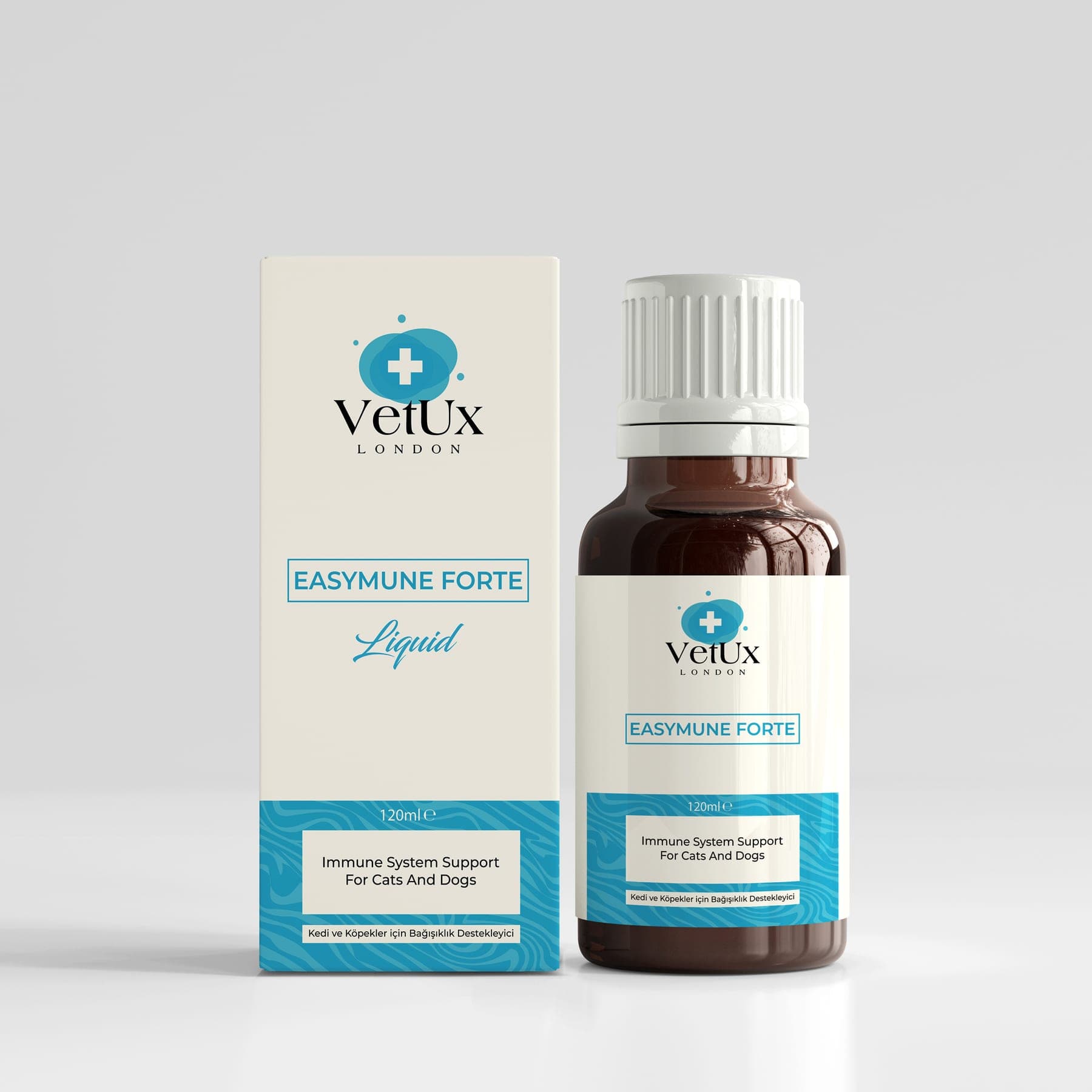
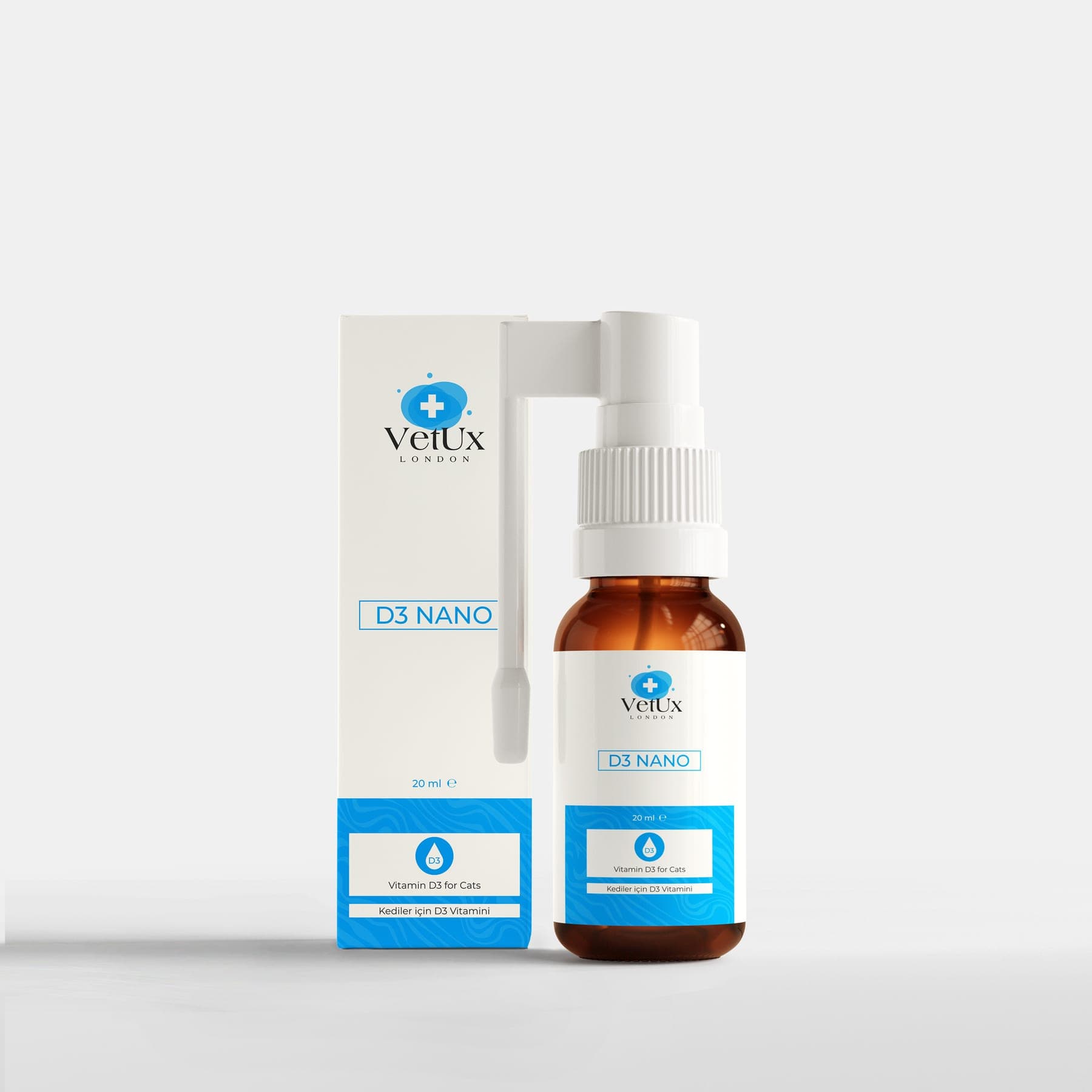
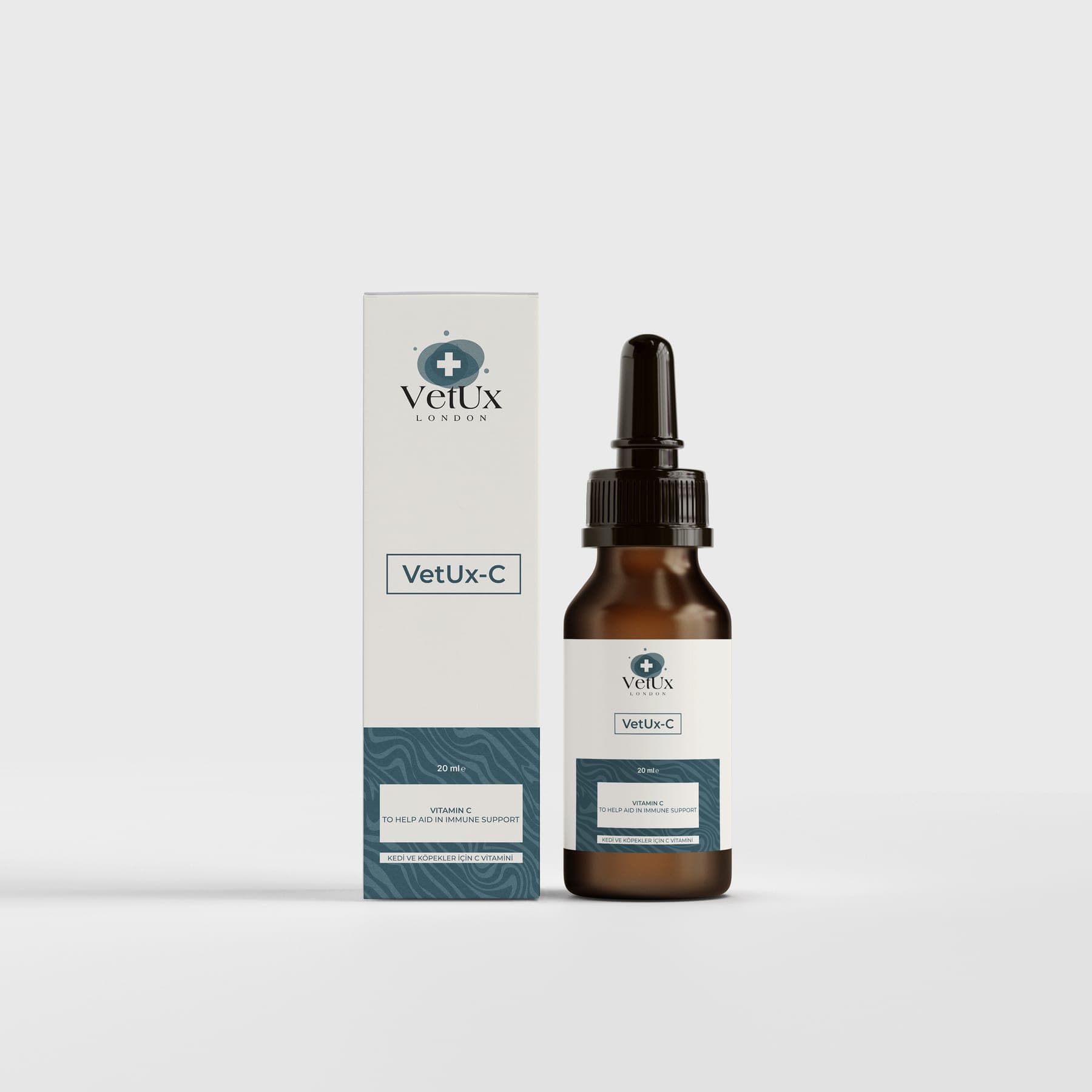
The Vetux London products related to this topic are complementary feeds; they do not replace a balanced diet or a veterinary examination, and they accompany care where your vet considers it appropriate. Easymune Forte is a liquid complementary feed for cats and dogs; its vitamins A, E and C together with taurine contribute to the normal oxidative balance of cells, the B group vitamins (B1, B2, B3, B5, B6, B9, B12 and biotin) support everyday energy metabolism, and the formula also contains propolis, nettle, dandelion, echinacea, turmeric, milk thistle and liquorice root extracts. D3 Nano is a vitamin D3 spray with a nano-emulsion carrier system, prepared for cats only; vitamin D3 contributes to the normal absorption of calcium and phosphorus and to maintaining bone and dental structure, and the product record states that it should not be used together with vitamin D2. VetUx-C Drops is a liquid vitamin C product containing ascorbic acid for cats and dogs; vitamin C contributes to the natural process of collagen formation, to the normal absorption of iron and to the antioxidant balance of cells. Because Easymune Forte contains vitamin A and D3 Nano contains vitamin D — both fat-soluble — and because cats make their own vitamin C, whether any of these products should be added, especially for a cat on a complete diet or already taking another supplement, and how it should be used, is a decision for your veterinary surgeon.
Frequently asked questions
Do I need to give my cat vitamins every day? Usually not, if your cat is healthy and eats an adequate amount of a food labelled "complete" that suits its life stage; the vitamins it needs are part of the food's formulation. Whether extra vitamins are needed is decided by your veterinary surgeon.
Can I give my cat vitamins made for people? No. The contents and amounts in human vitamins are not calculated for cats; those containing vitamin D in particular carry a risk of excess. If your cat swallows one by accident, contact your vet without delay.
How can I tell if my cat has a vitamin deficiency? Signs such as a dull coat, scaling, poor appetite, lethargy and weight loss are non-specific and overlap with other illnesses. Your veterinary surgeon assesses this through diet history, examination and, where needed, blood tests.
Do cats need vitamin C? A healthy cat makes its own vitamin C in the liver, so it is not considered essential in the diet. Extra vitamin C only comes into consideration in specific situations assessed by a vet; for cats with a history of urinary stones, always consult your vet first.
My cat never goes outside — should I give vitamin D because it gets no sun? Cats cannot make enough vitamin D in the skin; even with sunlight they rely mainly on their food. Complete foods contain vitamin D; because extra vitamin D carries a risk of excess, it should only be used if your veterinary surgeon considers it necessary.
My cat is shedding — could it be a vitamin deficiency? Shedding has many possible causes, including seasonal change, parasites, allergies, stress and hormonal factors; vitamin deficiency is only one of them. Your veterinary surgeon identifies the cause through examination.
How much of a vitamin product should I give, and how often? The amount and duration depend on your cat's weight, age, diet and health; this decision is made by your veterinary surgeon. Always consult your vet before using more than one supplement at the same time.
References
- 1National Research Council (NRC). Nutrient Requirements of Dogs and Cats. Washington, DC: The National Academies Press; 2006.
- 2FEDIAF. Nutritional Guidelines for Complete and Complementary Pet Food for Cats and Dogs. Brussels: FEDIAF European Pet Food Industry Federation; 2021.
- 3Freeman L, Becvarova I, Cave N, et al. WSAVA Nutritional Assessment Guidelines. Journal of Feline Medicine and Surgery. 2011;13(7):516-525.
- 4Morris JG. Ineffective vitamin D synthesis in cats is reversed by an inhibitor of 7-dehydrocholestrol-Δ7-reductase. Journal of Nutrition. 1999;129(4):903-908.
- 5Pion PD, Kittleson MD, Rogers QR, Morris JG. Myocardial failure in cats associated with low plasma taurine: a reversible cardiomyopathy. Science. 1987;237(4816):764-768.
- 6Polizopoulou ZS, Kazakos G, Patsikas MN, Roubies N. Hypervitaminosis A in the cat: a case report and review of the literature. Journal of Feline Medicine and Surgery. 2005;7(6):363-368.
- 7Simpson KW, Fyfe J, Cornetta A, et al. Subnormal concentrations of serum cobalamin (vitamin B12) in cats with gastrointestinal disease. Journal of Veterinary Internal Medicine. 2001;15(1):26-32.
- 8Wilson SA, Villaverde C, Fascetti AJ, Larsen JA. Evaluation of the nutritional adequacy of recipes for home-prepared maintenance diets for cats. Journal of the American Veterinary Medical Association. 2019;254(10):1172-1179.
- 9Lulich JP, Berent AC, Adams LG, et al. ACVIM Small Animal Consensus Recommendations on the Treatment and Prevention of Uroliths in Dogs and Cats. Journal of Veterinary Internal Medicine. 2016;30(5):1564-1574.
Whether your cat needs a vitamin, which one, and in what form is best judged by the person who examines your cat and knows its diet history. Before starting your cat on any vitamin or supplement, consult your veterinary surgeon.
Frequently asked questions
Do I need to give my cat vitamins every day?
Usually not, if your cat is healthy and eats an adequate amount of a food labelled "complete" that suits its life stage; the vitamins it needs are part of the food's formulation. Whether extra vitamins are needed is decided by your veterinary surgeon.
Can I give my cat vitamins made for people?
No. The contents and amounts in human vitamins are not calculated for cats; those containing vitamin D in particular carry a risk of excess. If your cat swallows one by accident, contact your vet without delay.
How can I tell if my cat has a vitamin deficiency?
Signs such as a dull coat, scaling, poor appetite, lethargy and weight loss are non-specific and overlap with other illnesses. Your veterinary surgeon assesses this through diet history, examination and, where needed, blood tests.
Do cats need vitamin C?
A healthy cat makes its own vitamin C in the liver, so it is not considered essential in the diet. Extra vitamin C only comes into consideration in specific situations assessed by a vet; for cats with a history of urinary stones, always consult your vet first.
My cat never goes outside — should I give vitamin D because it gets no sun?
Cats cannot make enough vitamin D in the skin; even with sunlight they rely mainly on their food. Complete foods contain vitamin D; because extra vitamin D carries a risk of excess, it should only be used if your veterinary surgeon considers it necessary.
My cat is shedding — could it be a vitamin deficiency?
Shedding has many possible causes, including seasonal change, parasites, allergies, stress and hormonal factors; vitamin deficiency is only one of them. Your veterinary surgeon identifies the cause through examination.
How much of a vitamin product should I give, and how often?
The amount and duration depend on your cat's weight, age, diet and health; this decision is made by your veterinary surgeon. Always consult your vet before using more than one supplement at the same time.
This article is for general information only; it does not replace veterinary examination, diagnosis or treatment. VetUx London products are complementary feed. If you have any concern about your companion, please consult your veterinary surgeon.
Share
The formulas matching the nutritional support described above.
Related articles
All articles Nutrition
Feeding Pregnant and Nursing Cats: What Changes During Pregnancy?
Why do a pregnant and nursing cat's energy, protein and vitamin needs rise, and what should you watch for at home? Vet. Hek. Metehan Çalıkuşu explains why human vitamins are off-limits and the risk of excess fat-soluble vitamins.
 Nutrition
Kitten Nutrition: Growth, Meal Routines and Transition Periods in the First 12 Months
Kitten nutrition begins with weaning, continues with small, frequent meals and ends with the move to adult food at around 12 months. This article explains the nutritional needs of the growth period, meal routines, gradual food changes and how to follow growth with your vet.
 Nutrition
What Are Cat and Dog Supplements? Complementary Feed vs Vitamins vs Veterinary Medicines
Most cat and dog supplements are legally complementary feed, not medicines. This guide gives clear definitions of complementary feed, vitamin supplements, veterinary medicines and dietetic feed, a label checklist and when to see your vet.