
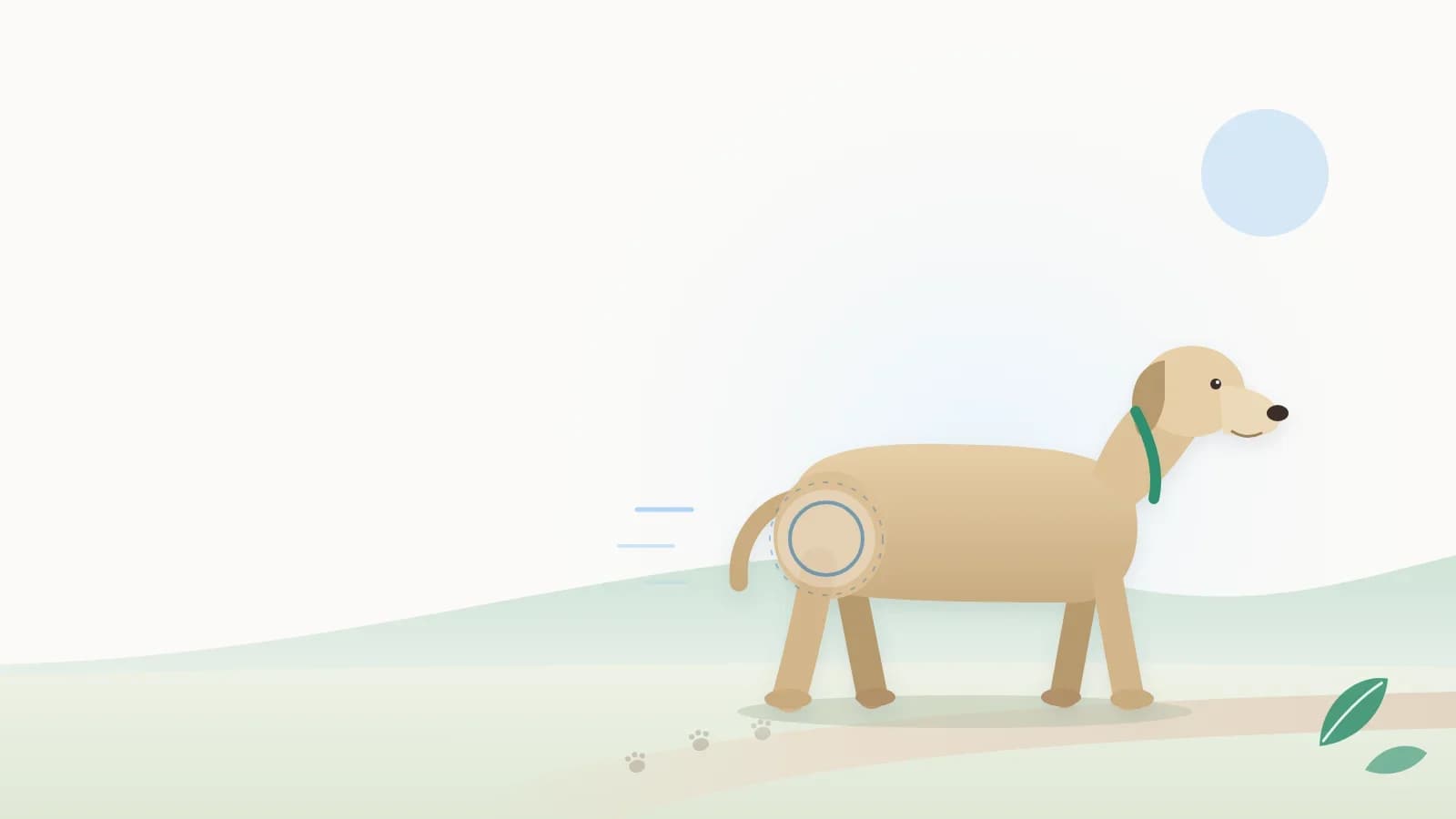
Hip Dysplasia in Dogs: Signs, Weight Control and an Exercise Plan
Hip dysplasia starts when the hip joint of a growing dog, most often a large breed, develops loose and ends in osteoarthritis over time. We explain the signs, why diagnosis needs an X-ray at the vet, how weight loads the joint and how to plan controlled exercise from puppyhood to old age.
Hip dysplasia in dogs is a loose, poorly fitting hip joint that develops during growth; the cartilage then wears and osteoarthritis follows. It is more common in large-breed puppies, and signs can appear in puppyhood or years later. Your vet diagnoses it with an examination and X-rays; ideal weight and controlled exercise are the foundations of joint health.
What is hip dysplasia?
Hip dysplasia means the hip joint does not develop as tight and well fitting as it should. Most dysplastic dogs are born with normal hips; the problem begins in the first months of rapid skeletal growth, when the joint stays loose. A loose joint shifts slightly with every step, which makes the joint surfaces wear unevenly. Over the years this process turns into permanent joint degeneration (osteoarthritis).
Hip dysplasia is an inherited condition shaped not by a single gene but by many genes acting together. Genetic predisposition is not the whole story, though: environmental factors such as growth rate, puppy nutrition, body weight and the type of exercise strongly influence how severe the condition becomes in a predisposed dog. That is why the weight and exercise advice in this article matters so much.
Which dogs are at risk?
Hip dysplasia can occur in any breed and in crossbreeds, but it is clearly more common in fast-growing large and giant breeds. These include the German Shepherd, Labrador Retriever, Golden Retriever, Rottweiler, Bernese Mountain Dog, Newfoundland and Saint Bernard.
Two life stages matter most:
- Puppyhood and adolescence: Joint laxity usually becomes apparent during the months of fastest growth. Overfeeding, rapid weight gain and high-impact activity at this stage increase the load on a loose hip.
- Adulthood and senior years: Dysplasia that caused no signs, or only mild ones, in puppyhood can show up years later as stiffness and reluctance to move due to osteoarthritis.
If you are getting a puppy, it is sensible to ask whether the parents have been hip scored. Many countries run official hip evaluation schemes for breeding dogs, such as the BVA/KC Hip Dysplasia Scheme in the UK.
How does the hip joint work, and what goes wrong in dysplasia?
Ball and socket: the structure of the hip
The hip is a "ball and socket" joint formed by the rounded head of the thigh bone (femur) and the cup-shaped socket in the pelvis (acetabulum). In a healthy hip the femoral head sits deep and snug in the socket. The joint is held together by a small ligament attaching the femoral head to the socket, the joint capsule surrounding it and the strong muscles around the hip.
The ends of the bones are covered with a smooth, resilient tissue called articular cartilage. Its structure is largely made of type II collagen fibres and proteoglycan molecules that hold water between them. The synovial fluid filling the joint space provides lubrication, thanks to the hyaluronic acid it contains, and nourishes the cartilage. This arrangement spreads the load of every step over a wide surface and lets the bones glide without grinding.
Laxity: where the problem starts
In a dysplastic hip the joint capsule and ligaments are lax; the femoral head does not seat fully and slides towards the rim of the socket with each step. This is called subluxation (partial dislocation). The load is then concentrated on a narrow area at the rim instead of being spread over the whole joint surface. As growing bone tries to adapt to this abnormal load, the socket can become shallower and the femoral head can lose its shape. In other words, laxity also changes the shape of the joint over time.
Cartilage wear and osteoarthritis
Repeated load on a small area causes microdamage to the cartilage. Cartilage has a limited capacity for self-repair; as damage builds up, the surface thins and roughens and in places the underlying bone is exposed. The joint responds by forming new bony outgrowths (osteophytes) and thickening its capsule. The result is a stiff, painful joint with reduced range of motion: osteoarthritis. These changes are irreversible, so the aim is to manage their pace and their impact on the dog's quality of life as well as possible.
The burden of weight
Every extra kilo adds to the mechanical load on the hip with each step. For a loose hip that already bears weight on a narrow area, this extra load is a major factor speeding up cartilage wear. Fat tissue is not just passive weight, either; it releases signalling substances that fuel inflammatory processes in the body. A long-term study found that Labrador Retrievers fed a controlled diet throughout life developed hip osteoarthritis later and less severely than their freely fed littermates. In overweight dogs with osteoarthritis, vet-supervised weight loss has been reported to markedly improve lameness.
Muscles are part of the equation too: strong hip and thigh muscles stabilise a loose joint from the outside. Inactivity leads to muscle loss, and muscle loss leads to more joint instability, creating a vicious circle.
What are the signs of hip dysplasia?
Signs vary with the dog's age, the degree of dysplasia and the progression of osteoarthritis. Some dogs show no signs for a long time despite clear X-ray changes; others struggle even with mild changes.
- Difficulty getting up after rest, especially in the morning, and stiffness in the first steps
- Reluctance to climb stairs or jump into the car or onto the sofa
- "Bunny hopping" — using both hind legs together when running
- A noticeable sway in the hindquarters when walking
- Loss of muscle mass in the hind legs, with more prominent shoulder muscles
- Tiring quickly on walks and in play, or seeming less keen than before
- Discomfort or avoidance when the hip area is touched
- A change in sitting posture (for example sitting with the legs splayed to one side)
- Lameness, often worse after a long walk or vigorous play
None of these signs is specific to hip dysplasia. Cruciate ligament injuries, elbow problems and spinal or neurological conditions can look similar. Spotting a sign is therefore not enough for a diagnosis; your dog needs to be assessed by a veterinary surgeon.
How is hip dysplasia diagnosed?
The diagnosis is made by your veterinary surgeon. It usually starts with a detailed history and gait observation. In the orthopaedic examination your vet then assesses the range of motion, pain response and laxity of the hips; some specific tests that measure laxity are more reliable when the dog is fully relaxed.
X-rays are needed to confirm the diagnosis. A hip X-ray shows how well the femoral head sits in the socket, how deep the socket is and whether there are signs of osteoarthritis. An accurate assessment requires the dog to lie still in a specific position, so the X-rays are often taken under sedation. There are also specialised X-ray methods that measure laxity numerically, and scoring schemes for breeding dogs. Your vet will decide which method suits your dog and at what age.
After the diagnosis, your vet will put together a management plan based on your dog's age, the degree of dysplasia, pain level and lifestyle. This plan may include weight management, adjusted exercise, physiotherapy, pain management and, where needed, surgical options. Treatment decisions belong entirely to your veterinary surgeon. Never give your dog painkillers on your own initiative, especially medicines made for people; some of them are seriously toxic to dogs.
How does weight control affect hip health?
In hip dysplasia, the most powerful tool an owner has is keeping the dog at an ideal weight. The goal is not a particular number on the scales but the dog's body condition:
- You should be able to feel the ribs easily under a thin layer of fat, without pressing.
- Seen from above, there should be a clear waist behind the ribs.
- Seen from the side, the belly should tuck up from the chest towards the hind legs.
Your vet can assess your dog's body condition score and set a target weight and a safe rate of weight loss. If weight loss is needed, make a plan with your vet rather than sharply cutting the food on your own; treats and table scraps count towards the daily energy budget too.
Feeding large-breed puppies
For large-breed puppies the aim is steady, controlled growth, not fast growth. To support this:
- Choose a complete and balanced puppy food formulated for large breeds.
- Do not try to keep your puppy chubby; a lean puppy whose ribs you can feel is a healthy puppy.
- Do not give extra calcium or vitamin D to a large-breed puppy on a complete and balanced food without talking to your vet. An excess of these during growth can affect skeletal development.
What should an exercise plan look like for a dog with hip dysplasia?
Inactivity is not the answer for a dog with hip dysplasia; the right kind of regular movement maintains muscle and supports the joint's range of motion. Your vet or veterinary physiotherapist will tailor the details to your dog; the general principles are:
- Consistency: Aim for a similar level of activity every day rather than quiet weekdays and very busy weekends.
- Short, frequent walks: Several shorter on-lead walks spread through the day are gentler on the joint than one long one.
- Low-impact activity: Swimming and controlled water-based exercise are good ways to work muscles while taking load off the joints. Ask your vet whether hydrotherapy suits your dog.
- Avoid jarring movement: Ball chasing on hard ground, sudden turns, jumping down from height and constant stair use all strain the hip.
- Warm up and cool down: Start and finish each walk at a slow pace.
- Watch your dog: If stiffness or lameness increases in the hours after activity or the next day, the pace may have been too much; share this with your vet.
Exercise in puppyhood
In puppies the aim is to support natural movement without overloading developing joints. Free play at the puppy's own pace on soft, even ground is beneficial. Forced long runs, running alongside a bicycle and frequent stair use at an early age, on the other hand, put too much load on growing joints. A prospective study of large-breed puppies in Norway found that frequent early stair use was associated with a higher risk of hip dysplasia, while free exercise on soft ground was associated with a lower risk.
Small changes at home
- Lay rugs or non-slip mats over slippery floors.
- Consider ramps for the sofa and the car.
- Provide a supportive, orthopaedic bed, kept away from cold, damp floors.
- Keep the fur between the paw pads and the nails short; this matters for a secure, non-slip footing.
Where does nutritional support for joint health fit in?
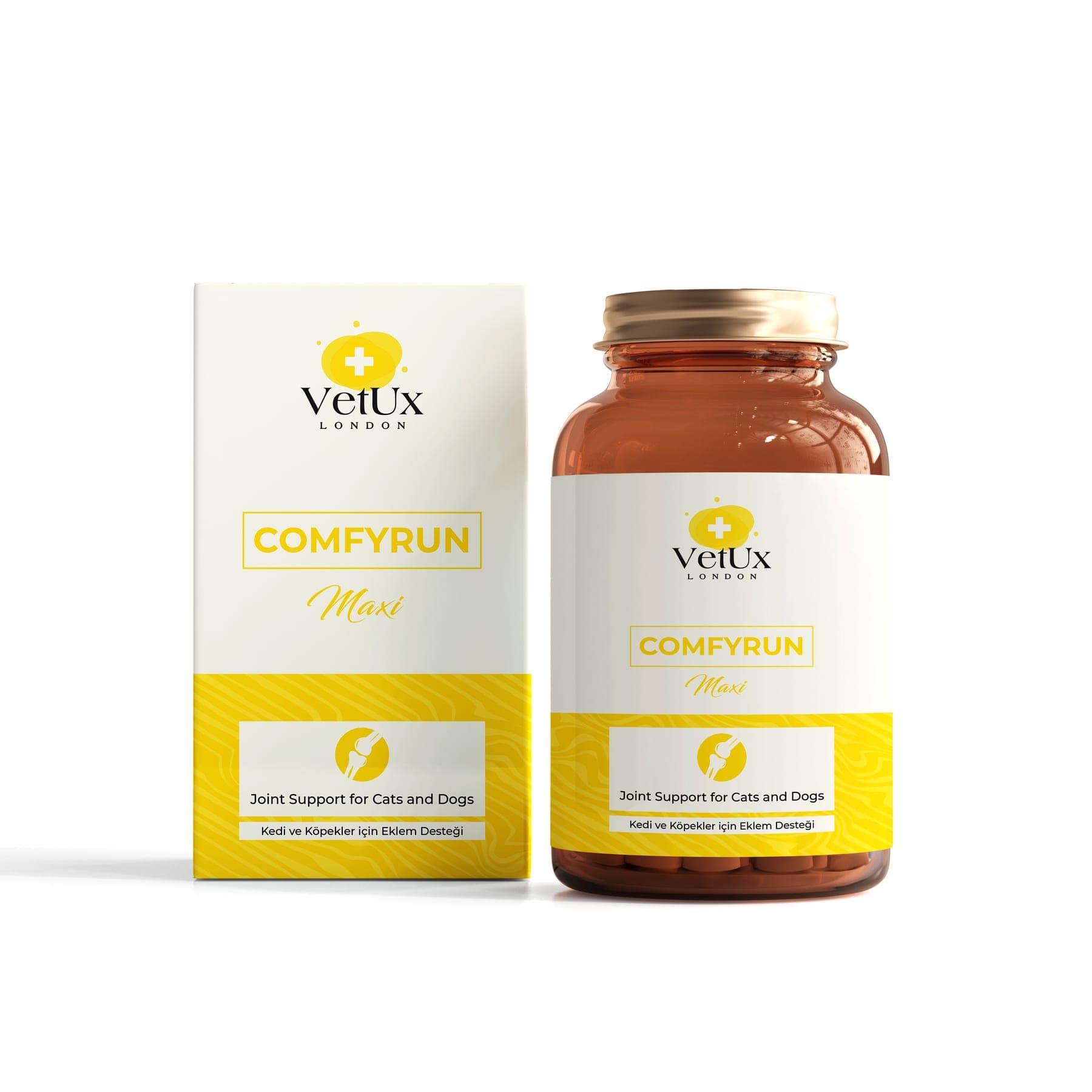
In hip dysplasia, the foundations are an accurate diagnosis, ideal weight, regular controlled exercise and the plan your vet sets. Complementary feeds do not replace this plan; where your vet considers it appropriate, they can accompany these foundations. Comfyrun Maxi is a complementary feed in tablet form for cats and dogs; it brings together glucosamine sulphate, chondroitin sulphate, MSM (methylsulfonylmethane), type II collagen and hyaluronic acid with boswellia serrata and turmeric (Curcuma longa) extracts and vitamins C and D3. Glucosamine and chondroitin accompany the natural structure of cartilage tissue and proteoglycan formation; type II collagen and hyaluronic acid contribute to the stability of cartilage and synovial fluid; vitamin C contributes to the natural process of collagen formation and vitamin D3 to calcium metabolism. Comfyrun Maxi does not change the shape of the hip joint and is not a treatment; it is a nutritional contribution that supports the physiological function of the joints. Because it contains vitamin D3, decide with your veterinary surgeon whether and how to use it, especially for growing puppies or if your dog is taking any other product or medicine.
When should you see a veterinary surgeon?
Book an appointment with your vet if:
- Your dog struggles to get up or avoids stairs or getting into the car
- Your dog bunny hops when running or sways noticeably in the hindquarters
- You notice thinning muscles in the hind legs
- Lameness lasts more than a few days or keeps coming back
- You have a large-breed puppy and want to discuss its growth, feeding and exercise plan
- Your dog has gained weight or you are unsure of its ideal weight
See your vet without delay if:
- Your dog cannot bear weight on its hind legs at all or cannot stand up
- Your dog cries out or whimpers clearly when moving or being touched
- There is sudden hind-limb weakness, wobbliness, knuckling of the paws or a change in bladder or bowel control (these can point to a spinal or neurological problem)
When describing the signs, short videos of your dog walking, getting up and climbing stairs are very helpful; dogs often hide their signs out of excitement in the consulting room.
Frequently asked questions
At what age does hip dysplasia appear? Joint laxity usually starts in the first months of rapid growth and causes signs in puppyhood in some dogs. In others, signs only appear in adulthood or old age as osteoarthritis develops. Whatever the age at which signs begin, your vet makes the diagnosis with an examination and X-rays.
Does hip dysplasia only affect large-breed dogs? No. It is clearly more common in large and giant breeds, but it can also occur in medium and small breeds, in crossbreeds and, less often, in cats. In small dogs the signs can be milder and easily overlooked.
Can a dog with hip dysplasia swim and exercise? Regular, controlled exercise is recommended for most dogs; low-impact activities such as swimming put less load on the joints. The type, duration and intensity of exercise depend on the dog's condition, though. The plan should be set by your vet or veterinary physiotherapist.
Does my dog need to be sedated for hip X-rays? An accurate assessment requires the dog to be in a specific position and fully relaxed, so X-rays are often taken under sedation. Your vet makes this decision after assessing your dog's general health.
Do joint supplements correct hip dysplasia? No. Hip dysplasia is a structural developmental problem of the joint, and complementary feeds do not change the shape of the joint. Products such as Comfyrun Maxi can accompany your vet's plan by supporting the physiological function of the joints; they do not replace weight control, controlled exercise and veterinary follow-up.
Should I give my large-breed puppy extra calcium? If your puppy is fed a complete and balanced food formulated for large-breed puppies, do not give extra calcium or vitamin D without talking to your vet. An excess of these during growth can affect skeletal development.
References
- 1Schachner ER, Lopez MJ. Diagnosis, prevention, and management of canine hip dysplasia: a review. Veterinary Medicine: Research and Reports. 2015;6:181–192. doi:10.2147/VMRR.S53266
- 2King MD. Etiopathogenesis of canine hip dysplasia, prevalence, and genetics. Veterinary Clinics of North America: Small Animal Practice. 2017;47(4):753–767. doi:10.1016/j.cvsm.2017.03.001
- 3Smith GK, Paster ER, Powers MY, et al. Lifelong diet restriction and radiographic evidence of osteoarthritis of the hip joint in dogs. Journal of the American Veterinary Medical Association. 2006;229(5):690–693. doi:10.2460/javma.229.5.690
- 4Kealy RD, Lawler DF, Ballam JM, et al. Effects of diet restriction on life span and age-related changes in dogs. Journal of the American Veterinary Medical Association. 2002;220(9):1315–1320. doi:10.2460/javma.2002.220.1315
- 5Krontveit RI, Nødtvedt A, Sævik BK, Ropstad E, Trangerud C. Housing- and exercise-related risk factors associated with the development of hip dysplasia as determined by radiographic evaluation in a prospective cohort of Newfoundlands, Labrador Retrievers, Leonbergers, and Irish Wolfhounds in Norway. American Journal of Veterinary Research. 2012;73(6):838–846. doi:10.2460/ajvr.73.6.838
- 6Marshall WG, Hazewinkel HAW, Mullen D, et al. The effect of weight loss on lameness in obese dogs with osteoarthritis. Veterinary Research Communications. 2010;34(3):241–253. doi:10.1007/s11259-010-9348-7
- 7Gruen ME, Lascelles BDX, Colleran E, et al. 2022 AAHA Pain Management Guidelines for Dogs and Cats. Journal of the American Animal Hospital Association. 2022;58(2):55–76. doi:10.5326/JAAHA-MS-7292
- 8WSAVA Global Nutrition Committee. Freeman L, Becvarova I, Cave N, et al. WSAVA Nutritional Assessment Guidelines. Journal of Small Animal Practice. 2011;52(7):385–396. doi:10.1111/j.1748-5827.2011.01079.x
This article is for information only and does not replace an examination. If you notice any change in how your dog walks, gets up or wants to move, consult your veterinary surgeon for an accurate diagnosis and a care plan that suits your dog.
Frequently asked questions
At what age does hip dysplasia appear?
Joint laxity usually starts in the first months of rapid growth and causes signs in puppyhood in some dogs. In others, signs only appear in adulthood or old age as osteoarthritis develops. Whatever the age at which signs begin, your vet makes the diagnosis with an examination and X-rays.
Does hip dysplasia only affect large-breed dogs?
No. It is clearly more common in large and giant breeds, but it can also occur in medium and small breeds, in crossbreeds and, less often, in cats. In small dogs the signs can be milder and easily overlooked.
Can a dog with hip dysplasia swim and exercise?
Regular, controlled exercise is recommended for most dogs; low-impact activities such as swimming put less load on the joints. The type, duration and intensity of exercise depend on the dog's condition, though. The plan should be set by your vet or veterinary physiotherapist.
Does my dog need to be sedated for hip X-rays?
An accurate assessment requires the dog to be in a specific position and fully relaxed, so X-rays are often taken under sedation. Your vet makes this decision after assessing your dog's general health.
Do joint supplements correct hip dysplasia?
No. Hip dysplasia is a structural developmental problem of the joint, and complementary feeds do not change the shape of the joint. Products such as Comfyrun Maxi can accompany your vet's plan by supporting the physiological function of the joints; they do not replace weight control, controlled exercise and veterinary follow-up.
Should I give my large-breed puppy extra calcium?
If your puppy is fed a complete and balanced food formulated for large-breed puppies, do not give extra calcium or vitamin D without talking to your vet. An excess of these during growth can affect skeletal development.
This article is for general information only; it does not replace veterinary examination, diagnosis or treatment. VetUx London products are complementary feed. If you have any concern about your companion, please consult your veterinary surgeon.
Share
The formulas matching the nutritional support described above.
Related articles
All articles Clinical Notes
Bad Breath in Cats: Tartar, Gum Disease and Causes Beyond the Mouth
Bad breath in cats usually comes from plaque and tartar, but it can also be an early sign of kidney disease or diabetes. We explain how the odour develops, why tartar removal belongs at the vet and how to care for your cat's mouth day to day.
 Clinical Notes
Signs of Heart Failure in Dogs: Coughing, Fast Breathing and Tiredness
Coughing, fast breathing during sleep and tiring quickly are the most common signs of heart failure in dogs. Why they happen, counting sleeping breathing rate at home, emergency signs and the diagnostic process, from a veterinary surgeon.
 Clinical Notes
Signs of Pancreatitis in Cats: A Digestive Problem That Often Goes Unnoticed
In cats, pancreatitis often progresses quietly rather than with vomiting; sometimes the only signs are poor appetite and lethargy. We explain the role of the pancreas in digestion, the signs to watch for, why feeding matters and when to see your veterinary surgeon.