
Signs of Pancreatitis in Cats: A Digestive Problem That Often Goes Unnoticed
In cats, pancreatitis often progresses quietly rather than with vomiting; sometimes the only signs are poor appetite and lethargy. We explain the role of the pancreas in digestion, the signs to watch for, why feeding matters and when to see your veterinary surgeon.
Unlike in dogs, pancreatitis in cats often does not announce itself with obvious vomiting or abdominal pain. More often it shows up as quiet signs: reduced appetite, lethargy, hiding and weight loss. In some cats, not eating may be the only sign. Because these signs overlap with many other conditions, diagnosis is made by a veterinary surgeon through examination and tests.
What is pancreatitis in cats?
Pancreatitis is inflammation of the pancreas. In cats it appears in two forms: acute pancreatitis, which starts suddenly and can be severe, and chronic pancreatitis, a low-grade inflammation that can persist for weeks, months or even years with occasional flare-ups. The chronic form is more common in cats, and because its signs are usually subtle, it is easily missed.
In most cats no clear underlying cause is found. The condition can occur at any age but is diagnosed more often in middle-aged and older cats. Chronic intestinal disease, inflammation of the bile ducts (cholangitis) and diabetes may be seen alongside pancreatitis.
What does the pancreas do in digestion, and why is pancreatitis so quiet in cats?
The pancreas has two jobs. Its endocrine part produces hormones such as insulin and glucagon, which regulate blood sugar. Its exocrine part carries much of the work of digestion: lipase, which breaks down fats; trypsin and other proteases, which break down proteins; and amylase, which acts on carbohydrates, are all released from here into the small intestine. The pancreas also secretes bicarbonate, which neutralises stomach acid. A detail specific to cats: the "intrinsic factor" needed to absorb vitamin B12 (cobalamin) comes largely from the pancreas.
A safety lock: enzymes are made in an inactive form. To avoid digesting its own tissue, the pancreas produces and stores its enzymes as inactive precursors (zymogens). These enzymes only become active once they reach the small intestine. Pancreatic tissue also contains protective substances that hold back premature activation.
In pancreatitis, this lock fails. If enzymes become active while still inside the pancreas, the tissue begins to digest itself; local inflammation develops, and in some cats it can progress to a picture that affects the whole body. In the chronic form, persistent low-grade inflammation can lead to lasting changes in the pancreatic tissue over time, which may later be associated with problems such as digestive enzyme insufficiency or diabetes.
Feline anatomy plays a part. In cats, the pancreatic duct joins the bile duct before opening into the duodenum. This shared outlet helps explain the close relationship between the pancreas, the liver and bile ducts, and the intestine. When all three are inflamed at the same time, the condition is called "triaditis", and it is recognised as a feline-specific picture.
Why so quiet? There are several physiological and behavioural reasons:
- Cats naturally hide pain and weakness; abdominal pain often shows only as inactivity, a hunched posture or hiding.
- Vomiting, the classic sign of pancreatitis in dogs, does not occur in every cat.
- The chronic form can progress with a fluctuating appetite and slow weight loss rather than a clear episode.
- The signs overlap with many conditions, including kidney, liver, intestinal and dental disease.
Indeed, histopathological studies have shown that signs of pancreatic inflammation can be found even in cats that appear clinically healthy. Calling the condition "quiet" is not an exaggeration; it is a natural consequence of feline physiology.
What are the signs of pancreatitis in cats?
The most common signs are non-specific: none of them points to pancreatitis on its own, but together they give the veterinary surgeon important clues:
- Reduced appetite or not eating at all — in some cats, this may be the only sign.
- Lethargy, dullness, loss of interest in play and surroundings
- Hiding, keeping away from the owner, a hunched posture
- Weight loss and muscle loss
- Signs of dehydration (dry gums, reduced skin elasticity)
- Vomiting (not seen in every cat)
- Diarrhoea, or soft, greasy-looking stools
- Jaundice: yellowing of the whites of the eyes, the gums or the inside of the ears — this may point to accompanying liver or bile duct problems.
- In severe cases, a drop in body temperature, pale gums and rapid breathing.
Loss of appetite matters especially in cats: in a cat that cannot eat enough for a few days, particularly an overweight cat, the risk of fatty liver (hepatic lipidosis) increases. For this reason, "he's just a bit off, he'll eat tomorrow" is not a suitable approach in cats.
How is pancreatitis diagnosed?
The diagnosis of pancreatitis does not rest on a single sign or a single test; the diagnosis is made by your veterinary surgeon. They will consider the history, a physical examination, blood tests (including a pancreas-specific lipase measurement) and imaging such as abdominal ultrasound together. Where needed, accompanying intestinal, liver and bile duct problems are also investigated. The findings must be interpreted as a whole, which is why it is important not to draw your own conclusions from the signs you see at home.
How should a cat with pancreatitis be fed?
Nutrition is one of the core parts of the plan your veterinary surgeon puts together for a cat with pancreatitis. Current expert opinion emphasises that prolonged fasting is not appropriate for cats and that feeding should be restarted as early as possible. For cats that will not eat on their own, your veterinary surgeon may consider options such as supportive medication or a feeding tube.
General principles include:
- An easily digested, palatable food that your cat accepts is preferred; warmed wet food can be more appealing to many cats.
- Fat content: your veterinary surgeon may recommend a low-fat profile for some cats. The need for fat restriction is less clear-cut in cats than in dogs, so the fat level is decided by your veterinary surgeon according to your cat's overall condition and any accompanying conditions.
- Meal pattern: your veterinary surgeon may ask you to split the daily amount into smaller portions.
- Do not force-feed; this can increase a cat's reluctance towards food.
- Fresh, clean water should always be available.
- Do not give fatty human food or table scraps; do not start any over-the-counter medicine or supplement without speaking to your veterinary surgeon.
Where does Elixir of PankreoFix fit into the feeding plan?
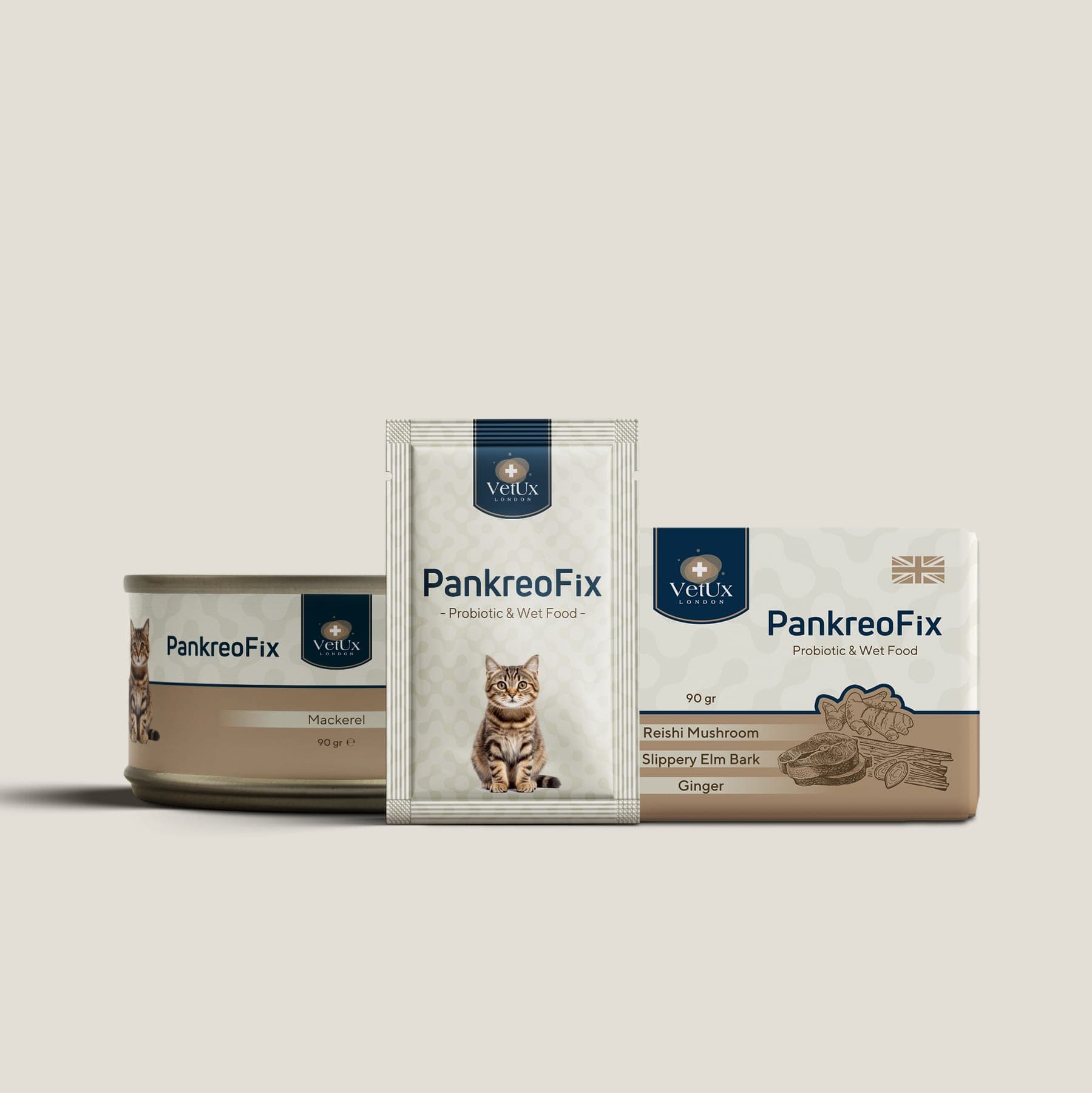
Elixir of PankreoFix is a complementary feed for cats, made up of a probiotic wet food and sachet combination with a mackerel-based, low-fat, gluten-free recipe. It contains mackerel, krill powder (Euphausia superba), bromelain (Ananas comosus), probiotic cultures, prebiotic fibre and vitamins A, D, E and K, and contributes to the maintenance of normal digestive function and everyday gut comfort through periods when digestive comfort needs extra attention. Elixir of PankreoFix is not a medicine and does not replace the diagnosis or treatment of pancreatitis; it accompanies the care and feeding plan recommended by your veterinary surgeon. Always agree with your veterinary surgeon how and how much of it to add to your cat's diet.
When should you see a veterinary surgeon?
Contact your veterinary surgeon if you notice any of the following:
- Your cat has not eaten anything for more than a day, or has been eating noticeably less for several days (sooner in overweight cats),
- Your cat is lethargic, dull or constantly hiding,
- There is repeated vomiting or ongoing diarrhoea,
- You see yellowing of the whites of the eyes, the gums or the inside of the ears,
- There is noticeable weight loss,
- Your cat avoids being touched on the belly or sits hunched,
- You notice a clear increase in drinking and urination.
Pale gums, cold ears and paws, marked weakness or rapid breathing are emergency signs; go to a veterinary clinic without delay.
Remember: the diagnosis and treatment of pancreatitis belong to your veterinary surgeon. Seeking help early allows them to assess both the pancreatitis and any accompanying problems in good time.
Frequently Asked Questions
My cat just isn't eating — could this be pancreatitis?
It could, but loss of appetite is a shared sign of many different conditions. In cats, pancreatitis sometimes shows itself only through reduced appetite and lethargy. Telling the causes apart requires examination and tests, so if the loss of appetite lasts longer than a day, contact your veterinary surgeon.
Should a cat with pancreatitis be fasted?
No. Cats do not cope well with prolonged fasting, and not eating increases the risk of fatty liver. Current expert opinion recommends restarting feeding as early as possible. How and with what your cat is fed is decided by your veterinary surgeon.
Does pancreatitis in cats go away completely?
The course varies from cat to cat. Some cats that have an acute episode come through it with veterinary management; in others the process becomes chronic and flare-ups may occur from time to time. Regular veterinary check-ups are important for cats with chronic pancreatitis.
Is pancreatitis contagious?
No. Pancreatitis is not a contagious disease; it does not pass to other cats in the household or to people.
Can a complementary feed replace treatment for pancreatitis?
No. Complementary feeds are not medicines and are not used in place of treatment for a disease. They contribute to nutrition through periods when digestive comfort needs extra attention, accompanying the care and feeding plan recommended by your veterinary surgeon. Plan their use together with your veterinary surgeon.
Which cats are more at risk?
Pancreatitis can occur in cats of any age and breed; it is diagnosed more often in middle-aged and older cats. It may be present alongside chronic intestinal disease, bile duct inflammation or diabetes. In these cats, it is worth watching changes in appetite and behaviour more closely.
References
- 1Forman MA, Steiner JM, Armstrong PJ, Camus MS, Gaschen L, Hill SL, Mansfield CS, Steiger K. ACVIM consensus statement on pancreatitis in cats. Journal of Veterinary Internal Medicine. 2021;35(2):703–723. doi:10.1111/jvim.16053
- 2Hill RC, Van Winkle TJ. Acute necrotizing pancreatitis and acute suppurative pancreatitis in the cat: a retrospective study of 40 cases (1976–1989). Journal of Veterinary Internal Medicine. 1993;7(1):25–33. doi:10.1111/j.1939-1676.1993.tb03165.x
- 3De Cock HEV, Forman MA, Farver TB, Marks SL. Prevalence and histopathologic characteristics of pancreatitis in cats. Veterinary Pathology. 2007;44(1):39–49. doi:10.1354/vp.44-1-39
- 4Xenoulis PG. Diagnosis of pancreatitis in dogs and cats. Journal of Small Animal Practice. 2015;56(1):13–26. doi:10.1111/jsap.12274
- 5Simpson KW. Pancreatitis and triaditis in cats: causes and treatment. Journal of Small Animal Practice. 2015;56(1):40–49. doi:10.1111/jsap.12313
- 6Klaus JA, Rudloff E, Kirby R. Nasogastric tube feeding in cats with suspected acute pancreatitis: 55 cases (2001–2006). Journal of Veterinary Emergency and Critical Care. 2009;19(4):337–346. doi:10.1111/j.1476-4431.2009.00438.x
If you notice any change in your cat's appetite, energy or behaviour, do not decide on your own; consult your veterinary surgeon for an accurate diagnosis and a care plan tailored to your cat.
Frequently asked questions
My cat just isn't eating — could this be pancreatitis?
It could, but loss of appetite is a shared sign of many different conditions. In cats, pancreatitis sometimes shows itself only through reduced appetite and lethargy. Telling the causes apart requires examination and tests, so if the loss of appetite lasts longer than a day, contact your veterinary surgeon.
Should a cat with pancreatitis be fasted?
No. Cats do not cope well with prolonged fasting, and not eating increases the risk of fatty liver. Current expert opinion recommends restarting feeding as early as possible. How and with what your cat is fed is decided by your veterinary surgeon.
Does pancreatitis in cats go away completely?
The course varies from cat to cat. Some cats that have an acute episode come through it with veterinary management; in others the process becomes chronic and flare-ups may occur from time to time. Regular veterinary check-ups are important for cats with chronic pancreatitis.
Is pancreatitis contagious?
No. Pancreatitis is not a contagious disease; it does not pass to other cats in the household or to people.
Can a complementary feed replace treatment for pancreatitis?
No. Complementary feeds are not medicines and are not used in place of treatment for a disease. They contribute to nutrition through periods when digestive comfort needs extra attention, accompanying the care and feeding plan recommended by your veterinary surgeon. Plan their use together with your veterinary surgeon.
Which cats are more at risk?
Pancreatitis can occur in cats of any age and breed; it is diagnosed more often in middle-aged and older cats. It may be present alongside chronic intestinal disease, bile duct inflammation or diabetes. In these cats, it is worth watching changes in appetite and behaviour more closely.
This article is for general information only; it does not replace veterinary examination, diagnosis or treatment. VetUx London products are complementary feed. If you have any concern about your companion, please consult your veterinary surgeon.
Share
The formulas matching the nutritional support described above.
Related articles
All articles Clinical Notes
Signs of Diabetes in Cats: Drinking More, Eating More and Losing Weight
A cat that drinks more and eats more but still loses weight may be showing the first signs of diabetes. We explain why these three signs appear, what to watch for at home, how a diagnosis is made with blood and urine tests, and when to see your veterinary surgeon without delay.
 Clinical Notes
Senior Dog Care Guide: A Checklist for Joints, Behaviour Changes and the Heart
What might night-time restlessness, disorientation, coughing and tiring quickly mean in an older dog? What should you watch at home, and when should you see your veterinary surgeon? A practical guide that looks at three body systems together.
 Clinical Notes
Itching and Sensitive Skin in Cats: Parasites, Food Sensitivity and the Skin Barrier
Why is my cat itchy, could it still be fleas if I can't see any, and how is food sensitivity identified? The causes of itching in cats, the skin barrier and the itch cycle, why an elimination diet is done with your vet and when to seek veterinary care.