
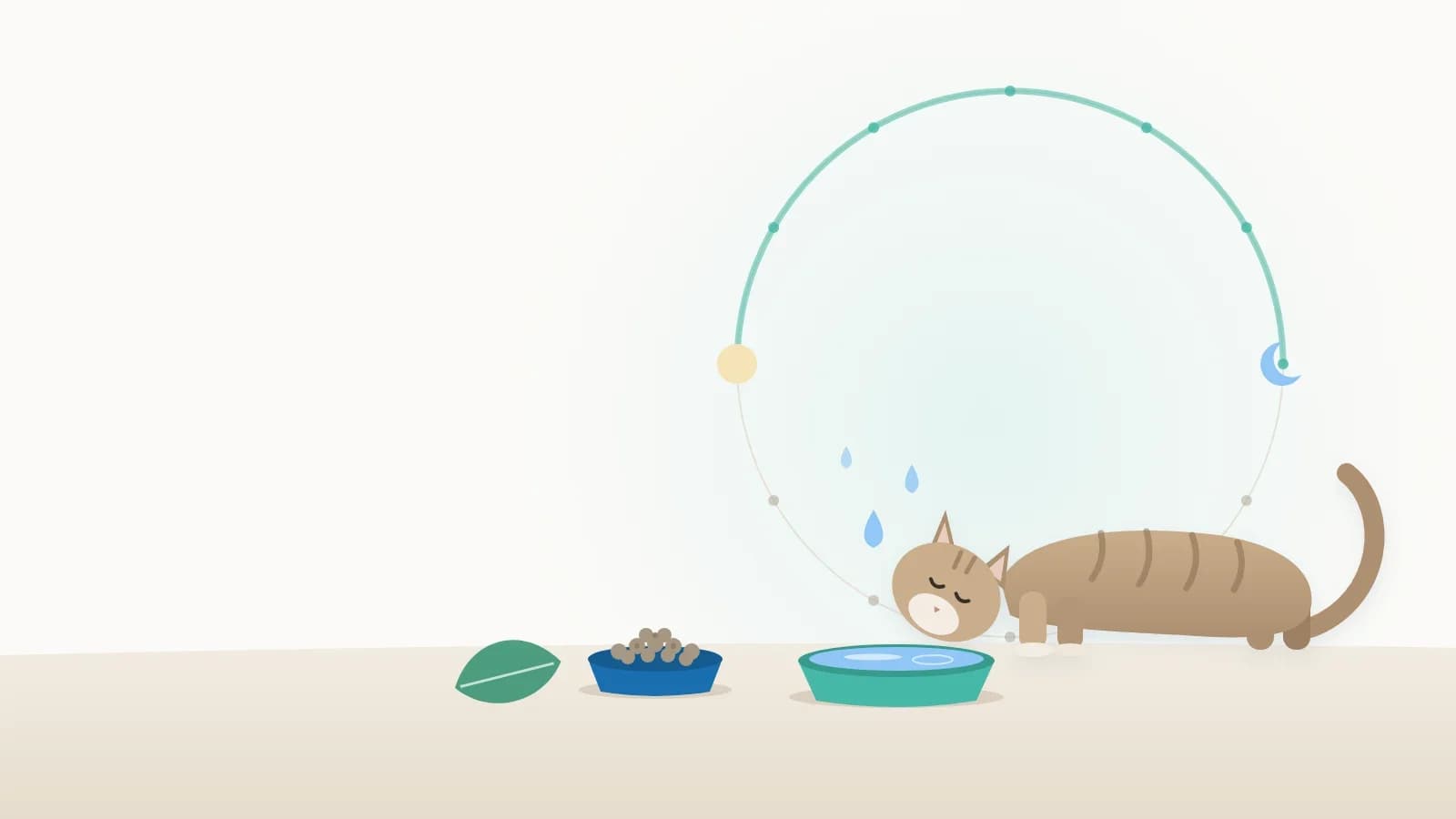
Signs of Diabetes in Cats: Drinking More, Eating More and Losing Weight
A cat that drinks more and eats more but still loses weight may be showing the first signs of diabetes. We explain why these three signs appear, what to watch for at home, how a diagnosis is made with blood and urine tests, and when to see your veterinary surgeon without delay.
Short answer: The most typical signs of diabetes in cats are drinking and urinating more, an increased appetite and weight loss despite eating more. Lethargy, a dull coat and walking with the hocks touching the ground can also be seen. These signs occur in other diseases too; your veterinary surgeon makes the diagnosis with blood and urine tests.
Diabetes mellitus is a common hormonal disease in middle-aged and older cats. It often starts quietly: the cat drinks a little more, the food bowl empties faster and the clumps in the litter tray grow. These changes are easy to miss in everyday life. Yet when diabetes is noticed early and managed under veterinary supervision, a cat's quality of life can be protected much better. In this article we look step by step at why the signs appear, which cats are at greater risk and how a diagnosis is reached.
What is diabetes in cats?
Diabetes is a condition in which blood glucose (sugar) stays persistently high because the body cannot move enough glucose from the blood into the cells. The hormone that allows glucose into the cells is insulin, produced by the beta cells of the pancreas. Diabetes in cats most often resembles type 2 diabetes in people: the tissues do not respond properly to insulin (insulin resistance) and, over time, the beta cells can no longer produce enough insulin (insulin deficiency). Excess weight and physical inactivity are among the main factors that increase insulin resistance (Rand et al., 2004). Less often, inflammation of the pancreas, hormonal diseases such as acromegaly, or certain medicines can also set the scene for diabetes (Sparkes et al., 2015).
What are the signs of diabetes in a cat?
The signs usually develop gradually over weeks. The most common are (Behrend et al., 2018; Sparkes et al., 2015):
- Drinking more (polydipsia): the water bowl empties more often, and the cat may start drinking from unusual places such as taps, sinks or plant saucers.
- Urinating more (polyuria): the clumps in the litter tray become larger and more numerous, the litter runs out faster, and sometimes the cat urinates outside the tray.
- Increased appetite (polyphagia): the cat asks for food more often and finishes its bowl quickly.
- Weight loss: the cat loses weight despite eating more; muscle loss may be noticeable over the back and hips.
Other signs that may come with them:
- Lethargy, less interest in play, sleeping more
- A dull coat, dandruff, the cat grooming itself less
- Weakness in the hind legs; the cat walking with its hocks touching the ground, or having difficulty jumping. This stance is linked to changes in the nerves caused by blood sugar staying high for a long time.
As the disease progresses, appetite may fall and vomiting and marked lethargy may appear. This can signal a serious complication and needs urgent assessment (see "When should you see a veterinary surgeon?" below).
Why does diabetes cause these signs?
Each of the signs is a different face of a single problem: the glucose is in the blood, but it cannot get into the cells.
1. Glucose cannot enter the cells. Because of insulin resistance or insulin deficiency, muscle, fat and liver cells cannot take up enough glucose, so it builds up in the blood. In cats, blood sugar that stays high for a long time can further impair beta cell function; this is called glucose toxicity (Rand et al., 2004).
2. Sugar passes into the urine (glucosuria). Normally the kidneys reabsorb the glucose they filter, so no sugar appears in the urine. But when blood glucose exceeds the level the kidneys can reabsorb, the excess spills into the urine.
3. The sugar takes water with it (polyuria). Glucose in the urine draws water along with it by osmosis, so the cat passes more, and more dilute, urine each time. This is called osmotic diuresis.
4. The body tries to replace the lost water (polydipsia). The water lost in urine triggers thirst. The cat drinks a lot because it is urinating a lot. The order matters: water is lost in the urine first, and thirst follows.
5. The cells go hungry (polyphagia). Even though there is plenty of glucose in the blood, the cells cannot use it. The body reads this as an energy shortfall, and appetite increases.
6. The body burns its own reserves (weight loss). Unable to use glucose, the body starts breaking down fat tissue and muscle protein for energy. The glucose lost in the urine is also lost energy. The result is a cat that eats more yet loses weight.
If heavy fat breakdown continues, ketone bodies can build up in the blood. This condition (diabetic ketoacidosis) is a life-threatening emergency marked by loss of appetite, vomiting, lethargy and fluid loss (Behrend et al., 2018).
Which cats are at greater risk?
A study of a large population of cats attending primary-care veterinary practices in England found that older age, male sex, higher body weight and certain breeds such as the Burmese were associated with diabetes (O'Neill et al., 2016). The guidelines also note that excess weight, inactivity and certain medicines (particularly long-term corticosteroid use) can increase risk (Sparkes et al., 2015). In cats at risk, regular check-ups and weight monitoring help you notice changes early. For monitoring an ageing cat, see our guide to check-ups after the age of 7.
Is a cat that drinks a lot diabetic? How is a diagnosis made?
Drinking more does not on its own mean diabetes. The same sign can be seen in chronic kidney disease, hyperthyroidism, liver disease and urinary tract infections. An increased appetite with weight loss is also a typical picture of hyperthyroidism, which is common in older cats. What is more, these diseases can occur together in the same cat. That is why the diagnosis is made by your veterinary surgeon, who considers the signs and laboratory results together. According to the guidelines, the diagnostic process usually includes (Behrend et al., 2018; Sparkes et al., 2015):
- Blood glucose measurement: your vet looks for persistently high blood sugar. In cats, even the stress of a clinic visit can raise blood sugar temporarily, so a single high reading is not enough for a diagnosis.
- Urinalysis: the urine is checked for sugar (glucosuria) and ketones, and for a urinary tract infection.
- Fructosamine: this test reflects average blood sugar over the past few weeks and helps distinguish a temporary, stress-related rise from persistently high levels.
- General blood tests: kidney, liver and thyroid values may be requested to reveal any accompanying disease.
The more detail you can give about your cat's signs, the easier your vet's job becomes.
What should you watch for at home?
If you suspect diabetes, or if your cat is in a risk group, note the following for a few days and take your notes to the appointment:
- Water intake: fill the water bowl to the same level each morning and check how much has gone the next day. A bowl emptying faster than before is an important clue. For more detail, see our article on water intake in older cats.
- Litter tray: are the clumps getting bigger and more frequent, and is the litter running out faster?
- Appetite: does your cat ask for food more often, or finish its bowl and look for food elsewhere?
- Weight: you can track it roughly at home by weighing yourself holding your cat and subtracting your own weight. For a more accurate reading, use the clinic scales.
- Movement and coat: is there difficulty jumping, walking with the hocks touching the ground, or a dull coat?
When did the signs start, and how have they changed? This information is very valuable during diagnosis.
When should you see a veterinary surgeon?
Contact your vet the same day, without waiting, if:
- Your cat is not eating, is vomiting, or is clearly lethargic and withdrawn
- It is breathing fast or deeply, or you notice an unusual smell on its breath
- There are signs of fluid loss (dry gums, sunken eyes, reduced skin elasticity)
- It cannot pass urine, or strains in the litter tray without producing any
- A cat on insulin shows trembling, wobbliness, extreme drowsiness, confusion or a seizure (this can be a sign that blood sugar has dropped too low and is an emergency)
Book an appointment soon if you notice:
- A clear increase in water intake and urine volume
- Weight loss despite an increased appetite
- Lethargy, a dull coat or difficulty jumping
- Walking with the hocks touching the ground
Both the diagnosis of diabetes and its treatment plan belong to your veterinary surgeon. What you observe at home is the most valuable help in that process.
What does care involve after diagnosis?
Your veterinary surgeon will set the care plan for a cat diagnosed with diabetes according to its overall condition and any accompanying diseases. The main points highlighted in the guidelines are (Sparkes et al., 2015; Behrend et al., 2018):
- Insulin treatment: insulin is the cornerstone of treating diabetes in cats. The type of insulin, the dose and the schedule are set by your vet and adjusted at check-ups. Never change the dose or stop insulin on your own.
- Nutrition: a diet low in carbohydrate is often recommended in the care of diabetic cats (Bennett et al., 2006). Your vet will choose the food and the amount. In a cat on insulin, changing the food can change its insulin needs, so make every change to its diet together with your vet.
- Weight management: in an overweight cat, controlled and gradual weight loss is planned under veterinary supervision.
- Regular meals and routine: consistent meal times and amounts make it easier for your vet to interpret blood sugar monitoring.
- Regular check-ups: blood glucose curves, fructosamine and urine checks are carried out at intervals set by your vet.
With early diagnosis and treatment under veterinary supervision, some cats can live for a time without needing insulin; this is called remission (Gostelow et al., 2014). Remission does not occur in every cat and may not be permanent. A cat in remission still needs to be monitored by your vet.
Which complementary feed can accompany care for cats whose carbohydrate intake needs attention?
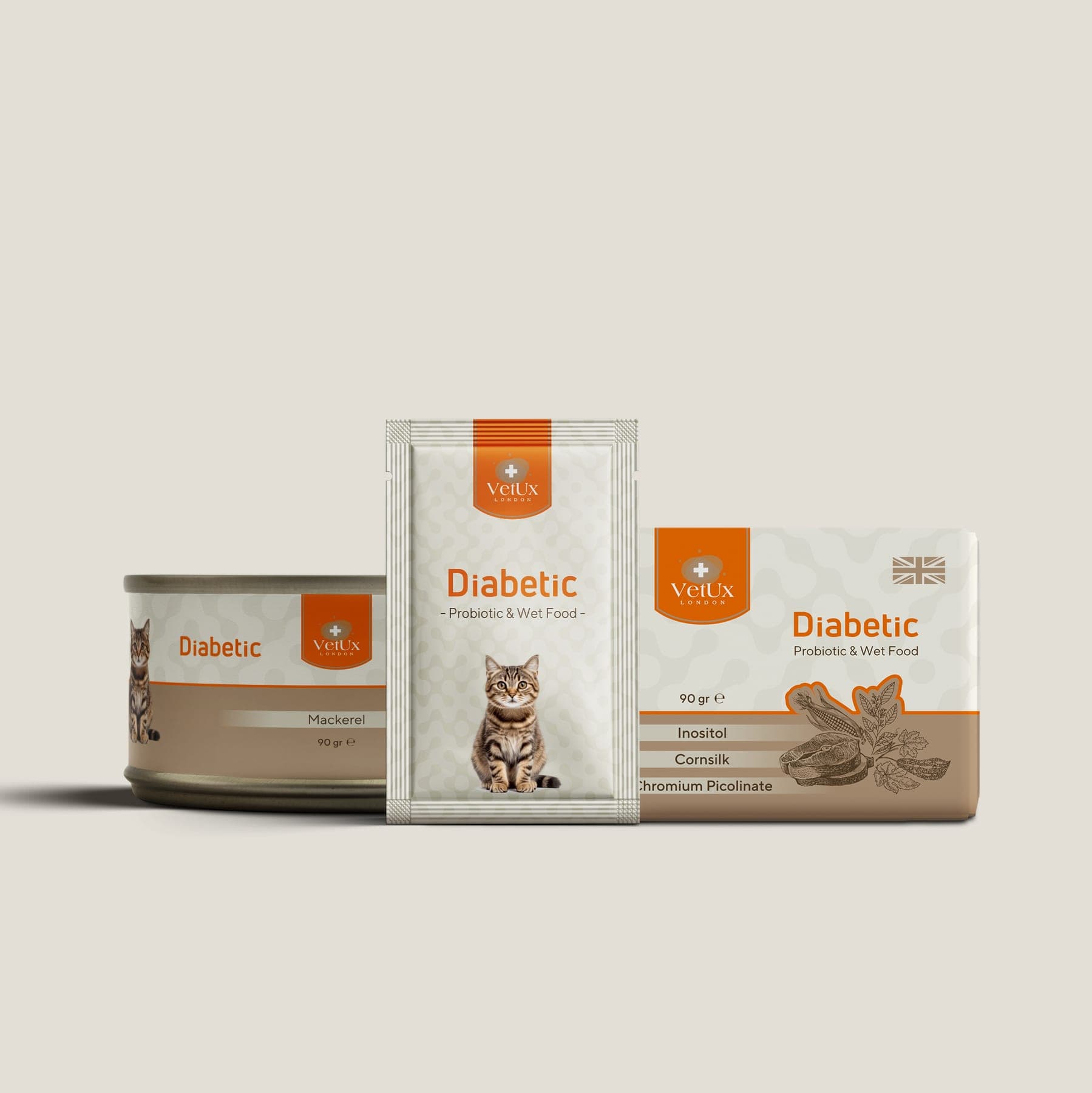
Elixir of Diabetic is a complementary feed made up of a probiotic wet food and sachet combination, prepared for cats whose carbohydrate intake needs extra attention. Its mackerel-based recipe, free from added sugar and gluten, contains chromium picolinate, corn silk (Zea mays), bitter melon (Momordica charantia), gymnema (Gymnema sylvestre), probiotic cultures, dietary fibre and a vitamin and mineral blend; it offers a controlled carbohydrate profile and contributes to maintaining an ideal body weight. Elixir of Diabetic is a complementary feed that accompanies the care recommended by your veterinary surgeon; it does not take the place of diagnosis or treatment of diabetes, and it is not used in place of insulin or any medicine your vet has prescribed. If your cat is on insulin or any other medicine, always talk to your vet before adding a new product to its diet. Your veterinary surgeon will decide whether the product is suitable for your cat and how it should be used.
Frequently asked questions
My cat is drinking a lot. Is it diabetic? It might be, but diabetes is not the only cause. Chronic kidney disease, hyperthyroidism, liver disease and urinary tract infections also increase water intake. Your vet will tell these apart with blood and urine tests. Note the increase in water intake for a few days and bring this to the appointment.
My cat eats a lot but is losing weight. Why? Weight loss despite a bigger appetite shows that the body cannot use the energy it takes in, or is using it up too fast. Diabetes and hyperthyroidism are among the most common causes; problems with absorption in the gut can give a similar picture. This always needs assessment by your vet.
Can diabetes in cats be tested for at home? What you observe at home (water intake, litter tray, appetite, weight) is very valuable, but it is not enough for a diagnosis. Because even stress can temporarily raise blood sugar in cats, the diagnosis is made by your veterinary surgeon, who considers tests such as blood glucose, urinalysis and fructosamine together.
Can diabetes in cats go away? With early diagnosis and treatment under veterinary supervision, some cats can live for a time without needing insulin; this is called remission. Remission does not occur in every cat and may not be permanent. The whole process is managed by your veterinary surgeon.
How should my diabetic cat be fed? A diet low in carbohydrate is often recommended in the guidelines. However, the type of food, the amount and the meal routine are set by your vet specifically for your cat. In a cat on insulin, a change of food can affect its insulin needs, so do not change its diet on your own.
Can a complementary feed replace insulin? No. Complementary feeds accompany the care your vet recommends; they do not replace insulin or medication. Insulin treatment and its dose are your veterinary surgeon's decision alone. Tell your vet about every product you give your cat at each visit.
Final word
Drinking more, eating more and still losing weight can be an important signal from your cat. Do not dismiss these signs as "just getting older" or "a good appetite". Watch the water bowl, the litter tray and your cat's weight for a few days and write down what you see. Diagnosis and treatment of diabetes are decided by your veterinary surgeon; talk to your veterinary surgeon about every change you notice in your cat.
References
- 1Sparkes AH, Cannon M, Church D, et al. ISFM consensus guidelines on the practical management of diabetes mellitus in cats. J Feline Med Surg. 2015;17(3):235–250. doi:10.1177/1098612X15571880
- 2Behrend E, Holford A, Lathan P, Rucinsky R, Schulman R. 2018 AAHA Diabetes Management Guidelines for Dogs and Cats. J Am Anim Hosp Assoc. 2018;54(1):1–21. doi:10.5326/JAAHA-MS-6822
- 3Rand JS, Fleeman LM, Farrow HA, Appleton DJ, Lederer R. Canine and feline diabetes mellitus: nature or nurture? J Nutr. 2004;134(8 Suppl):2072S–2080S. doi:10.1093/jn/134.8.2072S
- 4O'Neill DG, Gostelow R, Orme C, et al. Epidemiology of diabetes mellitus among 193,435 cats attending primary-care veterinary practices in England. J Vet Intern Med. 2016;30(4):964–972. doi:10.1111/jvim.14365
- 5Gostelow R, Forcada Y, Graves T, Church D, Niessen S. Systematic review of feline diabetic remission: separating fact from opinion. Vet J. 2014;202(2):208–221. doi:10.1016/j.tvjl.2014.08.014
- 6Bennett N, Greco DS, Peterson ME, et al. Comparison of a low carbohydrate–low fiber diet and a moderate carbohydrate–high fiber diet in the management of feline diabetes mellitus. J Feline Med Surg. 2006;8(2):73–84. doi:10.1016/j.jfms.2005.08.004
Frequently asked questions
My cat is drinking a lot. Is it diabetic?
It might be, but diabetes is not the only cause. Chronic kidney disease, hyperthyroidism, liver disease and urinary tract infections also increase water intake. Your vet will tell these apart with blood and urine tests. Note the increase in water intake for a few days and bring this to the appointment.
My cat eats a lot but is losing weight. Why?
Weight loss despite a bigger appetite shows that the body cannot use the energy it takes in, or is using it up too fast. Diabetes and hyperthyroidism are among the most common causes; problems with absorption in the gut can give a similar picture. This always needs assessment by your vet.
Can diabetes in cats be tested for at home?
What you observe at home (water intake, litter tray, appetite, weight) is very valuable, but it is not enough for a diagnosis. Because even stress can temporarily raise blood sugar in cats, the diagnosis is made by your veterinary surgeon, who considers tests such as blood glucose, urinalysis and fructosamine together.
Can diabetes in cats go away?
With early diagnosis and treatment under veterinary supervision, some cats can live for a time without needing insulin; this is called remission. Remission does not occur in every cat and may not be permanent. The whole process is managed by your veterinary surgeon.
How should my diabetic cat be fed?
A diet low in carbohydrate is often recommended in the guidelines. However, the type of food, the amount and the meal routine are set by your vet specifically for your cat. In a cat on insulin, a change of food can affect its insulin needs, so do not change its diet on your own.
Can a complementary feed replace insulin?
No. Complementary feeds accompany the care your vet recommends; they do not replace insulin or medication. Insulin treatment and its dose are your veterinary surgeon's decision alone. Tell your vet about every product you give your cat at each visit.
This article is for general information only; it does not replace veterinary examination, diagnosis or treatment. VetUx London products are complementary feed. If you have any concern about your companion, please consult your veterinary surgeon.
Share
The formulas matching the nutritional support described above.
Related articles
All articles Clinical Notes
Senior Dog Care Guide: A Checklist for Joints, Behaviour Changes and the Heart
What might night-time restlessness, disorientation, coughing and tiring quickly mean in an older dog? What should you watch at home, and when should you see your veterinary surgeon? A practical guide that looks at three body systems together.
 Clinical Notes
Itching and Sensitive Skin in Cats: Parasites, Food Sensitivity and the Skin Barrier
Why is my cat itchy, could it still be fleas if I can't see any, and how is food sensitivity identified? The causes of itching in cats, the skin barrier and the itch cycle, why an elimination diet is done with your vet and when to seek veterinary care.
 Clinical Notes
Fatty Liver in Cats (Hepatic Lipidosis): Why Is a Loss of Appetite Dangerous?
Why does a cat's liver fill with fat when it stops eating for a day or two, why are overweight cats more at risk, and when should you see a veterinary surgeon? The physiology of hepatic lipidosis, its signs and the principles of safe weight loss.