
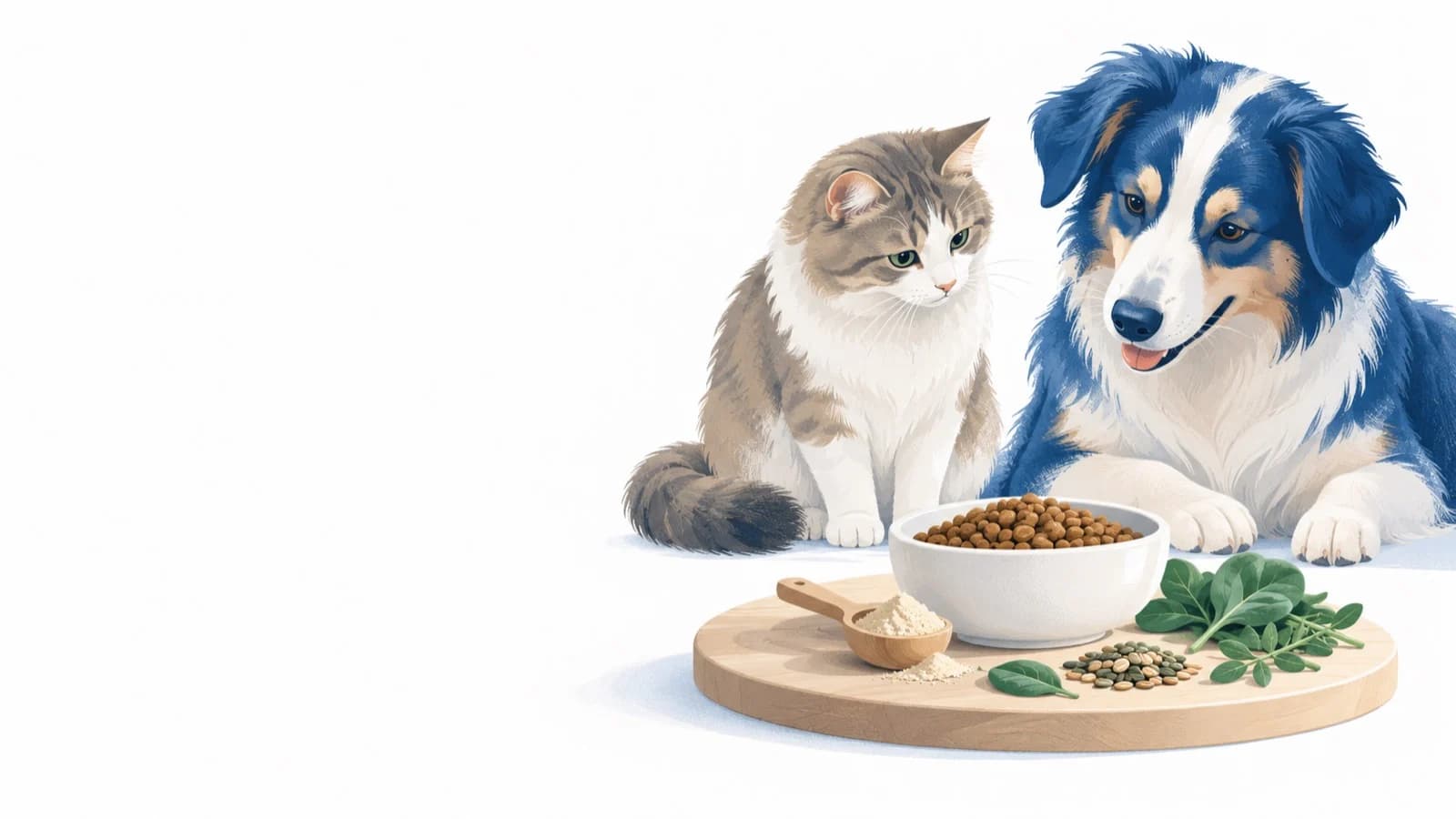
What Are Cat and Dog Supplements? Complementary Feed vs Vitamins vs Veterinary Medicines
Most cat and dog supplements are legally complementary feed, not medicines. This guide gives clear definitions of complementary feed, vitamin supplements, veterinary medicines and dietetic feed, a label checklist and when to see your vet.
Short answer: In most cases, a cat or dog supplement is legally a complementary feed: it does not replace a daily meal, but provides specific nutrients or feed additives alongside the main diet. A supplement is not a medicine; diagnosing and treating disease is the veterinarian's role, and the decision to use one is made with your vet.
Pet owners most often confuse three terms because the products on the shelf look so similar: complementary feed, vitamin-mineral supplements and veterinary medicines. The same tablet or paste format, similar-sounding ingredients and similar packaging make these groups hard to tell apart. Yet the difference is more than a technicality: it determines what the product is for, under which rules it is placed on the market and how it should be used. This guide explains the terms with clear definitions, shows what to look for on the label and lists the right questions to ask your vet.
What do supplement, complementary feed, vitamin and medicine mean?
The definitions below are plain-language summaries consistent with Regulation (EC) No 767/2009 on the placing on the market and use of feed, Regulation (EC) No 1831/2003 on feed additives, Regulation (EU) 2019/6 on veterinary medicinal products and the feed legislation of the Turkish Ministry of Agriculture and Forestry.
Complete feed (complete pet food): A compound feed which, by reason of its composition, is designed to meet the animal's daily nutritional requirements on its own. Its label states "complete feed" or "complete pet food".
Complementary feed: A compound feed with a high content of certain nutrients or additives which, by reason of its composition, meets the daily ration only when used in combination with other feed. Most tablets, powders, pastes, liquids and treat-style products that owners call "supplements" fall into this category. Complementary feed is not a medicine and may not be marketed with claims to treat disease.
Vitamin and mineral supplement: A product given to provide vitamins, trace elements or macrominerals. Vitamin-mineral products for cats and dogs are mostly registered as complementary feed; the vitamins and trace elements they contain are classed as "nutritional additives" under feed law. However, the category of a product is determined not by its ingredients but by its intended use, presentation and registration. The same vitamin may also appear in a licensed injectable preparation as a veterinary medicine.
Veterinary medicine (veterinary medicinal product): A product presented for the diagnosis, treatment or prevention of disease in animals, or used to restore, correct or modify physiological functions through a pharmacological, immunological or metabolic action, and which requires a marketing authorisation. In Türkiye, veterinary medicines are authorised by the Ministry of Agriculture and Forestry; prescription and dosing are decided by the veterinarian.
Dietetic feed (feed intended for particular nutritional purposes): A feed designed, by virtue of its particular composition or method of manufacture, to meet a specific nutritional need that arises in a particular physiological state. In the EU, the purposes for which a feed may carry this name are set out in a dedicated list (Commission Regulation (EU) 2020/354). These products remain feed; their labels state the recommended period of use and advise seeking a veterinarian's opinion before use.
How does complementary feed differ from a medicine?
The core difference lies in how the product works in the body.
Nutritional contribution: Complementary feed provides nutrients the body already uses (amino acids, fatty acids, vitamins, minerals, fibre sources, botanical ingredients). The aim is to support normal physiological function and contribute to nutrition. Its role is assessed together with the animal's overall diet, main food and duration of use.
Pharmacological effect: A veterinary medicine is developed for a dose-dependent, predictable effect on a specific target (a receptor, an enzyme or a microorganism). Its efficacy and safety are assessed with clinical data during authorisation; side effects, interactions and withdrawal periods are defined.
This is why a supplement does not replace your vet's diagnosis or prescribed treatment. At best, it can be a nutritional support that accompanies the treatment plan your vet has set.
With vitamins, more is not better
Vitamins fall into two groups according to how the body stores them, and this distinction matters for safety:
- Fat-soluble vitamins (A, D, E, K): Can accumulate in the liver and fat tissue. When given in excess over long periods, there is a risk of build-up. Excess vitamin A and D in particular has been associated with serious clinical conditions in cats and dogs. Cats cannot convert beta-carotene into vitamin A, so they need preformed vitamin A — but that does not remove the risk of excess.
- Water-soluble vitamins (B group, C): Excess is largely excreted in urine; even so, this does not mean they can be used without limits.
- Minerals: Minerals such as calcium, phosphorus, zinc and copper affect one another's absorption. For example, unbalanced calcium supplementation in large-breed puppies can adversely affect skeletal development.
A healthy animal fed a complete and balanced commercial diet often has no need for additional vitamins or minerals. Whether an extra product is needed is a decision for the veterinarian who knows the animal's dietary history.
How do complementary feed, vitamin supplements and veterinary medicines compare?
| Feature | Complementary feed | Vitamin-mineral supplement | Veterinary medicine | |---|---|---|---| | Legal category | Feed | Mostly complementary feed; some preparations are licensed as medicines | Veterinary medicinal product | | Main purpose | Contribute to nutrition, support physiological function | Provide specific vitamins/minerals | Diagnosis, treatment or prevention of disease | | Mode of action | Nutritional | Nutritional | Pharmacological, immunological or metabolic | | Placing on the market | Registration/approval under feed law | Feed registration or medicine authorisation, depending on category | Marketing authorisation required | | Replaces a daily meal? | No | No | No (not a feed) | | Disease treatment claims | Not permitted | Not permitted if registered as feed | Limited to authorised indications | | Who decides on use | Together with the vet | Together with the vet | Veterinary prescription/recommendation | | On the label | Composition, analytical constituents, additives, directions for use | Same + additive quantities | Active substance, dose, contraindications, package leaflet |
What should you check on a complementary feed label?
Feed legislation defines which information must appear on the label. When assessing a product, check the following:
- 1Type of feed: The words "complementary feed", "complete feed" or "dietetic feed" should be clearly stated.
- 2Target species and category: Is the product for cats or dogs, for puppies/kittens or adults? A product made for dogs may not be suitable for cats.
- 3Composition: The feed materials used, usually listed in descending order by weight.
- 4Analytical constituents: Values such as crude protein, crude fat (fat content), crude fibre, crude ash and, where relevant, moisture.
- 5Additives: Vitamins, trace elements and other additives, with their names and amounts.
- 6Directions for use: For complementary feed, the daily amount and duration of use must be stated on the label. This is the product's own instruction; confirm its suitability for your pet with your vet.
- 7Manufacturer and registration details: Name and address of the business responsible for placing the product on the market, and the establishment registration/approval number.
- 8Net quantity, batch number and best-before date.
If you see a claim on the label or in the marketing of a complementary feed suggesting it is a cure for disease, that wording is not compatible with feed legislation; talk to your vet before using the product.
Can human vitamins or medicines be given to cats and dogs?
No. Human vitamins and medicines should not be given to cats and dogs without a veterinarian's recommendation, for three main reasons:
- Dose differences: Vitamin amounts in human products can lead to excess, especially in cats and small-breed dogs; vitamin D is a well-known example.
- Dangerous excipients: Some human chewable tablets and gummies may contain sweeteners such as xylitol, which is toxic to dogs.
- Species differences: Because of differences in liver metabolism, cats are highly sensitive to some painkillers commonly used in people.
How should the decision to use a supplement be made?
The WSAVA Nutritional Assessment Guidelines recommend taking a dietary history at every examination, including not only the main food but also treats, home-prepared food and supplements. In practice, these steps help:
- Is your pet's current food a complete feed or a complementary feed? Show the label to your vet.
- List every product currently in use (supplements, treats, home-cooked food); getting the same vitamin from several sources increases the risk of accumulation.
- Agree with your vet on which physiological function the product is meant to support and for how long it will be used.
- If a disease is suspected, a diagnosis must come first; a supplement is not a substitute for diagnosis or treatment.
Note for veterinarians: Asking about supplement use as a separate question in the dietary history makes it easier to spot drug-supplement interactions and duplicate vitamin-mineral intake early. Explaining clearly to owners that the product is a feed — and what it does and does not replace — is important for managing expectations.
You can browse the general catalogue of Vetux complementary feed products on our products page; decide together with your vet which product, if any, is right for your pet.
When should you see a veterinarian?
In the following situations, contact your veterinarian directly rather than trying a supplement:
- Loss of appetite, vomiting, diarrhoea, excessive drinking or frequent urination
- Sudden weight loss, lethargy, lameness or a change in behaviour
- Skin redness, intense itching, wounds or patchy hair loss
- Your pet is pregnant, lactating, very young, elderly or on medication for a chronic condition
- Any unexpected sign such as vomiting, diarrhoea or appetite change after starting a supplement
- Your pet has accidentally swallowed a human vitamin or medicine (this is an emergency)
Diagnosis and treatment are your veterinarian's responsibility; supplements only accompany nutrition to the extent your vet considers appropriate.
Frequently asked questions
Is a supplement the same as complementary feed? Most cat and dog products called "supplements" in everyday language are legally complementary feed. Complementary feed is a compound feed that provides specific nutrients and meets the daily ration only in combination with other feed.
Can complementary feed be used instead of a medicine? No. Complementary feed is not a medicine; it is intended to support normal physiological function and contribute to nutrition. Diagnosis and treatment of disease are the veterinarian's responsibility.
Can I give my cat or dog human vitamins? No. Doses and excipients in human products (for example xylitol) may be unsuitable for cats and dogs. Only give your pet species-appropriate products recommended by your vet.
Does a pet fed a complete diet need a vitamin supplement? A healthy animal fed a complete and balanced food often does not need extra vitamins. Unnecessary use can create a risk of excess, especially with fat-soluble vitamins such as A and D. The decision should be made with your vet.
What is dietetic feed and how is it different from complementary feed? Dietetic feed (feed intended for particular nutritional purposes) is designed for a specific nutritional need arising in a particular physiological state. The purposes for which it may carry this name are listed in legislation, and it is usually used on a veterinarian's recommendation.
What should I check first on a supplement label? First check the type of feed (is it complementary feed?) and the target species (cat or dog?), then the composition, analytical constituents, additives, directions for use and the manufacturer's registration details.
References
- 1European Parliament and Council. Regulation (EC) No 767/2009 of 13 July 2009 on the placing on the market and use of feed. Official Journal of the European Union, L 229, 1.9.2009.
- 2European Parliament and Council. Regulation (EC) No 1831/2003 on additives for use in animal nutrition. Official Journal of the European Union, L 268, 18.10.2003.
- 3European Commission. Commission Regulation (EU) 2020/354 of 4 March 2020 establishing a list of intended uses of feed intended for particular nutritional purposes.
- 4European Parliament and Council. Regulation (EU) 2019/6 on veterinary medicinal products.
- 5Freeman L, Becvarova I, Cave N, et al. WSAVA Nutritional Assessment Guidelines. Journal of Small Animal Practice. 2011;52(7):385–396.
- 6WSAVA Global Nutrition Committee. Guidelines on Selecting Pet Foods. World Small Animal Veterinary Association.
- 7FEDIAF. Nutritional Guidelines for Complete and Complementary Pet Food for Cats and Dogs. Brussels: FEDIAF European Pet Food (current edition).
- 8National Research Council. Nutrient Requirements of Dogs and Cats. Washington, DC: The National Academies Press; 2006.
- 9AAFCO. Official Publication. Association of American Feed Control Officials (current edition).
- 10Republic of Türkiye. Law No. 5996 on Veterinary Services, Plant Health, Food and Feed (2010) and the feed legislation of the Ministry of Agriculture and Forestry (Regulation on the Placing on the Market and Use of Feed).
This article is for information only and does not replace a veterinary examination. Always consult your veterinarian before giving your cat or dog any supplement, vitamin or medicine.
Frequently asked questions
Is a supplement the same as complementary feed?
Most cat and dog products called "supplements" in everyday language are legally complementary feed. Complementary feed is a compound feed that provides specific nutrients and meets the daily ration only in combination with other feed.
Can complementary feed be used instead of a medicine?
No. Complementary feed is not a medicine; it is intended to support normal physiological function and contribute to nutrition. Diagnosis and treatment of disease are the veterinarian's responsibility.
Can I give my cat or dog human vitamins?
No. Doses and excipients in human products (for example xylitol) may be unsuitable for cats and dogs. Only give your pet species-appropriate products recommended by your vet.
Does a pet fed a complete diet need a vitamin supplement?
A healthy animal fed a complete and balanced food often does not need extra vitamins. Unnecessary use can create a risk of excess, especially with fat-soluble vitamins such as A and D. The decision should be made with your vet.
What is dietetic feed and how is it different from complementary feed?
Dietetic feed (feed intended for particular nutritional purposes) is designed for a specific nutritional need arising in a particular physiological state. The purposes for which it may carry this name are listed in legislation, and it is usually used on a veterinarian's recommendation.
What should I check first on a supplement label?
First check the type of feed (is it complementary feed?) and the target species (cat or dog?), then the composition, analytical constituents, additives, directions for use and the manufacturer's registration details.
This article is for general information only; it does not replace veterinary examination, diagnosis or treatment. VetUx London products are complementary feed. If you have any concern about your companion, please consult your veterinary surgeon.
Share
Related articles
All articles Nutrition
Practical ways to raise water intake in senior cats
Cats rarely show us that they are thirsty. Raising daily water intake is one of the simplest habits that helps maintain normal kidney function — and in most homes it takes only a few small changes.
 Clinical Notes
Shedding in Cats: How to Tell Seasonal Moulting from Problem Hair Loss
Shedding in cats is usually seasonal, but bald patches, redness and itching can point to an underlying cause. This guide explains how to tell the two apart and when to see your veterinary surgeon.
 Clinical Notes
Diarrhoea in Cats: Causes, Home Monitoring and When to See the Vet
Diarrhoea in cats is most often linked to a change of food, stress or parasites, but signs such as blood, vomiting and lethargy need a veterinary assessment the same day. Here is what to watch at home and when not to wait.