
Eye Discharge in Cats and Dogs: What Do Colour and Consistency Tell You, and How Should You Clean Around the Eyes?
What might clear, mucoid or yellow-green eye discharge point to, how can you clean around the eyes safely at home, and which signs mean you should see your vet without delay? Vet. Hek. Metehan Çalıkuşu explains tear staining and why human eye drops are never used.
Eye discharge is a visible sign of change in the tear film or eye surface. Clear, watery discharge is often linked to irritation or tear drainage; yellow-green, thick discharge, squinting, pain or cloudiness need a veterinary examination. The eye area can be gently cleaned as part of everyday care; diagnosis and treatment belong to your vet.
A small crust at the corner of your cat's eye in the morning, a brown trail running towards your dog's nose, fur that stays damp all day… Eye discharge is one of the changes cat and dog owners notice most often. Sometimes it simply means the eye area needs everyday cleaning; sometimes it points to an eye problem that needs examining. In this article we explain where discharge comes from, what its colour and consistency may indicate, how to clean around the eyes safely at home, and when you should see your veterinary surgeon without delay. The information here does not replace an examination; diagnosis and treatment are always your vet's responsibility.
Where does eye discharge come from?
The front surface of the eye is constantly covered by a thin but layered tear film. This film keeps the cornea moist and smooth and helps blinking clear away dust and small particles. In cats and dogs the tear film has three components:
- Lipid (oily) layer: secreted by the meibomian glands along the eyelid margin; it sits on the outside and limits rapid evaporation of the tears.
- Aqueous (watery) layer: produced by the lacrimal gland and the gland of the third eyelid; it makes up most of the film's volume.
- Mucin layer: secreted by goblet cells in the conjunctiva; it helps the tears adhere to the corneal surface.
Tears are normally collected through tiny openings (puncta) at the inner corner of the eyelids and drained through the tear duct into the nose. That is why tears are not expected to spill onto the cheeks of a healthy animal. Eye discharge usually appears in one of three ways: tears are overproduced (irritation, dust, eyelash or eyelid problems, pain), tears cannot drain properly (narrowing or blockage of the duct, eyelid conformation), or the character of the tears changes (inflammation, infection, or thickening of secretions when tear production is insufficient).
Why does the eye area get dirty?
Tears and secretions that reach the eyelid margin dry on contact with air and stick to the fur, forming crusts. Dust, pollen and shed hair get caught in them. In some animals the eye area soils more easily simply because of its structure:
- Flat-faced (brachycephalic) breeds (Persian, Himalayan and Exotic cats; dogs such as the Shih Tzu, Pug and French Bulldog): prominent eyes, facial folds and the shape of the inner eyelid corner can make tear drainage harder.
- Animals with long fur around the eyes: hair growing towards the eye can irritate it and also holds moisture.
- Eyelash and eyelid problems: lashes growing in the wrong direction or an inward-rolling eyelid can increase tear production through constant irritation. These can only be identified on examination.
What is tear staining?
The reddish-brown trail running down from the inner corner of the eye, especially noticeable on light-coloured fur, is commonly known as tear staining. Pigments called porphyrins, naturally present in tears, accumulate when the fur stays damp and darken on exposure to light. Skin and fur that remain constantly wet can develop an unpleasant smell, and the skin may become red. Tear staining often looks like a cosmetic issue, but the real question is why the tears are overflowing onto the face; a drainage problem, or irritation from eyelashes or the eyelids, may lie behind it. It is therefore sensible to show your vet any staining that is new or clearly increasing.
What do the colour and consistency of the discharge tell you?
The appearance of the discharge is one of the first clues your vet will use. Even so, colour alone does not make a diagnosis; the same appearance can arise from very different causes. The table below is meant to help you know what to look for when observing at home.
| Appearance | What it may be linked to | What to do | |---|---|---| | Clear, watery | Irritants such as dust, wind or smoke, an allergic response, poor tear drainage; in cats, the early stage of upper respiratory signs. If pain is present, there may also be a problem on the corneal surface. | If the eye looks comfortable, your pet is bright and the discharge is minimal, observe and gently clean around the eye. See your vet for squinting, redness or discharge that has not settled within a few days. | | Grey-white, mucoid, stringy | Reduced watery tear production (dry eye), conjunctival inflammation or chronic irritation. The eye surface may look dull. | A veterinary examination is needed; tear production can be measured with a simple test. | | Yellow-green, thick, sticky | A bacterial infection, marked inflammation or a problem on the corneal surface. The eyelids may stick together. | See your vet without delay. Do not put any medication in the eye at home. | | Reddish-brown dry trail | Most often porphyrin-related tear staining; the underlying cause is persistent tear overflow. | Keep the eye area clean and dry; show your vet any staining that is new or increasing. | | Blood or blood-tinged discharge | Trauma, a foreign body, a bleeding disorder or a problem involving the inner structures of the eye. | This is an emergency; a same-day examination is needed. |
While observing, the answers to these questions are also valuable to your vet: is the discharge in one eye or both? How long has it been going on? Is your pet squinting, pawing at the eye or rubbing its face on the floor? In cats, eye discharge is frequently seen together with sneezing and nasal discharge; agents such as feline herpesvirus-1 are among the common causes of this picture, and it needs to be assessed by a veterinary surgeon. Discharge that starts suddenly in one eye often points to a problem specific to that eye (a foreign body, a scratch, an eyelash).
When should you see a veterinary surgeon?
The eye is one of the organs least tolerant of delay; some eye problems can progress to permanent damage within hours or days. If you notice any of the following, contact your veterinary surgeon without waiting:
- Yellow-green, thick or sticky discharge
- Squinting, frequent blinking or being unable to open the eye — the most common signs of eye pain
- Pawing at the eye, or rubbing the face on the floor or furniture
- Cloudiness of the eye, a bluish-white appearance or loss of shine on the eye surface
- Marked redness of the white of the eye, or swollen eyelids
- The third eyelid becoming clearly visible at the inner corner of the eye
- Pupils of different sizes, or an eye that looks enlarged or bulging
- Behaviour suggesting loss of vision, such as bumping into objects
- A knock to the eye, a scratch or a suspected foreign body
- In cats, loss of appetite or lethargy alongside sneezing and nasal discharge; any eye discharge in a kitten or puppy
- Discharge that does not settle within a few days or keeps coming back, even if it looks mild
If pain, squinting and cloudiness occur together, a same-day examination is needed. Until you reach the vet, do not rub the eye, do not let your pet scratch it, and do not use medicines you have at home. In particular, never use eye drops sold for people: some of these products contain active ingredients that can make matters worse if there is damage to the corneal surface. Only an examination can show what is happening in the eye and what should be used; diagnosis and treatment belong to your veterinary surgeon.
How should you clean around the eyes?
If there are no warning signs such as pain, cloudiness or yellow-green discharge, gently cleaning dried secretions and crusts from around the eye is part of everyday care. The aim is not to do anything inside the eye, but to keep the skin and fur around the eye clean and dry. The general steps are:
- 1Preparation: wash your hands. Choose a calm setting; with cats, you can wrap your pet gently in a soft towel if needed.
- 2The right materials: use a clean, lint-free gauze swab or cotton pad. Use a separate swab for each eye, so you do not carry secretions from one eye to the other.
- 3Softening: do not pull dry crusts off. Moisten the swab with lukewarm water or an eye-area solution recommended by your vet, and hold it gently against the crust for a few seconds to let it soften.
- 4Wipe in one direction: wipe from the inner corner of the eye outwards and downwards, without pressing. Do not touch the eyeball.
- 5Drying: after cleaning, pat the eye area dry with a clean, dry cloth. Damp fur makes tear staining more noticeable.
- 6Dispose and reward: throw used swabs away immediately and never reuse them. Reward your pet so that this care becomes a positive routine.
Things to avoid: cotton buds (they can poke the eye if your pet moves suddenly), scented or alcohol-based wet wipes, make-up removers, hydrogen peroxide, home-made salt water, non-sterile home remedies such as tea or chamomile infusions, and “stain remover” products of unclear composition. If the fur around the eyes needs trimming, leave it to an experienced groomer or your veterinary practice. How often cleaning is needed depends on your pet's anatomy and eye health; decide this together with your vet.
If your pet is clearly uncomfortable during cleaning, squints, or the discharge returns quickly after every clean, this is not a grooming issue but a sign that an examination is needed.
Where does Opti Fix fit into everyday eye-area care?
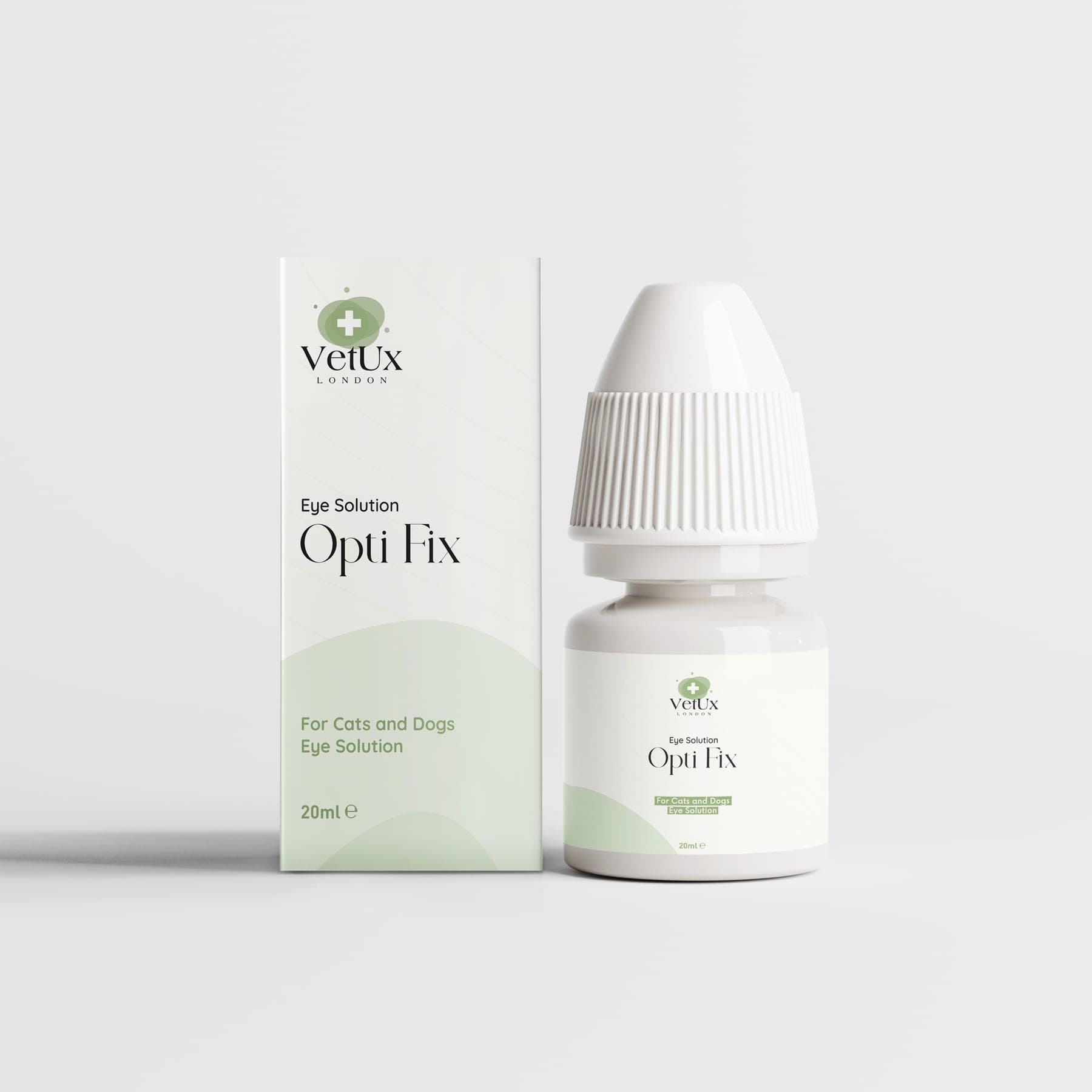
Opti Fix is an eye solution for external use, prepared for cats and dogs (20 ml). Its formulation contains boric acid and borax as pH buffer components, sodium chloride for isotonic balance, and tea tree oil (Melaleuca alternifolia); boric acid and borax accompany the natural pH balance of the tear film, and the product as a whole is designed to accompany the everyday hygiene of the eye area. Opti Fix is not a medicine; it does not remove the cause of eye discharge and does not replace the diagnosis or treatment of eye disease. If there is yellow-green discharge, pain, squinting or cloudiness, a veterinary examination comes first. Because tea tree oil is an ingredient that can cause sensitivity, particularly in cats, your veterinary surgeon should decide whether the product is suitable for your pet and how and how often it should be used. For full ingredient details, see the Opti Fix product page.
Frequently asked questions
My cat gets a small brown crust in the eye every morning. Is that normal?
A small amount of dried secretion at the eyelid margin is seen in many healthy cats and dogs, and gentle cleaning around the eye is often enough. If the amount increases, the colour turns yellow-green or your pet squints, contact your veterinary surgeon.
Is tear staining permanent?
Staining tends to return for as long as tears keep overflowing onto the face. Keeping the eye area clean and dry helps its appearance, but why the tears are overflowing (a duct, eyelash or eyelid problem) needs to be assessed by your vet.
Can I use eye drops sold for people?
No. Some human eye drops contain substances that can make matters worse if there is unnoticed damage to the eye surface. Do not put any product in your pet's eye without consulting your veterinary surgeon.
Can I wipe around the eyes with tea or chamomile infusion?
This is not recommended. Home preparations like these are not sterile, can leave particles in the eye and may cause irritation in some animals. Lukewarm water or a solution recommended by your vet is a safer choice for cleaning.
My cat has runny eyes and is sneezing. What should I do?
In cats, eye and upper respiratory signs are frequently seen together and may be associated with viral or bacterial agents. If your cat is off its food, lethargic or is a kitten, see your vet without delay; do not use medicines at home.
Is Opti Fix an eye medicine?
No. Opti Fix is an eye solution for external use that accompanies the everyday hygiene of the eye area. It does not address the cause of eye discharge; diagnosis and treatment belong to your vet. Because it contains tea tree oil, the decision to use it — particularly in cats — rests with your veterinary surgeon.
Final word
The colour and consistency of eye discharge are the most valuable part of what you can observe at home, but they do not make a diagnosis. A small amount of clear discharge can often be managed with gentle cleaning around the eye, whereas yellow-green discharge, squinting, pain and cloudiness need an examination without delay. Keeping the eye area clean and dry, staying away from human medicines and non-sterile home remedies, and noticing changes early are the greatest contributions you can make to your pet's eye health.
References
- Gelatt KN, Ben-Shlomo G, Gilger BC, Hendrix DVH, Kern TJ, Plummer CE (eds). Veterinary Ophthalmology. 6th ed. Hoboken, NJ: Wiley-Blackwell; 2021.
- Maggs DJ, Miller PE, Ofri R. Slatter's Fundamentals of Veterinary Ophthalmology. 6th ed. St. Louis, MO: Elsevier; 2018.
- Davidson HJ, Kuonen VJ. The tear film and ocular mucins. Veterinary Ophthalmology. 2004;7(2):71–77.
- Gould D. Feline herpesvirus-1: ocular manifestations, diagnosis and treatment options. Journal of Feline Medicine and Surgery. 2011;13(5):333–346.
- Thiry E, Addie D, Belák S, et al. Feline herpesvirus infection. ABCD guidelines on prevention and management. Journal of Feline Medicine and Surgery. 2009;11(7):547–555.
- Khan SA, McLean MK, Slater MR. Concentrated tea tree oil toxicosis in dogs and cats: 443 cases (2002–2012). Journal of the American Veterinary Medical Association. 2014;244(1):95–99.
This article is for information only and does not replace an examination by a veterinary surgeon. For your cat's or dog's eye discharge, eye-area care and any product you plan to use, consult your veterinary surgeon.
Frequently asked questions
My cat gets a small brown crust in the eye every morning. Is that normal?
A small amount of dried secretion at the eyelid margin is seen in many healthy cats and dogs, and gentle cleaning around the eye is often enough. If the amount increases, the colour turns yellow-green or your pet squints, contact your veterinary surgeon.
Is tear staining permanent?
Staining tends to return for as long as tears keep overflowing onto the face. Keeping the eye area clean and dry helps its appearance, but why the tears are overflowing (a duct, eyelash or eyelid problem) needs to be assessed by your vet.
Can I use eye drops sold for people?
No. Some human eye drops contain substances that can make matters worse if there is unnoticed damage to the eye surface. Do not put any product in your pet's eye without consulting your veterinary surgeon.
Can I wipe around the eyes with tea or chamomile infusion?
This is not recommended. Home preparations like these are not sterile, can leave particles in the eye and may cause irritation in some animals. Lukewarm water or a solution recommended by your vet is a safer choice for cleaning.
My cat has runny eyes and is sneezing. What should I do?
In cats, eye and upper respiratory signs are frequently seen together and may be associated with viral or bacterial agents. If your cat is off its food, lethargic or is a kitten, see your vet without delay; do not use medicines at home.
Is Opti Fix an eye medicine?
No. Opti Fix is an eye solution for external use that accompanies the everyday hygiene of the eye area. It does not address the cause of eye discharge; diagnosis and treatment belong to your vet. Because it contains tea tree oil, the decision to use it — particularly in cats — rests with your veterinary surgeon.
This article is for general information only; it does not replace veterinary examination, diagnosis or treatment. VetUx London products are complementary feed. If you have any concern about your companion, please consult your veterinary surgeon.
Share
The formulas matching the nutritional support described above.
Related articles
All articles Care Guides
Fireworks and Thunderstorm Fear in Dogs: A Preparation Plan Before New Year's Eve
Does your dog tremble, hide or try to bolt during fireworks or thunder? Vet. Hek. Metehan Çalıkuşu explains how fear develops in the body, gradual sound training before New Year's Eve, the safe space, ID tag precautions against escapes and when to see your veterinary surgeon.
 Care Guides
Senior Cat Care Guide: Check-ups, Nutrition and Warning Signs After Age 7
Cats hide pain and illness remarkably well. We explain which check-ups are needed after age 7, which behaviour, mouth, weight and water intake signs to watch for at home, and how to plan a change of food.
 Care Guides
Oral care at home: a step-by-step way to build the habit
The hard part of oral care is not the brushing — it is getting there. A patient two-week programme is usually enough for the routine to settle in most dogs and cats.