
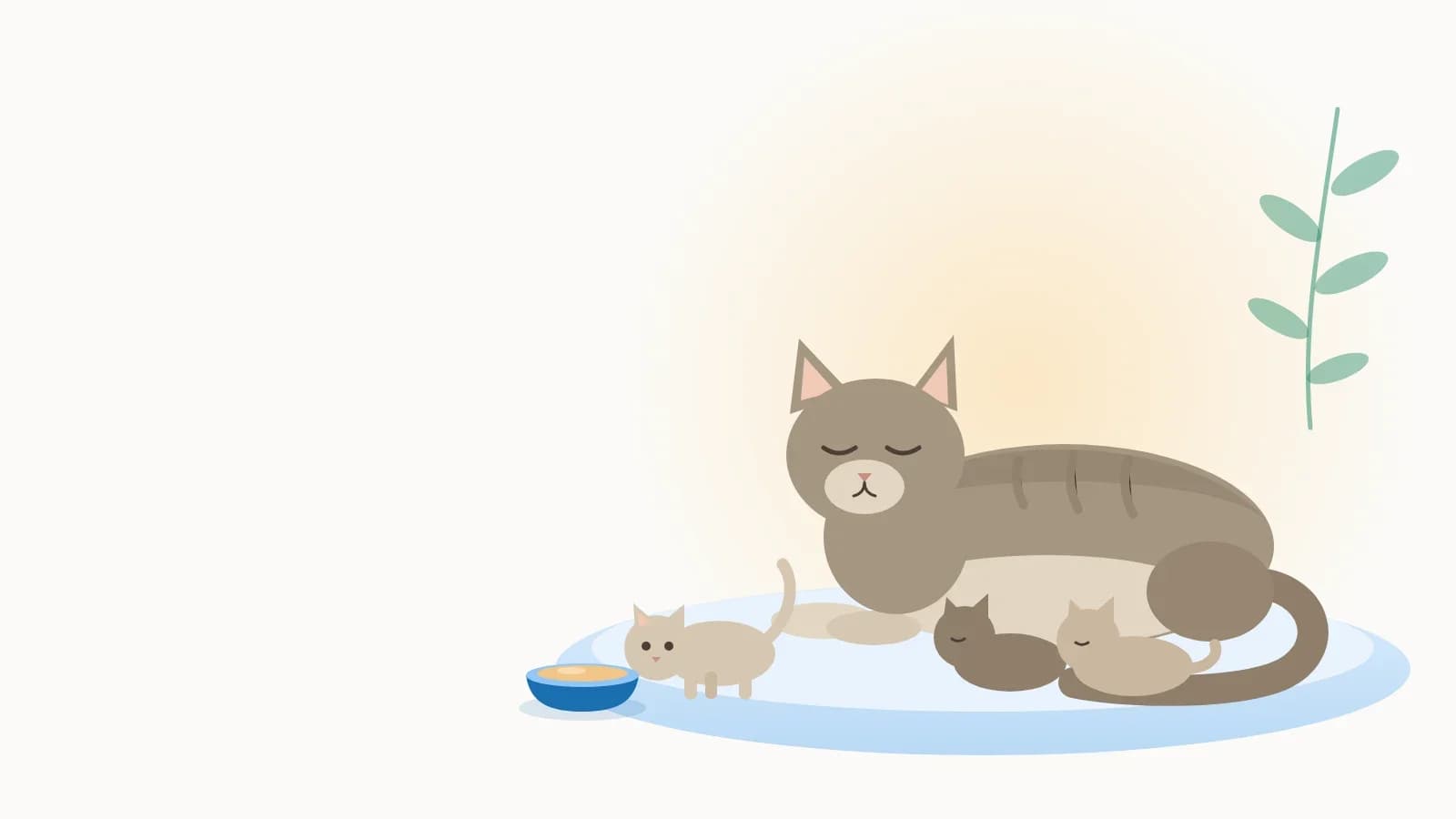
Gut Development in Pregnant Mothers and Nursing Young: The Move From Mother's Milk to Solid Food
Why do newborn kittens and puppies gain their immunity from colostrum, when does gut closure happen, and how should the move from mother's milk to solid food be planned? The physiology of nutrition through pregnancy and nursing; every decision belongs to your vet.
Short answer: Newborn kittens and puppies get most of their immunity from colostrum suckled in the first hours of life; the gut absorbs these antibodies intact for only about 24 hours. Weaning onto solid food should be gradual, matching maturing digestive enzymes and gut flora. During pregnancy, every feeding and supplement decision belongs to your vet.
Anyone caring for a pregnant cat or dog asks the same question: "Am I meeting the needs of the mother and her litter properly?" In this article we explain how the young gut develops from pregnancy through to weaning, why colostrum matters so much, and what the physiology of the move to solid food is built on. Pregnancy and nursing are among the most sensitive periods for both mother and young; examination, diagnosis, treatment and the feeding plan belong to your veterinary surgeon.
How do the nutritional needs of a pregnant cat or dog change during gestation?
Gestation in dogs and cats lasts around 63 days (roughly 63–66 days in cats). For the first two thirds, the mother's energy requirement stays close to maintenance; because most foetal growth takes place in the final third, the need for energy, protein and micronutrients rises markedly in that stage (NRC, 2006; Fontaine, 2012). Queens, unlike bitches, gain weight progressively from early pregnancy and draw on that reserve during lactation.
Lactation is a far greater metabolic load than pregnancy. Milk production peaks in the third to fourth week after birth, and the energy requirement of a mother nursing a large litter can rise to several times maintenance (NRC, 2006). The foundation in this period is a complete and balanced diet stated as suitable for pregnant and lactating animals (FEDIAF, 2021). Complementary feeds do not replace that foundation; they only accompany it where your vet considers it appropriate.
In pregnancy, the idea that "more can't hurt" is particularly risky. Excess intake of certain nutrients, such as vitamins A and D or calcium, can adversely affect foetal development and calcium balance after birth. Combining several supplements without knowing the content of the main diet is therefore not advised. Only your veterinary surgeon decides which product a pregnant animal should receive, when, and how much.
Why is a newborn's gut born "permeable"?
Dogs and cats have an endotheliochorial placenta, with several tissue layers between the maternal and foetal circulations. This structure limits the passage of large antibody molecules (IgG) to the young in the womb. A newborn puppy has received only a small fraction (around 5–10%) of its circulating antibodies across the placenta; the rest of its passive immunity comes entirely from colostrum (Day, 2007; Chastant-Maillard et al., 2017). The picture is similar in cats: kittens deprived of colostrum have markedly low serum antibody levels (Casal et al., 1996; Claus et al., 2006).
Nature's answer to this gap is the newborn gut itself. In the first hours after birth, small intestinal epithelial cells (enterocytes) can move colostral antibodies into the blood intact, without breaking them down. This permeability is temporary: in puppies, IgG absorption falls quickly within hours of birth and the intestinal barrier has largely "closed" within about 24 hours (Chastant-Maillard et al., 2012). This is known as gut closure.
The practical meaning is clear: how soon a newborn starts suckling decides how well passive immunity is transferred. A study in a large breeding kennel showed that puppies with inadequate passive immune transfer had a markedly higher risk of neonatal death (Mila et al., 2014). A newborn that does not suckle, cries weakly or stays away from its mother is a race against the clock and a matter for your vet.
Mechanism: how do colostrum, digestive enzymes and gut flora mature together?
Colostrum is more than antibodies
Colostrum is the secretion produced in the first one to two days after birth, and its composition differs clearly from mature milk. Alongside its mainly IgG antibodies, it contains IgA that protects the gut surface, natural defence proteins such as lactoferrin and lysozyme, and growth factors (Chastant-Maillard et al., 2017). While antibodies enter the circulation to provide systemic protection, the IgA and growth factors that remain in the gut act as a local shield and a maturation signal on the epithelial surface. The energy and fat content of colostrum also contributes to the newborn's physiological balance against hypothermia and hypoglycaemia in the first hours.
Digestive enzymes are reprogrammed from milk to food
The newborn's digestive system is designed for milk. At birth, lactase activity on the intestinal brush border is high; as the young grow and their diet diversifies, lactase activity declines while enzymes that digest starch and other carbohydrates, and pancreatic enzymes, increase (Buddington et al., 2003). This shift is the biological basis for moving to solid food: abrupt diet changes made before the enzyme profile is ready can lead to undigested food load, gas and soft stools.
Gut flora begins at birth and is shaped by weaning
From birth, the newborn gut begins to be colonised by the mother's vaginal, mammary and environmental flora. Studies in puppies have shown that the faecal microbiota changes rapidly in the first weeks and, with the move to solid food during weaning, evolves into a more diverse, adult-like structure (Guard et al., 2017). This developing flora interacts with the maturing intestinal barrier and with the education of gut-associated immune tissue (Day, 2007).
The immunity gap: as maternal antibodies fade
Maternal antibodies taken in with colostrum are not permanent; they decline gradually over their half-life, while the youngster's own immune response continues to mature. The window in which maternal antibodies fall below protective levels but the young animal's own protection is not yet fully developed usually coincides with the weaning weeks and is called the "immunity gap" (Day, 2007). Weaning diarrhoea is common in this period, when dietary change, stress and infectious agents overlap (Grellet et al., 2014). Vaccination timing and parasite control should therefore follow a plan your vet tailors to each litter.
How and when should the move from mother's milk to solid food happen?
Kittens and puppies usually start to show interest in their mother's food at around three to four weeks of age. At this stage a suitable kitten or puppy food, softened with lukewarm water, can be introduced in small portions. The transition should be gradual; for several weeks the young take both mother's milk and solid food, with the share of milk falling over time. Full weaning is completed in most litters between six and eight weeks (Lawler, 2008; Fontaine, 2012). Breed, litter size, the mother's milk yield and the litter's growth can all change this timeline; your vet's assessment is key to getting the timing right.
General principles that support the transition:
- Go gradually: New food is introduced over several days, not in one step. Enzymes and flora need time to adapt.
- A complete diet suited to growth: Choose a complete and balanced food formulated for growth; home-cooked meals and table scraps create an unbalanced nutrient profile.
- Access to clean water: Young animals moving onto solid food need constant access to clean water in a shallow bowl.
- Regular weighing: Weighing the litter daily, or at least at regular intervals, is the simplest way to spot growth problems early; birth weight and early weight gain are among the vital indicators in puppies (Mila et al., 2015).
- A resting area for the mother: Towards the end of nursing, a space where the mother can step away from the litter for short periods eases natural weaning.
Common mistakes at home should also be avoided: giving cow's milk to the young (its lactose content and composition differ from cat and dog milk and can cause diarrhoea), offering kitchen foods such as onion, garlic or grapes, or adding vitamin and mineral supplements without consulting a vet is not advised. For orphaned young or those unable to suckle, a suitable milk replacer and feeding plan must be set with your veterinary surgeon.
When should you contact your vet without delay?
If you notice any of the following during pregnancy, birth or nursing, contact your veterinary surgeon straight away:
- A newborn that does not suckle in the first hours, has a weak suckling reflex or cries constantly
- A newborn that feels cold to the touch, is inactive or lies away from its mother
- A youngster that is not gaining or is losing weight, or has watery diarrhoea
- Trembling, restlessness, muscle twitching or difficulty walking in the mother (which may relate to a calcium imbalance during lactation)
- A hot, hard, reddened or painful mammary gland in the mother, or the young avoiding that teat
- Foul-smelling, dark or prolonged vaginal discharge; loss of appetite and lethargy
None of these situations should be managed at home with supplements; they need prompt clinical assessment.
Where do Mallia Pregnant Kitten and Mallia Pregnant Puppy fit in this period?
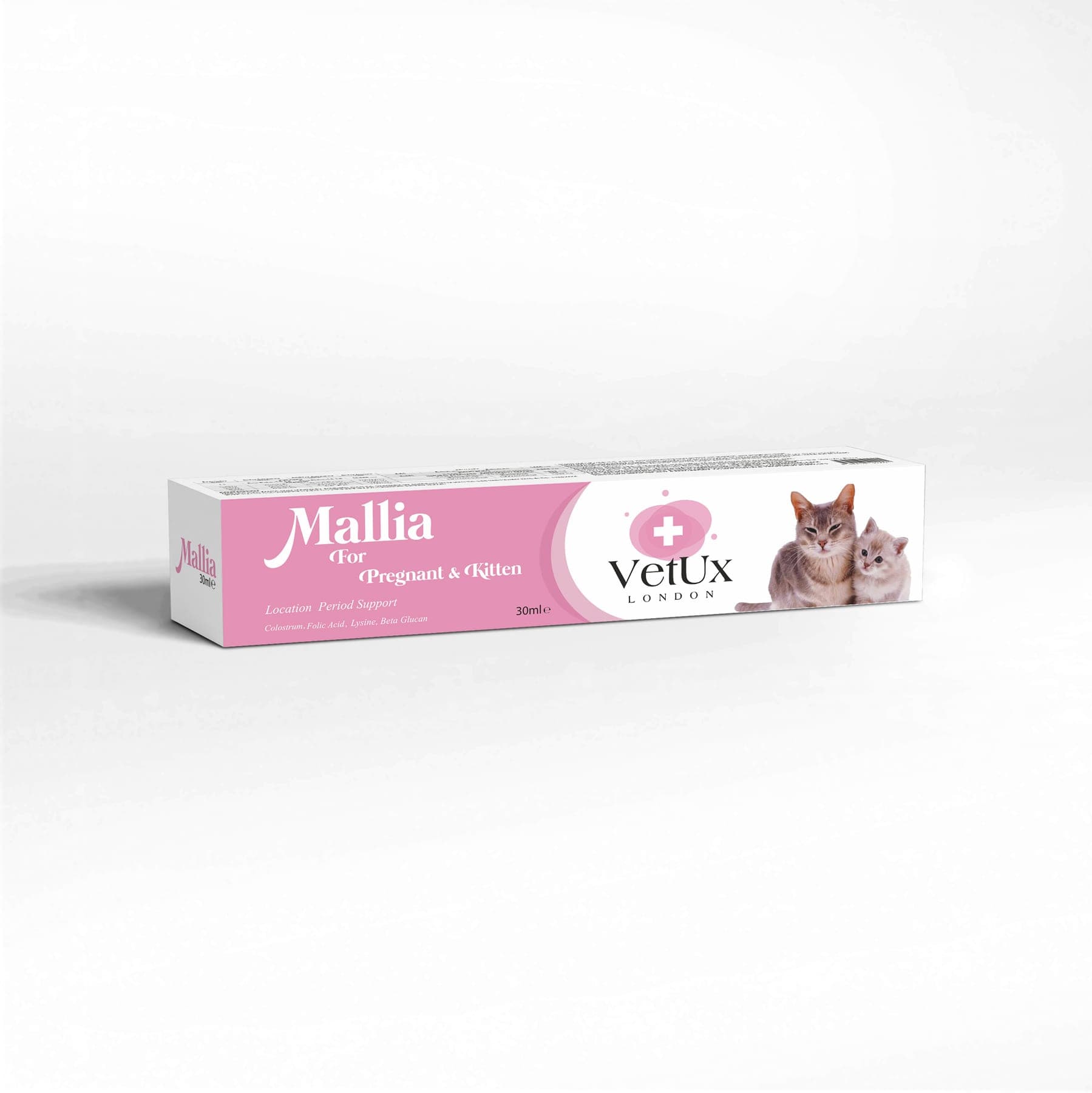
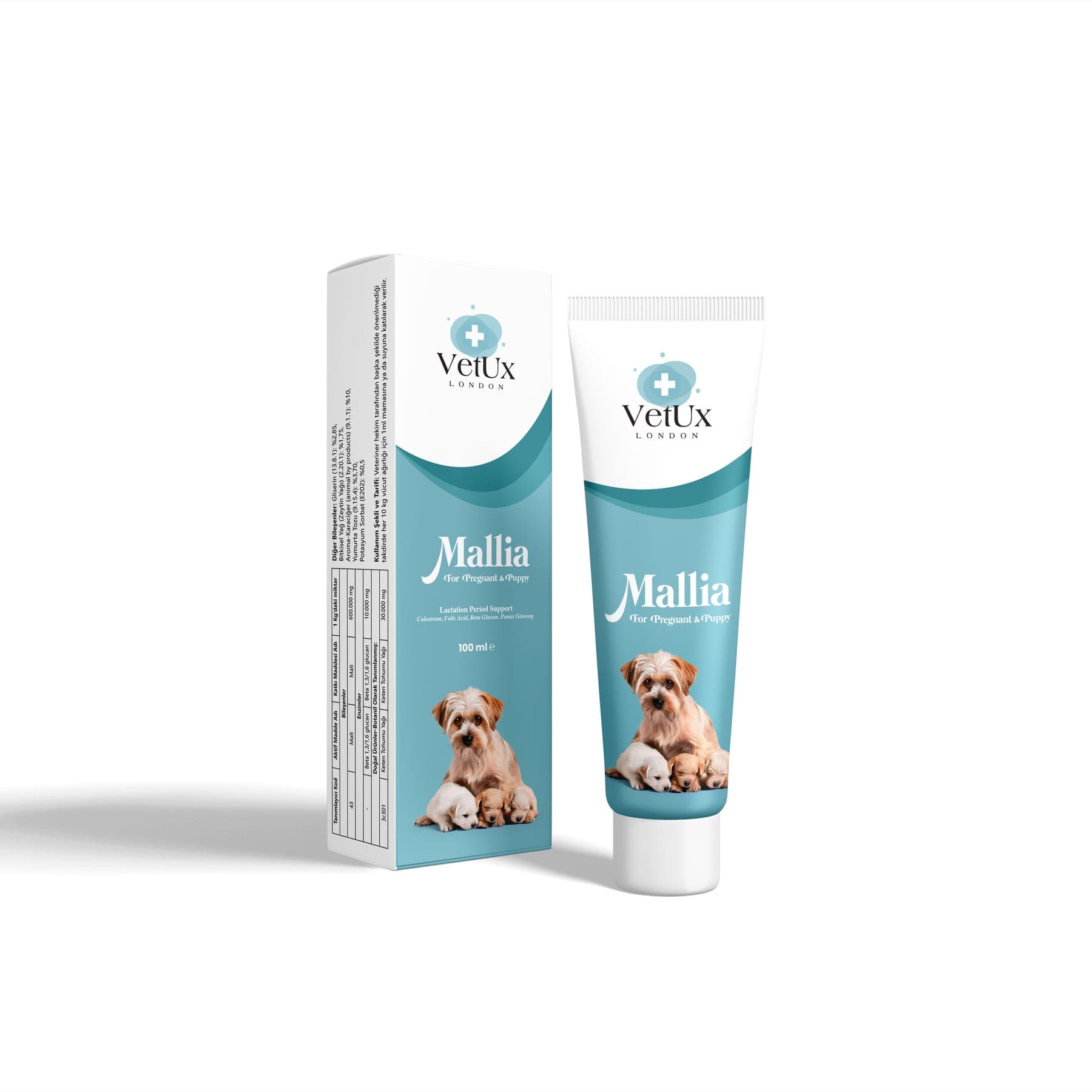
Mallia Pregnant Kitten (for cats) and Mallia Pregnant Puppy (for dogs) are complementary feeds in paste form, prepared to support the increased nutritional needs of pregnant and lactating animals. They do not replace the main diet; they accompany the feeding plan your vet recommends. Their formulation contains:
- Colostrum: As a natural source of immunoglobulins, it accompanies maternal health and the natural process of immune transfer; the effects of bovine colostrum added to the diet on immune function have been studied in dogs (Satyaraj et al., 2013). An important note: the young animal's passive immunity is gained by suckling its own mother's colostrum in the first hours; no complementary feed replaces that natural suckling.
- Folic acid (vitamin B9): A B vitamin involved in cell division and DNA synthesis; it gives nutritional support to the natural processes of cell development through pregnancy (Elwood and Colquhoun, 1997).
- Beta glucan 1,3-1,6: A natural polysaccharide that supports the normal function of the immune system (Stuyven et al., 2010).
- L-lysine: An essential amino acid that contributes to the natural processes of tissue protein synthesis.
- Panax ginseng, echinacea and garlic extracts: Botanical ingredients that accompany everyday resilience through a period of increased nutritional demand.
- Vitamins A, C and E: Contribute to meeting increased nutritional demand and to antioxidant balance.
For clarity: the Mallia formulation does not contain DHA (an omega-3 fatty acid) or dietary fibre; these nutrients should come from a complete and balanced main diet suitable for pregnant and lactating animals.
Mallia Pregnant Kitten and Mallia Pregnant Puppy are not medicines; they do not treat, cure or prevent any disease. Whether to use them during pregnancy and nursing, when to start and how much to give must be decided by your veterinary surgeon according to the condition of the mother and her litter. Assessing them together with the vitamins already present in the main diet is important, particularly for fat-soluble vitamins such as vitamin A.
Frequently Asked Questions
Within how many hours should a kitten or puppy receive colostrum?
The period in which the gut can pass antibodies intact into the blood is limited. Absorption is highest in the first hours after birth, and the intestinal barrier has largely closed within about 24 hours. That is why it matters that the young start suckling as soon as possible after birth. If a newborn is not suckling or seems weak, contact your vet without delay.
Can I give cow's milk to a youngster that cannot suckle from its mother?
No. The lactose, protein and fat composition of cow's milk differs clearly from cat and dog milk and can cause diarrhoea in the young. For orphaned young or those unable to suckle, a suitable milk replacer, feeding frequency and, where needed, how to manage a lack of colostrum should be decided by your veterinary surgeon.
Are soft stools normal in kittens and puppies during weaning?
Mild changes in stool consistency can occur during the move to solid food, as digestive enzymes and gut flora readjust. However, watery diarrhoea, bloody stools, vomiting, loss of appetite or weight loss are not normal. Because this period also coincides with the immunity gap as maternal antibodies fade, such signs need prompt veterinary assessment.
Can I give my pregnant cat or dog vitamin supplements on my own?
This is not advised. In pregnancy, an excess of some vitamins and minerals, particularly vitamins A and D and calcium, can pose risks to the mother and the foetuses. Whether a mother fed a complete and balanced diet needs additional support, and which product and how much is appropriate, can only be decided after a veterinary examination.
What is the difference between Mallia Pregnant Kitten and Mallia Pregnant Puppy?
Mallia Pregnant Kitten is formulated for cats and Mallia Pregnant Puppy for dogs. Both contain the same family of ingredients (colostrum, folic acid, beta glucan 1,3-1,6, L-lysine, Panax ginseng, echinacea and garlic extracts, and vitamins A, C and E) in different proportions. The product suited to the species should be used, and the decision to use it made with your vet.
Do Mallia products contain DHA or fibre, and do they replace the main diet?
No. The Mallia formulation does not contain DHA or dietary fibre; these nutrients should come from a complete and balanced main diet. Mallia products are complementary feeds; they do not replace the main diet or the diagnosis and treatment provided by your vet, and only accompany the feeding plan your vet recommends.
This article is for information only and does not replace veterinary examination, diagnosis or treatment. Consult your veterinary surgeon about every feeding and supplement decision during pregnancy and nursing.
Author: Vet. Hek. Metehan Çalıkuşu
References
- Casal ML, Jezyk PF, Giger U. Transfer of colostral antibodies from queens to their kittens. Am J Vet Res. 1996;57(11):1653-1658.
- Chastant-Maillard S, Freyburger L, Marcheteau E, Thoumire S, Ravier JF, Reynaud K. Timing of the intestinal barrier closure in puppies. Reprod Domest Anim. 2012;47(Suppl 6):190-193.
- Chastant-Maillard S, Aggouni C, Albaret A, Fournier A, Mila H. Canine and feline colostrum. Reprod Domest Anim. 2017;52(Suppl 2):148-152.
- Claus MA, Levy JK, MacDonald K, Tucker SJ, Crawford PC. Immunoglobulin concentrations in feline colostrum and milk, and the requirement of colostrum for passive transfer of immunity to neonatal kittens. J Feline Med Surg. 2006;8(3):184-191.
- Mila H, Feugier A, Grellet A, Anne J, Gonnier M, Martin M, Rossig L, Chastant-Maillard S. Inadequate passive immune transfer in puppies: definition, risk factors and prevention in a large multi-breed kennel. Prev Vet Med. 2014;116(1-2):209-213.
- Mila H, Grellet A, Feugier A, Chastant-Maillard S. Differential impact of birth weight and early growth on neonatal mortality in puppies. J Anim Sci. 2015;93(9):4436-4442.
- Day MJ. Immune system development in the dog and cat. J Comp Pathol. 2007;137(Suppl 1):S10-S15.
- Buddington RK, Elnif J, Malo C, Donahoo JB. Activities of gastric, pancreatic, and intestinal brush-border membrane enzymes during postnatal development of dogs. Am J Vet Res. 2003;64(5):627-634.
- Guard BC, Mila H, Steiner JM, Mariani C, Suchodolski JS, Chastant-Maillard S. Characterization of the fecal microbiome during neonatal and early pediatric development in puppies. PLoS One. 2017;12(4):e0175718.
- Grellet A, Chastant-Maillard S, Robin C, Feugier A, Boogaerts C, Boucraut-Baralon C, Grandjean D, Polack B. Risk factors of weaning diarrhea in puppies housed in breeding kennels. Prev Vet Med. 2014;117(1):260-265.
- Fontaine E. Food intake and nutrition during pregnancy, lactation and weaning in the dam and offspring. Reprod Domest Anim. 2012;47(Suppl 6):326-330.
- Lawler DF. Neonatal and pediatric care of the puppy and kitten. Theriogenology. 2008;70(3):384-392.
- Elwood JM, Colquhoun TA. Observations on the prevention of cleft palate in dogs by folic acid and potential relevance to humans. N Z Vet J. 1997;45(6):254-256.
- Stuyven E, Verdonck F, Van Hoek I, et al. Oral administration of beta-1,3/1,6-glucan to dogs temporally changes total and antigen-specific IgA and IgM. Clin Vaccine Immunol. 2010;17(2):281-285.
- Satyaraj E, Reynolds A, Pelker R, Labuda J, Zhang P, Sun P. Supplementation of diets with bovine colostrum influences immune function in dogs. Br J Nutr. 2013;110(12):2216-2221.
- National Research Council (NRC). Nutrient Requirements of Dogs and Cats. Washington, DC: The National Academies Press; 2006.
- FEDIAF. Nutritional Guidelines for Complete and Complementary Pet Food for Cats and Dogs. Brussels: FEDIAF; 2021.
Frequently asked questions
Within how many hours should a kitten or puppy receive colostrum?
The period in which the gut can pass antibodies intact into the blood is limited. Absorption is highest in the first hours after birth, and the intestinal barrier has largely closed within about 24 hours. That is why it matters that the young start suckling as soon as possible after birth. If a newborn is not suckling or seems weak, contact your vet without delay.
Can I give cow's milk to a youngster that cannot suckle from its mother?
No. The lactose, protein and fat composition of cow's milk differs clearly from cat and dog milk and can cause diarrhoea in the young. For orphaned young or those unable to suckle, a suitable milk replacer, feeding frequency and, where needed, how to manage a lack of colostrum should be decided by your veterinary surgeon.
Are soft stools normal in kittens and puppies during weaning?
Mild changes in stool consistency can occur during the move to solid food, as digestive enzymes and gut flora readjust. However, watery diarrhoea, bloody stools, vomiting, loss of appetite or weight loss are not normal. Because this period also coincides with the immunity gap as maternal antibodies fade, such signs need prompt veterinary assessment.
Can I give my pregnant cat or dog vitamin supplements on my own?
This is not advised. In pregnancy, an excess of some vitamins and minerals, particularly vitamins A and D and calcium, can pose risks to the mother and the foetuses. Whether a mother fed a complete and balanced diet needs additional support, and which product and how much is appropriate, can only be decided after a veterinary examination.
What is the difference between Mallia Pregnant Kitten and Mallia Pregnant Puppy?
Mallia Pregnant Kitten is formulated for cats and Mallia Pregnant Puppy for dogs. Both contain the same family of ingredients (colostrum, folic acid, beta glucan 1,3-1,6, L-lysine, Panax ginseng, echinacea and garlic extracts, and vitamins A, C and E) in different proportions. The product suited to the species should be used, and the decision to use it made with your vet.
Do Mallia products contain DHA or fibre, and do they replace the main diet?
No. The Mallia formulation does not contain DHA or dietary fibre; these nutrients should come from a complete and balanced main diet. Mallia products are complementary feeds; they do not replace the main diet or the diagnosis and treatment provided by your vet, and only accompany the feeding plan your vet recommends.
This article is for general information only; it does not replace veterinary examination, diagnosis or treatment. VetUx London products are complementary feed. If you have any concern about your companion, please consult your veterinary surgeon.
Share
The formulas matching the nutritional support described above.
Related articles
All articles Clinical Notes
Red Blood Cell Losses in Cats and Dogs: Bioavailability of Chelated Iron and Vitamin B12 Absorption
Why do red blood cell losses and anaemia of chronic disease cause lethargy in cats and dogs? Explore the hepcidin-ferroportin axis, the bioavailability of chelated iron and vitamin B12 (cobalamin) absorption, and the physiological principles of bone marrow erythropoiesis support.
 Clinical Notes
Hard Stools and Straining in Cats: The Peristaltic Power of Soluble and Insoluble Fibre
Why do cats develop hard stools and straining, and when does chronic constipation turn into a megacolon risk? This article covers the role of soluble and insoluble fibre in faecal bulk, water holding, peristalsis and the microbiota, plus the warning signs that need a veterinary surgeon.
 Clinical Notes
Vet Visits, Moving House and Fear of Thunder: The Neurological Power of L-Theanine and Tryptophan
Vet visits, moving house and thunder activate a cat's stress axis. How L-theanine and L-tryptophan relate to the GABA and serotonin systems, what the limited feline evidence shows, and practical steps at home. Diagnosis and treatment are for your veterinary surgeon.