
Vet Visits, Moving House and Fear of Thunder: The Neurological Power of L-Theanine and Tryptophan
Vet visits, moving house and thunder activate a cat's stress axis. How L-theanine and L-tryptophan relate to the GABA and serotonin systems, what the limited feline evidence shows, and practical steps at home. Diagnosis and treatment are for your veterinary surgeon.
Short answer: Cats respond strongly to unpredictable changes such as vet visits, moving house and thunderstorms, through their stress axis. L-theanine and L-tryptophan are amino acids linked to the GABA and serotonin systems, both associated with calmness, and are being studied for their role in supporting everyday calm through nutrition. Diagnosing and treating behavioural changes is the job of your veterinary surgeon.
Cat owners tend to describe the same scenes. The carrier comes out and the cat bolts under the bed. In a new home it hides for days. It trembles with every clap of thunder. None of this is "bad temper". It is the expected response of a nervous system tuned for survival. In this article we look at the biology behind it, where nutrition fits into the picture, and the steps you can take at home.
To be clear from the start: a change in your cat's behaviour may also have a medical cause. Making a diagnosis and planning treatment is the job of your veterinary surgeon. This article does not replace a veterinary examination.
Why are cats so sensitive to changes in their environment?
The cat is both predator and prey. Its sense of safety depends heavily on control and predictability: familiar scents, a stable territory and places to escape and hide. The AAFP/ISFM feline environmental needs guidelines stress that a healthy cat needs a safe place, separate key resources (food, water, litter tray, resting area), play, predictable social interaction and respect for its sense of smell [5]. Vet visits, moving house and loud noises upset this balance all at once.
What signs do vet visits, moving house and thunderstorms cause in cats?
Stress-related signs are often quiet and easy to miss [1]:
| Situation | Common signs | |---|---| | Vet visit | Avoiding the carrier, panting, hissing, freezing in the clinic, hiding after returning home | | Moving house / change in home routine | Hiding for days, reduced appetite, toileting outside the litter tray, overgrooming | | Thunder / fireworks | Trembling, dilated pupils, flattened ears, fleeing and hiding, vocalising |
These signs have a physiological counterpart. One study compared cats' readings at home with readings taken in the clinic and found that heart rate and blood pressure, among other parameters, rose significantly in the clinic setting [11]. Another reported that unusual external events, such as changes to feeding time, caretaker or surroundings, increased "sickness behaviours" such as vomiting, reduced appetite and toileting outside the litter tray, even in healthy cats [13].
How does stress work in a cat's body?
The stress axis: the hypothalamic–pituitary–adrenal (HPA) axis and the sympathetic system
When a cat perceives a threat, two systems switch on. The first is the fast sympathetic–adrenal medullary pathway: adrenaline and noradrenaline are released, the heart speeds up and muscle tone increases. The second is the slower HPA axis: the hypothalamus releases CRH, the pituitary releases ACTH, and finally the adrenal glands produce cortisol. Short-term stress is adaptive. Repeated or prolonged stress, however, can affect many systems, from appetite and immunity to digestion and the urinary tract [1].
GABA: the nervous system's "brake"
GABA (gamma-aminobutyric acid) is the main inhibitory neurotransmitter of the central nervous system. It keeps nerve cells from becoming overexcited. How strong a stress response is depends partly on the balance between excitatory glutamate signalling and inhibitory GABA signalling.
L-theanine is an amino acid found naturally in the tea plant (Camellia sinensis) and is structurally similar to glutamate. Rodent studies have reported central depressant effects of L-theanine [8] and effects on brain monoamine levels (serotonin, dopamine) and striatal dopamine release [14]. Reviews list its relationship with brain GABA levels and its weak interaction with glutamate receptors among the possible mechanisms [7, 10]. These findings come largely from rodent models. The mechanism in the feline brain has not been shown directly, so the accurate wording is that it "is associated with GABAergic and monoaminergic balance", not that it "directly activates GABA receptors".
Serotonin and tryptophan: a building block of mood
L-tryptophan is the only amino acid precursor of serotonin (5-hydroxytryptamine). Serotonin synthesis in the brain responds to how much tryptophan reaches it. Classic studies showed that plasma tryptophan levels directly influence brain serotonin content [6]. To cross the blood–brain barrier, tryptophan competes for the same transporter with the other large neutral amino acids (LNAAs: leucine, isoleucine, valine, phenylalanine, tyrosine). This means the overall amino acid profile of the diet also affects how much tryptophan reaches the brain [2]. Serotonin is a neurotransmitter associated with mood, the sleep–wake cycle and impulse control.
What do we know about L-theanine and tryptophan in cats?
Feline research is limited but informative:
- L-theanine: In an open-label field study without a control group, cats given L-theanine tablets showed a reduction in stress-related emotional signs as observed by their owners [4]. Because there was no placebo group, the results should be interpreted with caution.
- Tryptophan: In laboratory cats, a diet supplemented with alpha-casozepine and L-tryptophan was associated with favourable differences in some measures of fear and anxiety [9]. Because the formula contained both ingredients, the effect cannot be attributed to tryptophan alone.
In short, these amino acids are scientifically interesting candidates for supporting everyday calm through nutrition. They are not a solution on their own, however, and should be considered alongside environmental management and veterinary assessment.
Is there a link between stress and the lower urinary tract?
In cats, stress affects not only behaviour but also the lower urinary tract. The literature reports that stressful events are associated with signs such as toileting outside the litter tray [13], and that environmental modification has been evaluated in the management of cats with lower urinary tract signs [3]. If your cat visits the litter tray frequently, strains, or you see blood in the urine, do not wait: contact your veterinary surgeon. Being unable to pass urine is an emergency, especially in male cats.
What is in the formula of Elixir of Urinary & Relax?
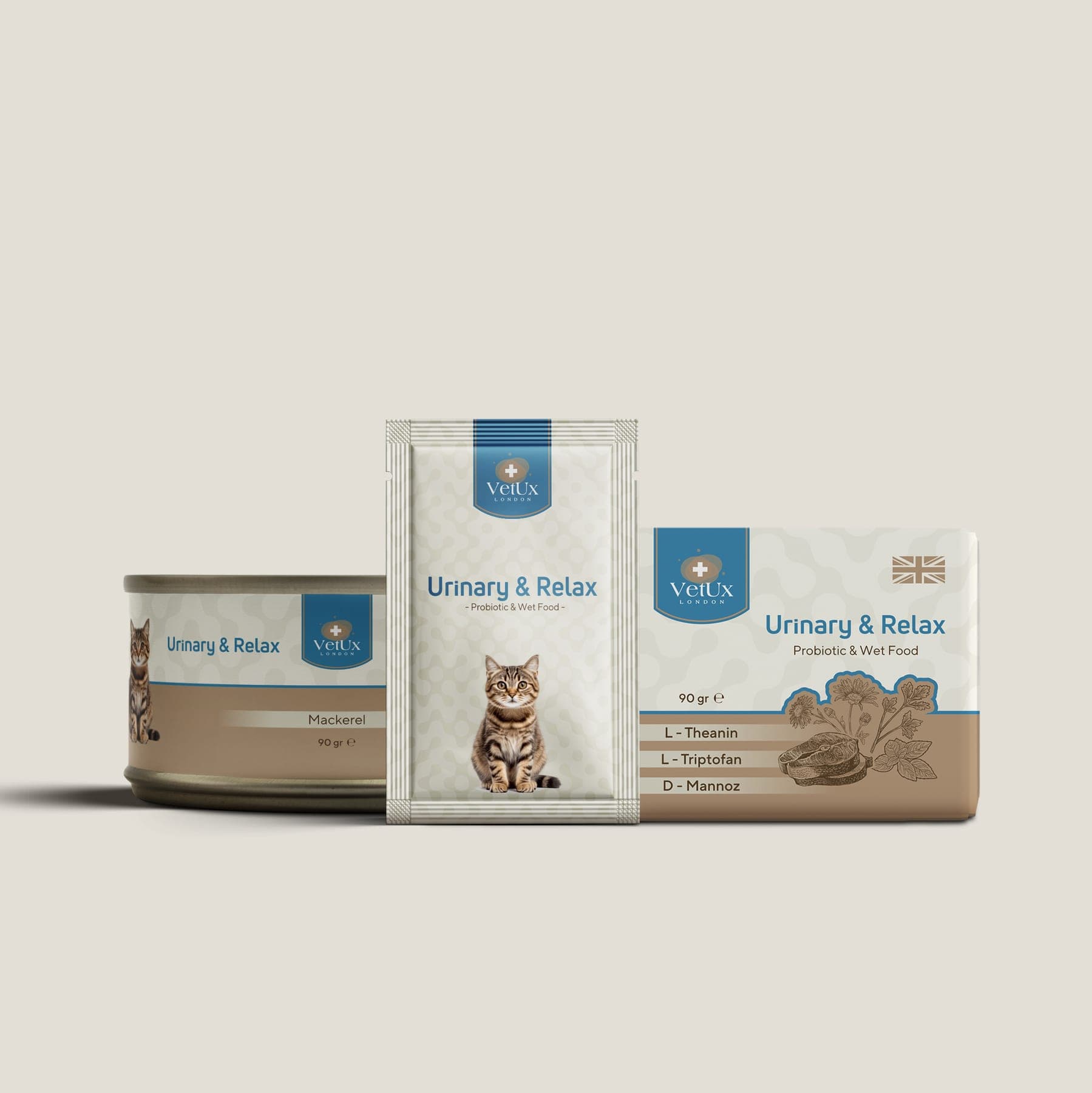
Elixir of Urinary & Relax is a probiotic wet food and sachet combination prepared for cats. The ingredients listed in its product record are:
- L-Theanine and L-Tryptophan: support everyday calm and comfort.
- *Cranberry (Vaccinium macrocarpon), D-Mannose and live probiotic cultures:* contribute to maintaining lower urinary tract health and a normal urinary pH balance.
- A *mackerel (Scomber scombrus)*-based, gluten-free recipe with controlled protein.
- High moisture content and a balanced mineral profile: increase daily fluid intake and support normal urine production.
The product is a complementary feed. It is not intended to diagnose, treat or prevent any disease. It accompanies the care recommended by your veterinary surgeon. The daily amount depends on your cat's weight and energy needs and should be decided together with your veterinary surgeon. If your cat is on a specific diet, do not change it without consulting your vet. Plan any switch to a new food gradually and complete it before a stressful event.
What can owners do during stressful periods?
Before a vet visit [12]:
- Leave the carrier out at home as part of the furniture, with a blanket that carries your cat's scent.
- Practise short, rewarded "into the carrier" sessions. Cover the carrier lightly with a cloth during travel.
- Where possible, book appointments at quieter times at the clinic.
When moving house [5]:
- For the first few days, settle your cat in a single "safe room" with food, water, a litter tray and a hiding place.
- Move familiar blankets, beds and toys to the new home in advance.
- Provide high perches and hiding spots, and let your cat explore the home gradually.
During thunder and fireworks:
- Prepare a hiding corner in an interior room away from windows, and do not block your cat from hiding.
- Do not force your cat to be held. Staying calm and behaving normally sends the best signal.
- Close the curtains and keep household sounds at their usual level.
At all times: Keep feeding, play and cleaning routines as consistent as possible. Predictability is one of the most powerful calming factors for cats.
When should you contact your veterinary surgeon?
- Loss of appetite lasting more than a day
- Toileting outside the litter tray, frequent urination, straining or blood in the urine
- Hair loss or skin lesions from overgrooming
- A sudden increase in aggression, or hiding for days
These signs may be caused by pain, urinary tract problems or another systemic illness. Only a veterinary surgeon can make the differential diagnosis.
Conclusion
Vet visits, moving house and thunder are powerful triggers of a cat's stress axis. The GABA and serotonin systems help keep this response in balance, and L-theanine and L-tryptophan are amino acids being studied for their role in supporting everyday calm through nutrition. Even so, the most effective approach is a holistic one: a predictable environment, cat-friendly carrying and handling habits, and complementary nutrition where appropriate. Diagnosing and treating behavioural changes is always the job of your veterinary surgeon. If you notice a new or persistent change in your cat, consult your vet first.
References
- 1Amat M, Camps T, Manteca X. Stress in owned cats: behavioural changes and welfare implications. J Feline Med Surg. 2016;18(8):577-586. doi:10.1177/1098612X15590867
- 2Bosch G, Beerda B, Hendriks WH, van der Poel AFB, Verstegen MWA. Impact of nutrition on canine behaviour: current status and possible mechanisms. Nutr Res Rev. 2007;20(2):180-194. doi:10.1017/S095442240781331X
- 3Buffington CAT, Westropp JL, Chew DJ, Bolus RR. Clinical evaluation of multimodal environmental modification (MEMO) in the management of cats with idiopathic cystitis. J Feline Med Surg. 2006;8(4):261-268. doi:10.1016/j.jfms.2006.02.002
- 4Dramard V, Kern L, Hofmans J, Rème CA, Nicolas CS, Chala V, et al. Effect of l-theanine tablets in reducing stress-related emotional signs in cats: an open-label field study. Ir Vet J. 2018;71:21. doi:10.1186/s13620-018-0130-4
- 5Ellis SLH, Rodan I, Carney HC, Heath S, Rochlitz I, Shearburn LD, et al. AAFP and ISFM feline environmental needs guidelines. J Feline Med Surg. 2013;15(3):219-230. doi:10.1177/1098612X13477537
- 6Fernstrom JD, Wurtman RJ. Brain serotonin content: physiological dependence on plasma tryptophan levels. Science. 1971;173(3992):149-152. doi:10.1126/science.173.3992.149
- 7Kakuda T. Neuroprotective effects of theanine and its preventive effects on cognitive dysfunction. Pharmacol Res. 2011;64(2):162-168. doi:10.1016/j.phrs.2011.03.010
- 8Kimura R, Murata T. Influence of alkylamides of glutamic acid and related compounds on the central nervous system. I. Central depressant effect of theanine. Chem Pharm Bull. 1971;19(6):1257-1261. doi:10.1248/cpb.19.1257
- 9Landsberg G, Milgram B, Mougeot I, Kelly S, de Rivera C. Therapeutic effects of an alpha-casozepine and L-tryptophan supplemented diet on fear and anxiety in the cat. J Feline Med Surg. 2017;19(6):594-602. doi:10.1177/1098612X16669399
- 10Nathan PJ, Lu K, Gray M, Oliver C. The neuropharmacology of L-theanine (N-ethyl-L-glutamine): a possible neuroprotective and cognitive enhancing agent. J Herb Pharmacother. 2006;6(2):21-30. doi:10.1080/J157v06n02_02
- 11Quimby JM, Smith ML, Lunn KF. Evaluation of the effects of hospital visit stress on physiologic parameters in the cat. J Feline Med Surg. 2011;13(10):733-737. doi:10.1016/j.jfms.2011.07.003
- 12Rodan I, Dowgray N, Carney HC, Carozza E, Ellis SLH, Heath S, et al. 2022 AAFP/ISFM Cat Friendly Veterinary Interaction Guidelines: Approach and Handling Techniques. J Feline Med Surg. 2022;24(11):1093-1132. doi:10.1177/1098612X221128760
- 13Stella JL, Lord LK, Buffington CAT. Sickness behaviors in response to unusual external events in healthy cats and cats with feline interstitial cystitis. J Am Vet Med Assoc. 2011;238(1):67-73. doi:10.2460/javma.238.1.67
- 14Yokogoshi H, Kobayashi M, Mochizuki M, Terashima T. Effect of theanine, r-glutamylethylamide, on brain monoamines and striatal dopamine release in conscious rats. Neurochem Res. 1998;23(5):667-673. doi:10.1023/A:1022490806093
Frequently asked questions
How can I tell whether my cat is stressed or unwell?
Hiding, reduced appetite and toileting outside the litter tray can be signs of stress as well as of many illnesses. You cannot tell them apart at home. Diagnosis and treatment are the job of your veterinary surgeon, and if the signs persist, an examination should not be delayed.
Will L-theanine and tryptophan make my cat drowsy?
These amino acids are studied as natural components of the diet. The aim is to support everyday calm physiologically, not to cause sedation. If you notice a marked change in your cat's energy levels, consult your veterinary surgeon.
How long before a stressful event should I start a complementary feed?
A switch to a new food should be gradual and completed before the stressful event, so that the change of food does not become another source of stress. Agree the daily amount and the transition plan with your veterinary surgeon based on your cat's needs.
Will Elixir of Urinary & Relax get rid of my cat's fear?
No. It is a complementary feed and does not treat any behavioural problem or disease. It is a nutritional option that supports everyday calm and lower urinary tract health. Assessing, diagnosing and treating signs of fear and anxiety is the job of your veterinary surgeon.
Does comforting my cat during a thunderstorm reinforce its fear?
Letting your cat come to you and staying calm yourself is fine. What matters is not to restrain it, to respect its hiding place and to keep your own behaviour normal.
This article is for general information only; it does not replace veterinary examination, diagnosis or treatment. VetUx London products are complementary feed. If you have any concern about your companion, please consult your veterinary surgeon.
Share
The formulas matching the nutritional support described above.
Related articles
All articles Clinical Notes
Feeding Pets That Have Recovered from Acute Pancreatitis: Precautions for Exocrine Pancreatic Insufficiency
Why does digestive load matter after a cat or dog recovers from acute pancreatitis, and which signs of exocrine pancreatic insufficiency should owners watch for? This article covers the mechanisms, feeding principles and the central role of veterinary follow-up.
 Clinical Notes
Diabetes Management in Cats and Dogs: Botanical and Nutritional Supports Slowing Carbohydrate Absorption
Blood glucose fluctuations, insulin resistance, and postprandial glycemic control in cats and dogs. Bitter melon, gymnema, chromium picolinate, and Elixir of Diabetic for cellular glycemic balance.
 Clinical Notes
Feline Hyperthyroidism vs Canine Hypothyroidism: Balancing Metabolic Harmony
Weight loss with voracious appetite in geriatric cats versus lethargy and weight gain in aging dogs. Understanding thyroid endocrine balance, L-carnitine, selenium, and Thyrovet support.