

Caring for Your Cat After Neutering: A Checklist for the First 10 Days
The first 10 days after neutering are the most important stage of recovery. A step-by-step checklist covering the collar, wound checks, the first meal, weight gain and the signs that mean it's time to see your vet.
Quick answer: For the first 10 days after neutering, keep the protective collar on, check the wound site every day, restrict activity and offer small, regular meals. Balanced nutrition during convalescence and keeping an eye on weight are part of the routine too. If you notice discharge, swelling, the wound opening or loss of appetite, contact your veterinary surgeon promptly.
Neutering is one of the most common surgical procedures in cats, but "common" does not mean "nothing to think about". How the first 10 days at home go matters as much as the operation itself. This guide walks you through what to watch for during that time. Your cat's individual instructions always come first: diagnosis and treatment decisions belong to your veterinary surgeon.
How should you prepare your home for your cat's return?
Until the anaesthetic has fully worn off, your cat may be wobbly, sleepy and less interested in their surroundings than usual. For those first hours:
- Choose a quiet, warm, draught-free room. Set the bed low to the ground, and don't place your cat right next to a heat source.
- Block access to high places. Sofa backs, windowsills and the tops of cupboards should be off-limits for the first days. If your vet recommends it, use a large crate or a confined area of a room.
- Keep other pets apart. Play and scuffles put unwanted tension on the wound site.
- Put the litter tray nearby. Choose a low-sided, easy-access tray with dust-free litter.
Why does the protective collar matter so much?
A cat's tongue is rough. A few minutes of licking can loosen stitches, irritate the wound edges and soil the area. The protective collar should therefore stay on day and night until your vet tells you it can come off.
- It is normal for a cat to walk backwards or bump the collar into furniture at first; most adapt quickly.
- Swap food and water bowls for shallow ones your cat can reach comfortably while wearing the collar.
- If your cat really cannot cope with the collar, don't take it off on your own. Ask your vet about alternatives such as a recovery suit.
How should you check the wound site?
In female cats the incision is usually on the midline of the abdomen or on the flank. Male cats usually have small incisions on the scrotum, which may be left without stitches. With some techniques the stitches sit under the skin and can't be seen. Ask your vet which method was used.
- Look twice a day in good light. Take a photo from the same angle each time; comparing photos over several days is far easier than spotting a change at a glance.
- What you may expect: In the first days the wound edges may look slightly pink and a little raised. Both should settle over the following days.
- What not to do: Unless your vet advises it, don't wipe or try to clean the wound. Don't apply creams, ointments, powder, alcohol or hydrogen peroxide. Don't bathe your cat or let the area get wet.
When and how should you give the first meal after surgery?
Anaesthesia can make some cats nauseous. Time the first meal according to your vet's instructions and offer a small part of a normal meal of the food your cat is used to. If there is no vomiting, gradually return to normal portions over the next meals. Fresh water should always be available.
Don't switch to a new food now; it adds strain on digestion. A poor appetite on the first evening is common. However, if your cat is still not eating at all the day after surgery, call your vet. In cats, going without food for a prolonged period can set the stage for a serious condition involving fat build-up in the liver (hepatic lipidosis).
How does tissue repair after surgery, and why do nutritional needs rise?
Closing a surgical incision is a biological process that moves through four overlapping phases:
- 1Haemostasis: In the first minutes and hours, a blood clot temporarily seals the incision and provides a scaffold for repair.
- 2Inflammation: Over the first few days, immune cells clear the area. This is why mild pinkness and swelling appear.
- 3Proliferation: Fibroblasts lay down new collagen, small blood vessels form and the wound edges are covered by epithelium. This phase becomes noticeable towards the end of the first week.
- 4Remodelling: Over weeks and months, collagen fibres are reorganised and the tissue gradually gains strength against tension.
One key point: even when the skin surface looks closed, the tissue underneath has not yet reached full strength. That is why jumping and running are restricted in the early days.
Each of these phases needs raw materials and energy. Surgical stress raises cortisol and catecholamine levels; protein synthesis and breakdown speed up, and energy and protein requirements rise. Collagen formation depends on amino acids such as lysine and proline, and on vitamin C, which acts as a cofactor when these amino acids are hydroxylated. Cats can make their own vitamin C, but nutritional balance still matters when demand goes up.
Cats are obligate carnivores. The liver enzymes that break down amino acids don't adapt to a low protein intake the way they do in dogs, so even when a cat eats less, the body keeps using up protein. Arginine is also an essential amino acid for cats: it must come from the diet for the urea cycle to work and for ammonia to be cleared from the body. Methionine, a sulphur-containing amino acid, plays a role in protein synthesis. Vitamin E contributes to the oxidative balance of cells, and vitamin B1 (thiamine) to energy metabolism.
In practice, a good-quality, balanced diet covers most of these needs in a healthy young cat. The challenge comes when appetite drops during convalescence just as demand rises. How to bridge that gap is for your vet to assess.
Why do neutered cats tend to gain weight?
Once reproductive hormones are removed, two changes happen together: appetite tends to increase while energy requirements decrease. Research suggests that increased food intake plays the leading role in weight gain after neutering. Excess weight, in turn, is a risk factor for conditions such as diabetes and joint problems later in life.
It is important to get the balance right. The first 10 days are not a time for dieting; adequate nutrition for tissue repair comes first. But this period is a good time to lay the groundwork for weight control:
- Weigh food on kitchen scales rather than measuring by eye.
- Keep treats to a minimum.
- At the check-up, weigh your cat and discuss a food and portion plan suited to a neutered cat with your vet.
What does the first-10-days checklist look like?
Day 0 — The evening you come home
- Quiet, warm room ready; high places blocked
- Collar on
- Water available; first small meal at the time your vet advised
- Any medication given exactly as written. Painkillers made for people are seriously dangerous to cats, so never give them.
Days 1–3
- Check the wound site morning and evening and take a photo
- Note eating, drinking, urination and bowel habits
- If there is still no appetite the day after surgery, call your vet
- No contact with other pets, no jumping
Days 4–7
- As energy returns, the urge to jump grows, so keep restricting activity
- Collar stays on; no bathing
- Clean the litter tray often
- Move to measured feeding for weight (measuring, not dieting)
Days 8–10
- Check-up: wound check or stitch removal on the date your vet set
- The decision to remove the collar and return to normal activity rests with your vet
- Weigh-in and a long-term feeding plan
When should you see your veterinary surgeon?
Contact your vet without delay if you notice any of the following:
- Ongoing oozing from the wound, or cloudy, dark or foul-smelling discharge
- Swelling that increases, hardens or feels warm, or redness that spreads
- Wound edges pulling apart, a broken stitch or tissue visible at the incision (urgent)
- Loss of appetite that continues the day after surgery, or repeated vomiting
- Worsening lethargy, hiding, obvious pain when touched, pale gums or rapid breathing
- Being unable to pass urine, or straining to do so
- The collar coming off and the wound being licked or chewed
Working out the cause of these signs and planning treatment is your veterinary surgeon's job. Don't wait it out at home or try to intervene based on advice found online.
Which products can accompany care during convalescence?
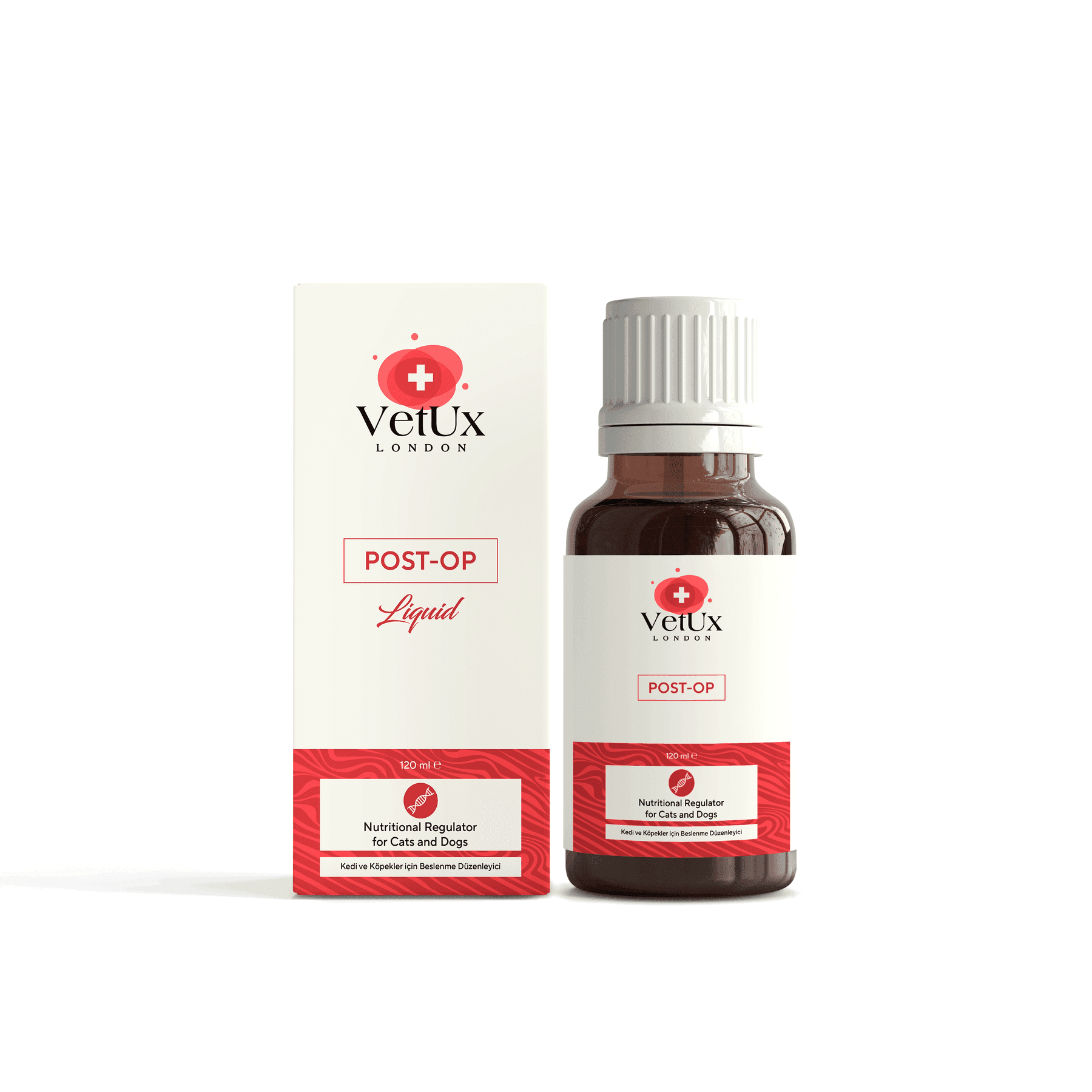
For cats with a reduced appetite or loss of condition after surgery, Post-Op Liquid is a liquid complementary feed developed to support the increased nutritional needs of convalescence. With L-lysine, DL-methionine and L-arginine it gives nutritional support to the natural processes of tissue renewal. Beta 1,3/1,6 glucan, propolis and echinacea accompany the body's natural defences; turmeric and milk thistle extracts accompany normal liver function. Vitamins C, E and B1 support normal energy metabolism. For the everyday care of the skin surface there are two creams for external use: ScarOut Day, whose light texture suits daytime use, and ScarOut Night, whose richer texture forms a covering layer through the night. In both creams, clinoptilolite and zinc oxide keep the surface protected, while Centella asiatica extract with D-panthenol accompanies the natural process of collagen formation and the moisture balance of the skin. Chlorhexidine gluconate and rivanol contribute to surface hygiene, and St John's wort oil with vitamins C and E accompanies the comfort of skin that has become reactive. These products do not replace veterinary care. Whether to use them, and when and how much, is for your veterinary surgeon to decide. In particular, whether the creams should be applied to a fresh incision line or to an open wound must be decided only on your vet's assessment.
Frequently asked questions
How long should the collar stay on? Until your vet tells you it can come off; this is usually assessed at the check-up. Even if the wound looks closed, the tissue underneath is not yet fully strong. Don't remove the collar on your own initiative.
Can I put cream or ointment on the stitches? Not unless your vet advises it. Whether any product should be applied to the incision line, and when, is for your veterinary surgeon to decide.
When can my cat eat after surgery? Your vet will set the time of the first meal; usually you start with a small portion of the food your cat is used to. If your cat still eats nothing at all the day after surgery, call your vet.
Why do neutered cats gain weight? Hormonal change makes appetite tend to rise while energy needs fall. The first 10 days are not a time for dieting, but starting measured feeding and agreeing a long-term plan with your vet at the check-up lays the groundwork for weight control.
When can my cat jump and play again? A return to normal activity should follow your vet's approval after the check-up. Until then, restrict jumping and rough play.
Does my cat need a supplement after surgery? For a healthy cat, a balanced diet is the foundation. If appetite drops or condition is lost, your veterinary surgeon will assess whether additional nutritional support is needed.
References
- 1Griffin B, Bushby PA, McCobb E, et al. The Association of Shelter Veterinarians' 2016 Veterinary Medical Care Guidelines for Spay-Neuter Programs. J Am Vet Med Assoc. 2016;249(2):165-188.
- 2Freeman L, Becvarova I, Cave N, et al. WSAVA Nutritional Assessment Guidelines. J Small Anim Pract. 2011;52(7):385-396.
- 3Guo S, DiPietro LA. Factors affecting wound healing. J Dent Res. 2010;89(3):219-229.
- 4Zoran DL. The carnivore connection to nutrition in cats. J Am Vet Med Assoc. 2002;221(11):1559-1567.
- 5Morris JG, Rogers QR. Arginine: an essential amino acid for the cat. J Nutr. 1978;108(12):1944-1953.
- 6Kanchuk ML, Backus RC, Calvert CC, Morris JG, Rogers QR. Weight gain in gonadectomized normal and lipoprotein lipase-deficient male domestic cats results from increased food intake and not decreased energy expenditure. J Nutr. 2003;133(6):1866-1874.
- 7Fettman MJ, Stanton CA, Banks LL, et al. Effects of neutering on bodyweight, metabolic rate and glucose tolerance of domestic cats. Res Vet Sci. 1997;62(2):131-136.
- 8Center SA. Feline hepatic lipidosis. Vet Clin North Am Small Anim Pract. 2005;35(1):225-269.
Every cat's surgery, stitching technique and pace of recovery is different; this list is a general guide. For a care plan tailored to your cat and for any questions you have, please consult your veterinary surgeon.
Frequently asked questions
How long should the collar stay on?
Until your vet tells you it can come off; this is usually assessed at the check-up. Even if the wound looks closed, the tissue underneath is not yet fully strong. Don't remove the collar on your own initiative.
Can I put cream or ointment on the stitches?
Not unless your vet advises it. Whether any product should be applied to the incision line, and when, is for your veterinary surgeon to decide.
When can my cat eat after surgery?
Your vet will set the time of the first meal; usually you start with a small portion of the food your cat is used to. If your cat still eats nothing at all the day after surgery, call your vet.
Why do neutered cats gain weight?
Hormonal change makes appetite tend to rise while energy needs fall. The first 10 days are not a time for dieting, but starting measured feeding and agreeing a long-term plan with your vet at the check-up lays the groundwork for weight control.
When can my cat jump and play again?
A return to normal activity should follow your vet's approval after the check-up. Until then, restrict jumping and rough play.
Does my cat need a supplement after surgery?
For a healthy cat, a balanced diet is the foundation. If appetite drops or condition is lost, your veterinary surgeon will assess whether additional nutritional support is needed.
This article is for general information only; it does not replace veterinary examination, diagnosis or treatment. VetUx London products are complementary feed. If you have any concern about your companion, please consult your veterinary surgeon.
Share
The formulas matching the nutritional support described above.


Related articles
All articles Clinical Notes
Liver Health in Cats and Dogs: A Guide to Enzymes, Signs and Nutrition
What do the liver values on a blood test mean, which signs are urgent and how should your pet be fed? An evidence-based guide to liver health for cat and dog owners.
 Clinical Notes
Cat and Dog Joint Health Guide: Signs, Weight and Movement
Struggling to get up, avoiding the stairs or a cat that no longer jumps up high can be quiet signs of joint problems. This guide covers the signs, how weight affects the joints and the right kind of movement.
 Clinical Notes
Shedding in Cats: How to Tell Seasonal Moulting from Problem Hair Loss
Shedding in cats is usually seasonal, but bald patches, redness and itching can point to an underlying cause. This guide explains how to tell the two apart and when to see your veterinary surgeon.