

How to Choose a Dog Joint Supplement: Glucosamine, Chondroitin and What to Check on the Label
Which amounts, glucosamine form and weight-based usage information should you check on the label when choosing a joint supplement for your dog? The role of glucosamine and chondroitin in cartilage, the strength of the evidence, how long to wait before judging results, and why dogs on medication need vet approval.
Short answer: A good dog joint supplement is labelled as a "complementary feed", states the per-tablet amount of every ingredient separately, and gives a form and usage information that fit your dog's body weight. Glucosamine and chondroitin accompany the natural physiology of cartilage; judging the result takes weeks of regular use. If your dog is on medication, get your veterinary surgeon's approval first.
Shelves, websites and clinic displays hold dozens of joint supplements; the packs look alike and the promises are often bold. This article follows on from our Cat and Dog Joint Health Guide, where we covered signs, weight management and movement. Here we focus on one question: what should you look for when choosing a joint supplement for your dog?
Let us be clear from the start: finding the cause of limping, stiffness or reluctance to move, and planning treatment, is the job of your veterinary surgeon. A supplement does not replace that plan; where your vet considers it appropriate, it accompanies it.
What does a joint supplement do, and what does it not do?
In European and Turkish legislation, joint supplements are mostly classed as complementary feeds. They are not medicines; they are not designed to diagnose, treat or cure disease. Their role is to give nutritional support to the normal physiological function of joint tissue.
In practice this means:
- A supplement does not replace the medicines, physiotherapy or weight programme your vet recommends.
- Phrases such as "relieves pain" or "treats arthritis" should not appear on a complementary feed label; if you see them, treat it as a warning sign.
- The strongest foundation for joint health is still an ideal body weight and regular, controlled exercise. A long-term study showed that lifelong controlled feeding in dogs was associated with a later onset of joint changes (Kealy et al., 2002).
What do glucosamine and chondroitin do in cartilage?
Cartilage structure in brief
The cartilage covering joint surfaces has no blood vessels or nerves. Its relatively few cells (chondrocytes) secrete collagen fibres and large, water-binding molecules called proteoglycans. Type II collagen gives cartilage tensile strength, while proteoglycans bind water so the tissue can flex like a sponge under load. Hyaluronic acid in the synovial fluid contributes to lubrication and viscosity.
Glucosamine
Glucosamine is an amino sugar and a precursor used in building glycosaminoglycan chains (the side chains of proteoglycans, and hyaluronic acid). Laboratory studies have observed effects linked to chondrocyte metabolism and to the balance between building and breakdown of the cartilage matrix. It is known to be absorbed when given by mouth, but how much reaches joint tissue, and how far this translates into clinical benefit, is still debated.
Chondroitin sulphate
Chondroitin sulphate is the most abundant glycosaminoglycan in aggrecan, the main proteoglycan of cartilage, and is central to the tissue's water-holding capacity. Its oral absorption varies with molecular size and with the raw-material source (bovine, porcine, chicken or marine). That is why it is useful when a label states the source.
Other ingredients often found in formulas
- MSM (methylsulfonylmethane): an organic sulphur source; evidence in dogs is limited.
- Type II collagen and hyaluronic acid: natural components of cartilage and synovial fluid; small-scale studies exist in dogs.
- Boswellia serrata and turmeric (Curcuma longa): plants with a long history in phytotherapy. The oral bioavailability of their active compounds (boswellic acids, curcuminoids) is low, and controlled studies in dogs are few.
- Vitamin C: acts as a cofactor in the natural process of collagen formation.
- Vitamin D3: accompanies calcium metabolism. If your dog takes other vitamin supplements, total intake should be reviewed with your vet.
What does the evidence say? An honest summary
The question owners ask most is "Does it actually work?" The scientific picture is as follows:
- Systematic reviews of nutritional supplements in dogs and cats rated the evidence for glucosamine–chondroitin as low to moderate; most studies are small and methodologically limited (Vandeweerd et al., 2012; Comblain et al., 2016).
- A 2022 meta-analysis reported that the most consistent evidence in joint nutrition is for omega-3-enriched diets, while glucosamine–chondroitin combinations did not show a consistent effect on pain-related outcomes (Barbeau-Grégoire et al., 2022).
- In a randomised, double-blind dog study, the change in clinical scores in the glucosamine–chondroitin group only became clear over a few months, at around day 70 (McCarthy et al., 2007).
- In terms of safety, glucosamine and chondroitin are reported to be generally well tolerated in dogs, with mild digestive signs the most commonly reported side effect (Bhathal et al., 2017).
- The AAHA (2022) and WSAVA (2022) pain management guidelines treat such supplements not as a stand-alone solution but as a possible complement within a multimodal plan managed by the vet.
In short: glucosamine and chondroitin have a biologically meaningful link with cartilage physiology, but the clinical evidence is modest. The right expectation is "nutritional support for joint function", not a miracle.
What should you check on the label?
We covered general label-reading rules in How to Read a Supplement Label. Here is the checklist specific to joint supplements:
- 1Product class: the words "complementary feed" and the target species ("for dogs") should be clearly stated.
- 2Amount per ingredient: the amount of each active ingredient per tablet, chew or scoop should be listed separately. Labels that give only a total under a "proprietary blend" heading stop you seeing what your dog actually receives.
- 3Form of glucosamine: "glucosamine sulphate" and "glucosamine hydrochloride" deliver different proportions of glucosamine at the same weight. If the form is not stated, two products cannot be compared.
- 4Source of chondroitin: it may be bovine, porcine, chicken or marine; this matters for dogs with food sensitivities. Glucosamine is also often derived from shellfish.
- 5What the amount refers to: per tablet or per daily serving? Is there a weight-based usage table, and is it written for dogs?
- 6Excipients and flavourings: xylitol, which can be found in human products, is toxic to dogs. Do not give your dog a joint product made for people.
- 7Manufacturer details, batch number and expiry date: these should be legible; keep the pack for as long as you use the product.
- 8Exaggerated claims: wording such as "treats", "cures" or "works like a medicine" is not permitted on a complementary feed and calls the product's seriousness into question.
Which form suits your dog's body weight?
Usage amounts for joint supplements are almost always linked to body weight, which directly affects the choice of form:
- Small breeds: tablet size, whether it can be split, and palatability all matter. Check whether the usage table covers low body weights.
- Medium and large breeds: if a product family offers forms with different per-tablet content, the higher-content form may keep daily giving practical for a large dog.
- Acceptance and ease of giving: forms that can be given with food or directly by mouth make long-term regular use easier. Consistency is decisive with joint supplements.
Which form to use, and how much, should be decided by your veterinary surgeon, taking into account your dog's current weight, age, kidney and liver status and any medicines. When weight changes, the usage information should be reviewed again.
How long before you can judge the result?
Joint supplements are not fast-acting products. Cartilage is a slowly renewing tissue, and any response to nutritional support emerges over weeks. In the study mentioned above, a clear change took around two and a half months.
Practical advice:
- Before starting, make short notes on your dog's movement: getting up from bed, climbing stairs, walk length, interest in play. Short videos help.
- When you start, agree a review date with your vet.
- Do not conclude "it didn't work" without several weeks of regular use; but if signs get worse during that time, do not wait — contact your vet.
Can a dog on medication take a joint supplement?
Yes, but only with your veterinary surgeon's approval. Many dogs with joint problems are also on anti-inflammatory or pain medication, heart medication, anticoagulants or hormone therapy. Herbal ingredients (e.g. turmeric, boswellia) and some vitamins may, in theory, raise interaction questions or need consideration before surgery.
Go to your vet with the actual packs, not from memory, and show the boxes of every medicine and supplement your dog uses. Do not stop a medicine your vet prescribed just because you have started a supplement.
A veterinary assessment is also essential before starting a supplement if your dog has chronic kidney or liver disease, diabetes, is pregnant or nursing, has surgery planned, or has a known food allergy.
When should you see a veterinary surgeon?
This question comes before choosing any supplement. Contact your vet without delay if you notice:
- Sudden lameness, or not putting any weight on a leg
- Swelling, warmth or marked tenderness in a joint
- Lameness that starts after a fall, knock or sudden twist
- Difficulty getting up, weakness or wobbliness in the hind legs
- Lameness together with fever, loss of appetite or lethargy
- Whimpering when touched, hiding, or unusual aggression
- Visible muscle loss in the hind legs or thighs
- Lameness in a young, growing dog (developmental joint problems need early diagnosis)
- Signs that persist or worsen despite supplement use
Only a veterinary surgeon can make a diagnosis and set a treatment plan. A supplement may become part of that plan after this assessment and in the way your vet considers appropriate.
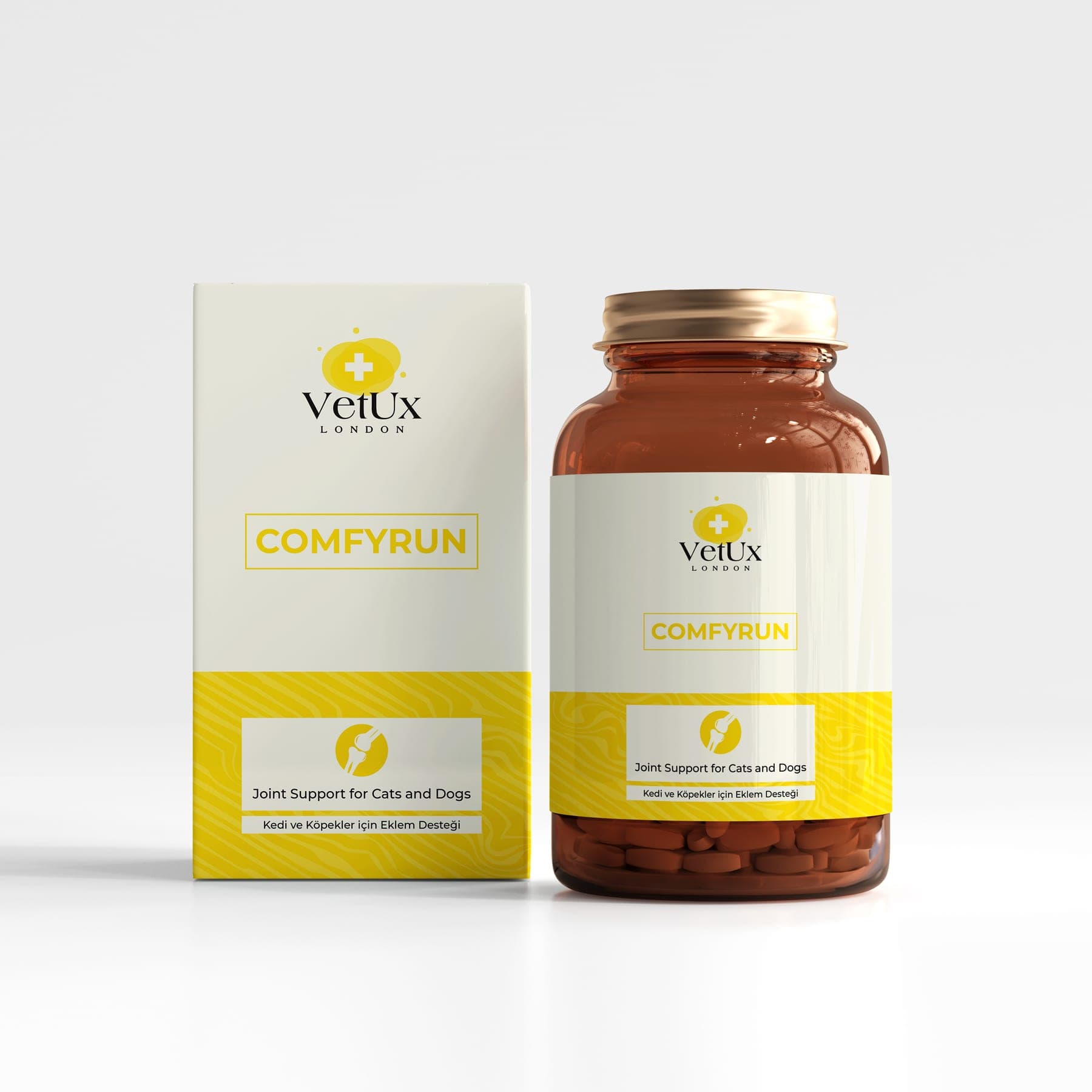
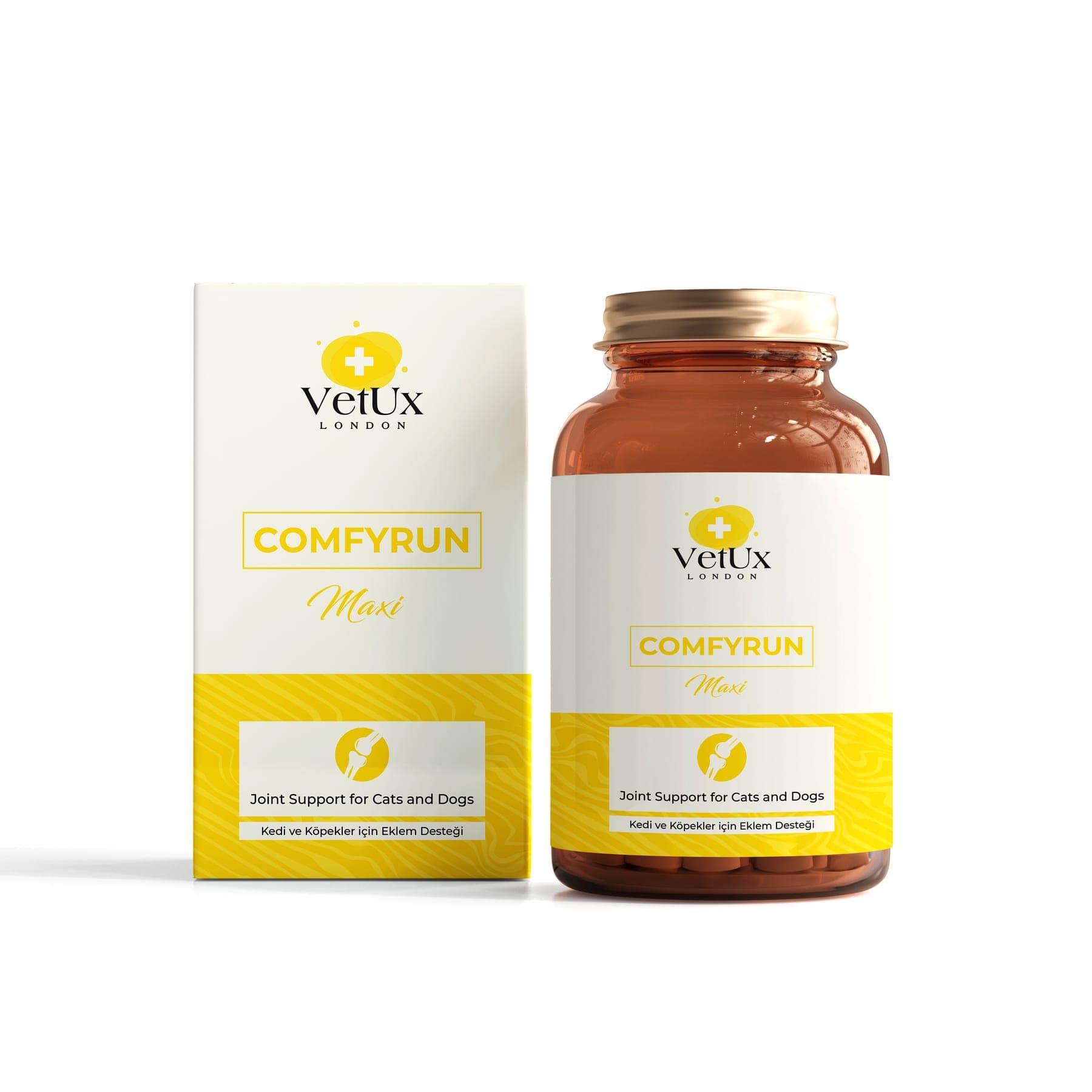
What do Comfyrun and Comfyrun Maxi offer on the label?
Comfyrun and Comfyrun Maxi, from the Vetux London joint range, are complementary feeds in tablet form. The labels of both products list glucosamine sulphate, chondroitin sulphate, MSM (methylsulfonylmethane), vitamin C, boswellia serrata extract, turmeric extract, type II collagen, hyaluronic acid and vitamin D3; the per-tablet amount of each ingredient is stated separately, and usage information is given by body weight. Comfyrun provides usage information for cats and dogs, while Comfyrun Maxi contains the same ingredients, most of them at higher per-tablet amounts and its usage table is written for dogs. Both are formulated to help maintain joint health and comfortable movement and to accompany the natural integrity of cartilage tissue. Which form suits your dog, and how much, should be decided by your veterinary surgeon based on body weight, health status and any medicines; these products do not replace diagnosis or treatment.
Frequently asked questions
Do glucosamine and chondroitin really work in dogs? They have a biologically meaningful link with cartilage physiology, but the clinical evidence in dogs is low to moderate. The right expectation is nutritional support for joint function. Discuss with your vet whether a supplement is appropriate for your dog.
Can I give my dog glucosamine tablets made for people? This is not recommended. Human products are not formulated for dogs and may contain sweeteners such as xylitol, which is toxic to dogs. Choose a product made for dogs that your vet considers suitable.
When should a joint supplement be started? That decision should be made by your veterinary surgeon based on your dog's age, breed, weight and joint status. If a young dog is limping, a diagnosis must come first; a supplement does not replace it.
Can a joint supplement replace pain medication prescribed by my vet? No. Complementary feeds are not medicines. Do not stop or reduce a medicine your vet prescribed on your own; plan every change with your vet.
When can I judge whether the supplement is helping? Joint supplements act slowly; judging them takes several weeks of regular use. Agree a review date with your vet when you start, and if signs worsen during that time, get in touch without waiting.
Can my dog take more than one supplement at a time? It can, but the same vitamin or ingredient may be repeated across products (vitamin D, for example). Show your vet the packs of every product you use and review total intake together.
References
- 1Vandeweerd JM, Coisnon C, Clegg P, et al. Systematic review of efficacy of nutraceuticals to alleviate clinical signs of osteoarthritis. J Vet Intern Med. 2012;26(3):448–456.
- 2Comblain F, Serisier S, Barthelemy N, Balligand M, Henrotin Y. Review of dietary supplements for the management of osteoarthritis in dogs in studies from 2004 to 2014. J Vet Pharmacol Ther. 2016;39(1):1–15.
- 3Barbeau-Grégoire M, Otis C, Cournoyer A, Moreau M, Lussier B, Troncy E. A 2022 systematic review and meta-analysis of enriched therapeutic diets and nutraceuticals in canine and feline osteoarthritis. Int J Mol Sci. 2022;23(18):10384.
- 4McCarthy G, O'Donovan J, Jones B, McAllister H, Seed M, Mooney C. Randomised double-blind, positive-controlled trial to assess the efficacy of glucosamine/chondroitin sulfate for the treatment of dogs with osteoarthritis. Vet J. 2007;174(1):54–61.
- 5Bhathal A, Spryszak M, Louizos C, Frankel G. Glucosamine and chondroitin use in canines for osteoarthritis: a review. Open Vet J. 2017;7(1):36–49.
- 6Gruen ME, Lascelles BDX, Colleran E, et al. 2022 AAHA Pain Management Guidelines for Dogs and Cats. J Am Anim Hosp Assoc. 2022;58(2):55–76.
- 7Monteiro BP, Lascelles BDX, Murrell J, et al. 2022 WSAVA guidelines for the recognition, assessment and treatment of pain. J Small Anim Pract. 2023;64(4):177–254.
- 8Kealy RD, Lawler DF, Ballam JM, et al. Effects of diet restriction on life span and age-related changes in dogs. J Am Vet Med Assoc. 2002;220(9):1315–1320.
- 9European Parliament and Council. Regulation (EC) No 767/2009 on the placing on the market and use of feed.
This article is for information only and does not replace diagnosis or treatment. For every decision about your dog's joint health — before starting a supplement and throughout its use — consult your veterinary surgeon.
Frequently asked questions
Do glucosamine and chondroitin really work in dogs?
They have a biologically meaningful link with cartilage physiology, but the clinical evidence in dogs is low to moderate. The right expectation is nutritional support for joint function. Discuss with your vet whether a supplement is appropriate for your dog.
Can I give my dog glucosamine tablets made for people?
This is not recommended. Human products are not formulated for dogs and may contain sweeteners such as xylitol, which is toxic to dogs. Choose a product made for dogs that your vet considers suitable.
When should a joint supplement be started?
That decision should be made by your veterinary surgeon based on your dog's age, breed, weight and joint status. If a young dog is limping, a diagnosis must come first; a supplement does not replace it.
Can a joint supplement replace pain medication prescribed by my vet?
No. Complementary feeds are not medicines. Do not stop or reduce a medicine your vet prescribed on your own; plan every change with your vet.
When can I judge whether the supplement is helping?
Joint supplements act slowly; judging them takes several weeks of regular use. Agree a review date with your vet when you start, and if signs worsen during that time, get in touch without waiting.
Can my dog take more than one supplement at a time?
It can, but the same vitamin or ingredient may be repeated across products (vitamin D, for example). Show your vet the packs of every product you use and review total intake together.
This article is for general information only; it does not replace veterinary examination, diagnosis or treatment. VetUx London products are complementary feed. If you have any concern about your companion, please consult your veterinary surgeon.
Share
The formulas matching the nutritional support described above.
Related articles
All articles Clinical Notes
Vomiting in Cats: Hairball or Something Else?
Is your cat's vomiting a hairball or a sign of something else? What the colour and frequency of vomit tell you, and when to see your vet.
 Clinical Notes
Shedding and Skin Changes in Neutered Cats: The Role of Hormones
Why does your cat's coat change after neutering? How hormones affect sebaceous glands, the hair cycle and weight, what must be ruled out first with a bald patch, and when to see your veterinary surgeon.
 Clinical Notes
How to Choose a Probiotic for Cats and Dogs: Strain, Colony Count and Storage Conditions
What should you look for on the label when choosing a probiotic for your cat or dog? Why the strain name and code matter, how to read the colony count (CFU), how storage affects viability and why human probiotics should not be given, with references.