
How to Choose a Probiotic for Cats and Dogs: Strain, Colony Count and Storage Conditions
What should you look for on the label when choosing a probiotic for your cat or dog? Why the strain name and code matter, how to read the colony count (CFU), how storage affects viability and why human probiotics should not be given, with references.
Short answer: When choosing a probiotic for your cat or dog, check three things on the label: the full strain name (genus, species and strain code), the colony count (CFU) guaranteed until expiry, and the storage conditions. Never give pets probiotics made for people. Your veterinary surgeon decides whether one is needed and how it is timed with antibiotics.
What is a probiotic, and is every product containing bacteria a probiotic?
Under the internationally accepted definition, probiotics are live microorganisms that, when administered in adequate amounts, confer a health benefit on the host (Hill et al., 2014). The definition stands on three legs: the microorganism must be alive, it must be present in an adequate amount, and its effect must have been shown for that microorganism. If any of these is missing, a product does not fully meet the definition, even if its label says "probiotic".
For this reason, phrases such as "fermentation product", "bacterial culture" or simply "contains probiotics" are not enough information on their own. In a study of cat and dog foods, none of the products claiming to contain probiotics contained all of the microorganisms listed on the label (Weese and Arroyo, 2003). A similar evaluation showed that there can be important differences between what probiotic products state on the label and what they actually contain (Weese and Martin, 2011). An informed choice starts with reading the label correctly.
Why does the strain name matter so much?
The full name of a probiotic has three parts: the genus (for example Lactobacillus), the species (for example acidophilus) and the strain code. The strain code is an identifier made of letters and numbers, usually showing the deposit number in a culture collection. Different strains of the same species can differ markedly in their tolerance of stomach acid and bile, their ability to adhere to the gut wall and their interaction with the gut flora.
This is known as strain specificity: the result of a study carried out with one strain cannot automatically be transferred to another strain of the same species (Hill et al., 2014; Jugan et al., 2017). Probiotic studies in cats and dogs have likewise been carried out with specific strains and specific products, and the results vary with the strain, the amount and the condition of the animal (Grześkowiak et al., 2015; Schmitz, 2021). If the label gives only a genus or species name, there is no way to trace which scientific evidence the product relies on.
In the European Union, probiotic microorganisms used in cat and dog feed are classed as "zootechnical additives" in the "gut flora stabilisers" group; each strain is authorised only after a safety and efficacy assessment for the target species (Regulation (EC) No 1831/2003; EFSA FEEDAP Panel, 2018). That is why the strain code is the single most important piece of label information: it shows which assessment the product is based on.
There is one more detail worth knowing when reading labels: in 2020 the genus Lactobacillus was reclassified and some species received new genus names. For example, Lactobacillus reuteri now appears in the scientific literature as Limosilactobacillus reuteri (Zheng et al., 2020). A label using the old or the new name may refer to the same species; on its own, this is not an error.
How do you read the colony count (CFU)?
CFU (colony forming unit) indicates the amount of live microorganisms in a product that are capable of multiplying. The figures are usually written in scientific notation: 1 × 10⁹ CFU means one billion, and 1 × 10¹² CFU means one trillion colony forming units. When reading the colony count on a label, ask three questions:
- What amount is it given for? The colony count may be stated per gram, per kilogram or per sachet or scoop. The same figure means a very different amount depending on the unit.
- Is it given separately for each strain? In products with more than one strain, stating the amount of each strain separately is clearer label information.
- Until when is it guaranteed? The number of live microorganisms falls over time. A figure given "at manufacture" is not the same as a figure guaranteed "until the expiry date".
"The more, the better" does not apply to probiotics. What matters is the amount studied and authorised for that strain; a higher number does not by itself mean a better outcome (Jugan et al., 2017). Your veterinary surgeon decides which product and amount are suitable for your pet.
How do storage conditions affect a probiotic's viability?
Because probiotics contain live microorganisms, storage conditions directly affect the value of the product. The main factors that reduce viability are heat, moisture, oxygen and light. Powdered probiotics are usually in a dried state and can lose viability more quickly once they meet moisture. Single-use sachets and moisture-proof packaging therefore protect the product from the outside environment better than large containers that are opened and closed repeatedly.
The following general principles can guide storage:
- Follow the storage instructions on the label. Some products are designed to be kept at room temperature, others in the refrigerator; only the product label can tell you which.
- Keep the product in its original packaging in a cool, dry place, away from humid rooms such as the bathroom, away from cookers and radiators, and away from places that heat up, such as the inside of a car.
- Use an opened sachet straight away; with large containers, close the lid tightly after every use.
- Avoid adding it to hot food; decide how the product is given according to the label and your veterinary surgeon's advice.
- Do not use a product past its expiry date.
Can probiotics made for people be given to cats and dogs?
No; do not give your pet probiotics made for people. The strains and amounts in these products were chosen for humans and may not have been assessed for cats and dogs. Some human products contain sweeteners, flavourings and other excipients that are not suitable for cats or dogs; xylitol, for example, a sweetener used in some human products, is toxic to dogs. In addition, the gut flora of cats and dogs differs from that of humans (Grześkowiak et al., 2015). Choose a product made for animals, with the strain and amount clearly stated on the label, together with your veterinary surgeon.
Can probiotics be given during a course of antibiotics?
Antibiotics can affect beneficial gut bacteria as well as disease-causing ones, which makes a course of antibiotics a period in which the balance of the gut flora may be unsettled (Pilla and Suchodolski, 2020). Studies on the place of probiotics during this period are limited, and the results differ with the strain and product used (Schmitz, 2021). You can read more in our article on the gut flora after antibiotics.
Your veterinary surgeon decides whether a cat or dog on antibiotics should be given a probiotic, which product to choose and how the probiotic is timed in relation to the antibiotic. Never stop, pause or change the dose of an antibiotic course on your own.
What should you check on the label? A short checklist
- 1Full strain name: Are the genus, species and strain code written together?
- 2Colony count: Is it given for each strain, and for which unit (gram, kilogram, sachet)?
- 3Guarantee period: Is the colony count guaranteed until the expiry date?
- 4Storage conditions: Room temperature or refrigerator? Does the packaging protect against moisture?
- 5Target species: Is the product made for cats and/or dogs?
- 6Product class and manufacturer details: Does the label state that the product is a complementary feed and give the manufacturer or distributor details?
What are Flora Guard and Flora Guard Plus?
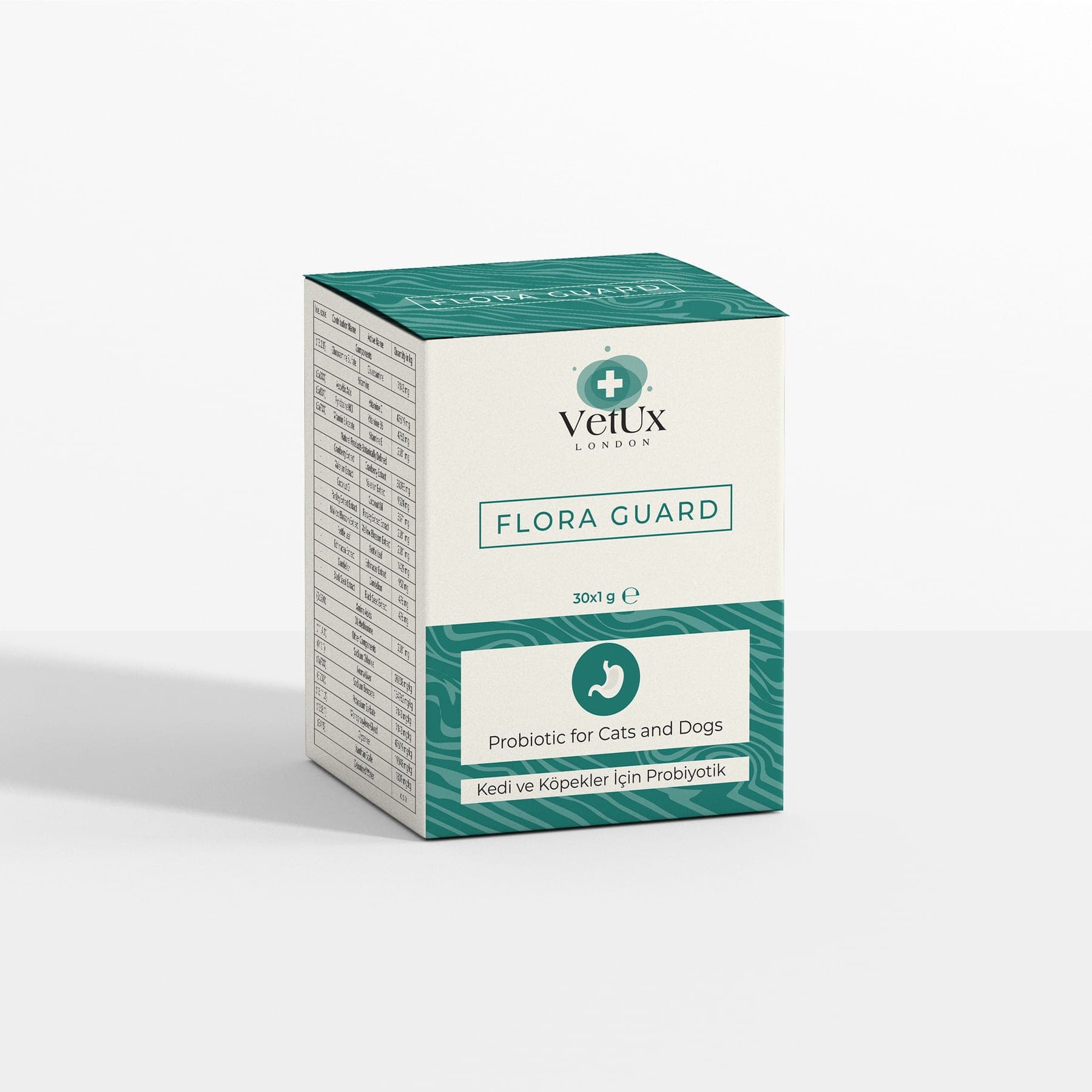
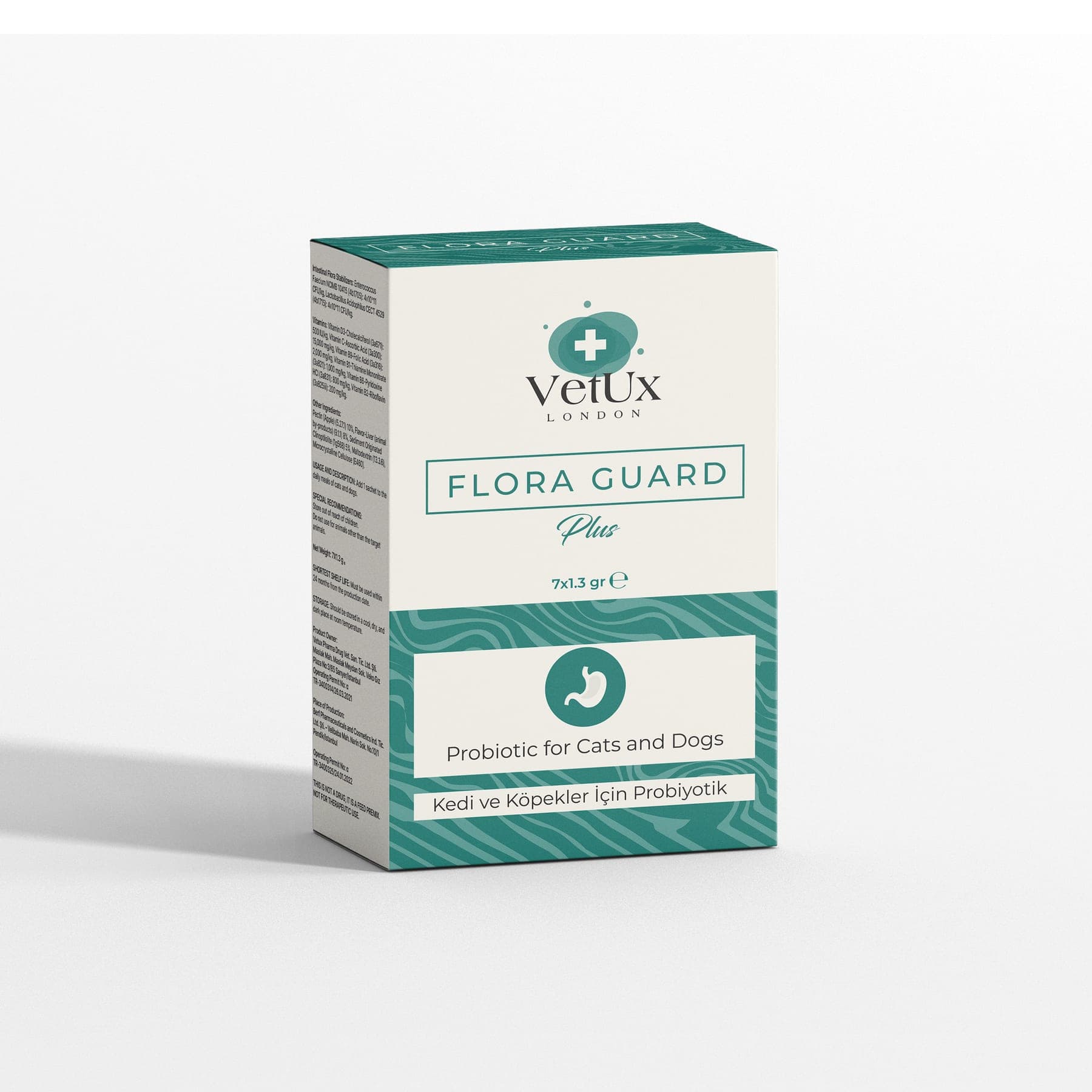
Flora Guard and Flora Guard Plus are complementary feeds in sachet form that help maintain the normal balance of the gut flora in cats and dogs. The label composition of Flora Guard includes two probiotics identified by strain code (Enterococcus faecium NCIMB 10415 and Lactobacillus acidophilus CECT 4529, each 1 × 10¹² CFU per kilogram), together with L-lysine and vitamins B1, B2, B6, C and D3. Flora Guard Plus combines the same two strains (each 4 × 10¹¹ CFU per kilogram) with Lactobacillus reuteri, apple pectin (a prebiotic fibre), zeolite (clinoptilolite, a natural mineral) and vitamins C, B9 (folic acid), B1, B6, B2 and D3; the apple pectin accompanies the natural transit of gut contents and the regularity of stool consistency. On both labels the colony counts are stated per kilogram, and storage in a cool, dry place is recommended. These products are not medicines and do not replace the diagnosis or treatment of any disease. Your veterinary surgeon decides whether they are suitable for your pet, how they are used and how they are timed during a course of antibiotics.
When should you see a veterinary surgeon?
Complementary feeds containing probiotics do not reveal the cause of a digestive problem and do not replace an examination. Contact your veterinary surgeon without delay if:
- there is blood in the stool, black tar-like stool or repeated vomiting;
- your pet is lethargic, will not drink or shows signs of abdominal pain (a hunched posture, not wanting to be touched);
- diarrhoea does not settle within a day or two, gets worse or keeps coming back;
- your cat has not eaten for more than a day;
- the animal is very young, elderly or has a chronic illness;
- your pet has a condition affecting the immune system or takes medicines that suppress it; in these animals the use of probiotics must always be assessed by a veterinary surgeon (Jugan et al., 2017);
- there are long-standing signs such as weight loss, a deteriorating coat or a change in appetite;
- a new sign appears after starting a product containing probiotics.
Diagnosis and treatment are the role of the veterinary surgeon; a product containing probiotics should only be seen as support that accompanies the vet's plan.
Frequently asked questions
Is a probiotic with a higher colony count better?
Not by itself. What matters is the amount studied and authorised for that strain. A high number without a strain code tells you no more than a product that clearly states its strain and amount.
Can I give my cat or dog the probiotic I take myself?
No. The strains and amounts in human products were chosen for people, and some products contain sweeteners such as xylitol, which is toxic to dogs. Choose a product made for animals together with your veterinary surgeon.
Can a probiotic be given alongside antibiotics?
Your veterinary surgeon makes this decision. They will decide, based on your pet's condition, whether a probiotic is needed, which product to use and how it is timed in relation to the antibiotic. Do not change an antibiotic course on your own.
Do probiotics need to be kept in the fridge?
It depends on the product. Some are designed to be kept at room temperature, others in the refrigerator. Follow the storage instructions on the label and protect the product from moisture, heat and direct sunlight.
Is a food that says it contains probiotics enough?
The viability of probiotics in pet food may not be maintained through manufacture, storage and shelf life; in one study, no food contained all of the microorganisms stated on its label (Weese and Arroyo, 2003). Talk to your veterinary surgeon about whether your pet needs additional support.
How soon does a probiotic work, and how long is it used for?
This varies with the product, the strain and the animal's condition. Your veterinary surgeon decides how long and how often it is used; if signs persist or worsen, contact your vet rather than switching products on your own.
Conclusion
A good probiotic choice starts not with the claim on the packet but with the details on the label: the full strain name, the colony count for each strain, the date until which that count is guaranteed, and the storage conditions. Probiotics made for people should not be given to pets, and use alongside antibiotics should always be planned on the vet's decision. Diagnosis and treatment are the job of the veterinary surgeon; to choose the right probiotic and plan for your pet, consult your veterinary surgeon.
References
- 1Hill C, Guarner F, Reid G, et al. Expert consensus document: The International Scientific Association for Probiotics and Prebiotics consensus statement on the scope and appropriate use of the term probiotic. Nat Rev Gastroenterol Hepatol. 2014;11(8):506-514. doi:10.1038/nrgastro.2014.66
- 2Jugan MC, Rudinsky AJ, Parker VJ, Gilor C. Use of probiotics in small animal veterinary medicine. J Am Vet Med Assoc. 2017;250(5):519-528. doi:10.2460/javma.250.5.519
- 3Schmitz SS. Value of probiotics in canine and feline gastroenterology. Vet Clin North Am Small Anim Pract. 2021;51(1):171-217. doi:10.1016/j.cvsm.2020.09.011
- 4Grześkowiak Ł, Endo A, Beasley S, Salminen S. Microbiota and probiotics in canine and feline welfare. Anaerobe. 2015;34:14-23. doi:10.1016/j.anaerobe.2015.04.002
- 5Weese JS, Arroyo L. Bacteriological evaluation of dog and cat diets that claim to contain probiotics. Can Vet J. 2003;44(3):212-215.
- 6Weese JS, Martin H. Assessment of commercial probiotic bacterial contents and label accuracy. Can Vet J. 2011;52(1):43-46.
- 7Pilla R, Suchodolski JS. The role of the canine gut microbiome and metabolome in health and gastrointestinal disease. Front Vet Sci. 2020;6:498. doi:10.3389/fvets.2019.00498
- 8Zheng J, Wittouck S, Salvetti E, et al. A taxonomic note on the genus Lactobacillus: Description of 23 novel genera, emended description of the genus Lactobacillus Beijerinck 1901, and union of Lactobacillaceae and Leuconostocaceae. Int J Syst Evol Microbiol. 2020;70(4):2782-2858. doi:10.1099/ijsem.0.004107
- 9EFSA Panel on Additives and Products or Substances used in Animal Feed (FEEDAP). Guidance on the characterisation of microorganisms used as feed additives or as production organisms. EFSA J. 2018;16(3):5206. doi:10.2903/j.efsa.2018.5206
- 10European Parliament and Council. Regulation (EC) No 1831/2003 of 22 September 2003 on additives for use in animal nutrition. Official Journal of the European Union L 268, 18.10.2003, p. 29-43.
Frequently asked questions
Is a probiotic with a higher colony count better?
Not by itself. What matters is the amount studied and authorised for that strain. A high number without a strain code tells you no more than a product that clearly states its strain and amount.
Can I give my cat or dog the probiotic I take myself?
No. The strains and amounts in human products were chosen for people, and some products contain sweeteners such as xylitol, which is toxic to dogs. Choose a product made for animals together with your veterinary surgeon.
Can a probiotic be given alongside antibiotics?
Your veterinary surgeon makes this decision. They will decide, based on your pet's condition, whether a probiotic is needed, which product to use and how it is timed in relation to the antibiotic. Do not change an antibiotic course on your own.
Do probiotics need to be kept in the fridge?
It depends on the product. Some are designed to be kept at room temperature, others in the refrigerator. Follow the storage instructions on the label and protect the product from moisture, heat and direct sunlight.
Is a food that says it contains probiotics enough?
The viability of probiotics in pet food may not be maintained through manufacture, storage and shelf life; in one study, no food contained all of the microorganisms stated on its label (Weese and Arroyo, 2003). Talk to your veterinary surgeon about whether your pet needs additional support.
How soon does a probiotic work, and how long is it used for?
This varies with the product, the strain and the animal's condition. Your veterinary surgeon decides how long and how often it is used; if signs persist or worsen, contact your vet rather than switching products on your own.
This article is for general information only; it does not replace veterinary examination, diagnosis or treatment. VetUx London products are complementary feed. If you have any concern about your companion, please consult your veterinary surgeon.
Share
The formulas matching the nutritional support described above.
Related articles
All articles Clinical Notes
Diarrhoea in Dogs: What to Check in the First 24 Hours, and Which Signs Are an Emergency?
What to watch in the first 24 hours after your dog's diarrhoea starts, the signs of fluid loss, why bloody diarrhoea in a puppy is an emergency and the role of the gut flora, with references.
 Clinical Notes
My Cat Keeps Going to the Litter Box: Lower Urinary Tract Signs and Emergencies
Frequent litter box trips, straining and bloody urine are lower urinary tract signs in cats, and a male cat that cannot urinate is an emergency. We explain the signs, the role of stress and water intake, and when to see your vet.
 Clinical Notes
What Is Lanthanum Carbonate? Phosphorus Balance and Phosphate Binders in Cats and Dogs
Lanthanum carbonate is a phosphate binder that forms insoluble lanthanum phosphate with dietary phosphate in the intestinal lumen. Its mechanism, why it is given with meals, its link to diet and key monitoring points, with references.