
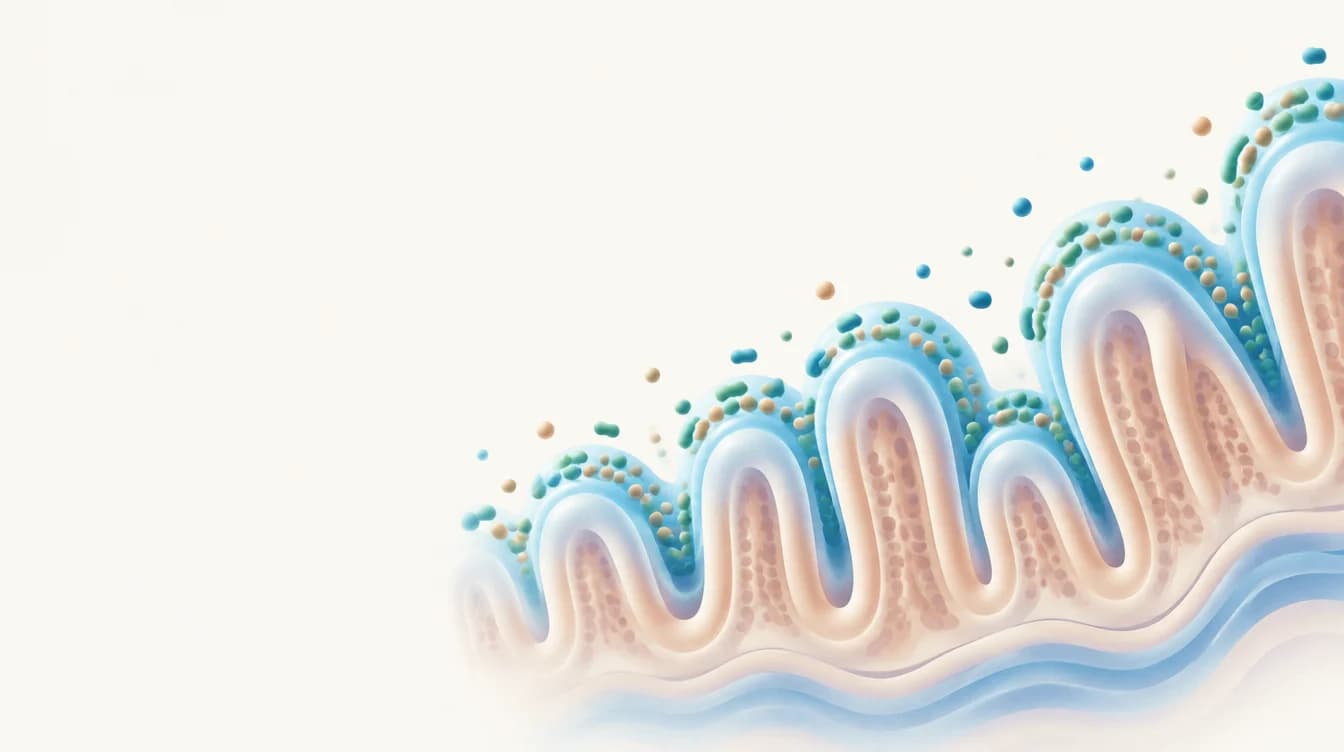
Post-Antibiotic Diarrhoea and Gut Flora Disruption: How Is the Epithelium Protected?
The physiology behind stools that soften during antibiotic treatment: loss of flora balance, falling short-chain fatty acid production, and why the intestinal epithelium is a heading of its own.
In brief — the direct answer: Antibiotic therapy thins out the beneficial microbial community in the gut alongside its intended target. When that balance is disturbed, short-chain fatty acid production falls, water absorption is impaired and stools soften. Protecting the epithelium rests on three things: staying with the veterinary surgeon's plan, offering the gut a soluble-fibre foundation, and accompanying the restoration of the flora's normal balance.
Softening stools within a few days of starting an antibiotic are among the most common accompanying pictures seen in practice. This article explains the physiology behind that picture and why the intestinal epithelium deserves a heading of its own. Diagnosis and treatment decisions rest solely with your veterinary surgeon; this content does not replace a clinical assessment.
How does an antibiotic affect the gut flora?
The gut carries the densest microbial community in the body. That community is not a passenger: it ferments fibre into short-chain fatty acids, supplies a substantial share of the daily energy used by intestinal epithelial cells, and occupies the space in which pathogens would otherwise settle.
A systemic antibiotic suppresses its target pathogen but thins this community non-selectively at the same time. The result is the loss of balance described in the literature as dysbiosis: diversity falls, dominant strains shift, and the metabolic output of the community declines. In cats and dogs this change can begin days into a course and persist for a while after it ends.
Why do stools soften? What the mechanism says
Soft stool is not a disease in itself but the shared result of several physiological changes:
- Reduced fermentation. As short-chain fatty acid production falls, the main energy source of the colonocytes weakens and the colon's capacity to reabsorb water declines.
- Osmotic load. Carbohydrates that are not fermented remain in the lumen and draw water.
- Bile acid balance. When the flora's role in transforming bile acids weakens, the bile acid profile reaching the colon changes and secretion may rise.
- A looser barrier. The physiological integrity of the tight junctions between epithelial cells depends on adequate energy and a balanced luminal environment.
What these four share is this: the issue is not simply "missing bacteria" but the gut environment as a whole. That is why a supportive approach is thought of in two layers — foundation plus community — rather than as a single ingredient.
Why is the intestinal epithelium a heading of its own?
The intestinal epithelium is one of the largest surfaces at which the body meets the outside world, and it is a single cell layer thick. These cells renew rapidly, and that renewal is sensitive to nutrient and energy supply. Together with the overlying mucus layer, the epithelium forms the physiological boundary between luminal contents and circulation.
When the flora is disturbed, the working of that boundary is affected too. "Stopping diarrhoea" and "protecting the epithelium" are therefore not the same sentence: the first is a clinical objective and the veterinary surgeon's decision; the second is a physiological function supported through nutrition and the gut environment.
What do soluble fibre and pectin add to the gut environment?
Soluble fibres form a gel-like structure with water and accompany the transit of intestinal contents. Apple pectin is the typical example of this group. Fibre-rich botanical sources such as pumpkin and pumpkin seed provide a similar foundation: they accompany the natural regularity of stool consistency and supply a substrate the flora can ferment.
One distinction matters here: fibre is not a substance that "cleans" the gut. What it does is turn the gut environment into a foundation on which the microbial community can settle again.
What do probiotic strains do — and not do?
Probiotics are live micro-organisms that, given in adequate amounts, help maintain the normal balance of the gut flora. Enterococcus faecium and Lactobacillus acidophilus are among the most extensively studied strains in animal nutrition.
What they do not do matters just as much: a probiotic is not an antibiotic, it does not treat an infection, and it does not replace a treatment your veterinary surgeon has started. If support is to be planned during or after a course of antibiotics, its timing and suitability are a veterinary decision.
Where does Prolifia sit in this picture?
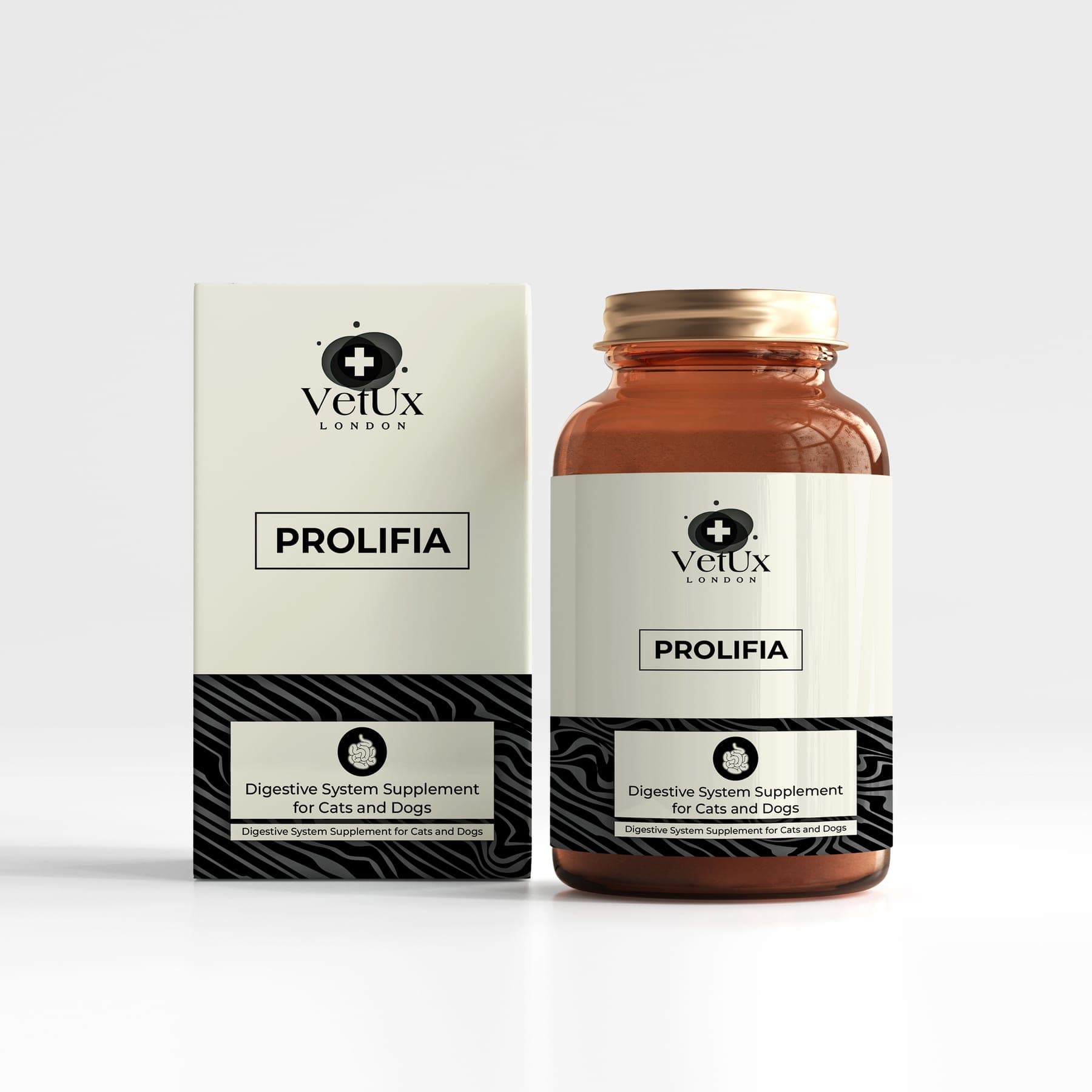
Prolifia is a complementary feed in tablet form for cats and dogs. It is not a medicine; it does not treat or prevent any disease and does not replace veterinary treatment. Its composition, as published in the live product record, maps onto the two-layer logic described above:
| Layer | Ingredient | Physiological role | |---|---|---| | Fibre foundation | Pumpkin Extract (Cucurbita pepo), Pumpkin Seed Extract | Accompanies the natural regularity of stool consistency and comfortable gut transit | | Soluble fibre | Apple Pectin (Pectin 5.27.1) | Its gel structure accompanies the transit of intestinal contents | | Flora | Enterococcus faecium NCIMB 10415, Lactobacillus acidophilus CECT 4529 | Helps maintain the normal balance of the gut flora | | Everyday comfort | Bromelain (Ananas comosus), Broccoli and Blueberry extracts | Support everyday digestive comfort |
The full ingredient and quantity declaration for Prolifia is published on its product page. The decision to use it, its timing, and how it sits alongside current treatment rest with your veterinary surgeon.
What to tell the owner
For an owner seeing softer stools during a course of antibiotics, three points are clear:
- 1The antibiotic is not stopped or altered on one's own. That is the veterinary surgeon's decision alone.
- 2Access to water must be uninterrupted. With soft stools, fluid loss is the fastest-developing risk.
- 3Blood, marked lethargy, vomiting, loss of appetite or heavy diarrhoea lasting beyond 24 hours means going to the clinic without delay. That picture is not a matter for a complementary feed.
Frequently asked questions
Can a complementary feed be given during antibiotic treatment? That decision belongs to the veterinary surgeon, who weighs the patient's picture, the medicine in use and the timing together. A complementary feed does not replace antibiotic treatment.
Does Prolifia stop diarrhoea? No. Prolifia is a complementary feed; it cannot be claimed to treat any disease or remove any sign. Its fibre and probiotic components accompany the natural regularity of stool consistency and the maintenance of the gut flora's normal balance.
Is the situation the same in cats and dogs? The underlying physiology is shared, but there are species differences. Cats naturally drink less, and fluid loss becomes a problem faster. The threshold for clinical follow-up is therefore lower in cats.
For how long is it given, and at what dose? Dose and duration are outside the scope of this article and are not given here. Together with the usage information on the product label, the patient-specific decision is made by your veterinary surgeon.
Is support continued once the diarrhoea has resolved? Re-establishing the balance of the flora can take longer than the resolution of clinical signs. Whether support continues depends on the veterinary surgeon's assessment.
References
- Pilla R, Suchodolski JS. The Role of the Canine Gut Microbiome and Metabolome in Health and Gastrointestinal Disease. Frontiers in Veterinary Science. 2020;6:498.
- Suchodolski JS. Analysis of the gut microbiome in dogs and cats. Veterinary Clinical Pathology. 2021;50(Suppl 1):6–17.
- Unterer S, Busch K. Acute Hemorrhagic Diarrhea Syndrome in Dogs. Veterinary Clinics of North America: Small Animal Practice. 2021;51(1):79–92.
- Hill C, Guarner F, Reid G, et al. The International Scientific Association for Probiotics and Prebiotics consensus statement on the scope and appropriate use of the term probiotic. Nature Reviews Gastroenterology & Hepatology. 2014;11(8):506–514.
- WSAVA Global Nutrition Committee. Global Nutrition Guidelines. World Small Animal Veterinary Association.
- VetUx London product record — Prolifia (composition and usage information): vetuxlondon.co.uk/products/prolifia
This content is for information only and does not replace a veterinary examination. Diagnosis and treatment decisions rest solely with your veterinary surgeon. Prolifia is a complementary feed.
Frequently asked questions
Can a complementary feed be given during antibiotic treatment?
That decision belongs to the veterinary surgeon, who weighs the patient's picture, the medicine in use and the timing together. A complementary feed does not replace antibiotic treatment.
Does Prolifia stop diarrhoea?
No. Prolifia is a complementary feed; it cannot be claimed to treat any disease or remove any sign. Its fibre and probiotic components accompany the natural regularity of stool consistency and the maintenance of the gut flora's normal balance.
Is the situation the same in cats and dogs?
The underlying physiology is shared, but there are species differences. Cats naturally drink less and fluid loss becomes a problem faster, so the threshold for clinical follow-up is lower in cats.
For how long is it given, and at what dose?
Dose and duration are outside the scope of this content. Together with the usage information on the product label, the patient-specific decision is made by your veterinary surgeon.
Is support continued once the diarrhoea has resolved?
Re-establishing the balance of the flora can take longer than the resolution of clinical signs. Whether support continues depends on the veterinary surgeon's assessment.
This article is for general information only; it does not replace veterinary examination, diagnosis or treatment. VetUx London products are complementary feed. If you have any concern about your companion, please consult your veterinary surgeon.
Share
The formulas matching the nutritional support described above.
Related articles
All articles Clinical Notes
Can Two Supplements Be Used Together in Cats and Dogs with Kidney Disease? How the Vet Builds the Plan
Whether two different complementary feeds can sit in the same plan for a patient with reduced kidney function is not a product question — it is a clinical decision. This article sets out, at ingredient level, which separate lines Nephrovet and Azo-Fix occupy, where they overlap when given together, and what a veterinary surgeon actually looks at when building the plan. Dosage and sequencing are deliberately not covered here: that decision belongs to the veterinary surgeon examining the animal.
 Clinical Notes
Removing Uraemic Toxins Through the Gut: The Enteric Dialysis Rationale in Azotaemia Management
A substantial share of uraemic toxins is produced not in the kidney but in the colon. The urea–ammonia cycle, protein-bound solutes and the gut–kidney axis: the basis and limits of the "enteric dialysis" rationale.
 Clinical Notes
Why Are Phosphorus Retention and Microcirculation Vital in Chronic Kidney Disease?
In chronic kidney disease, blood phosphorus can look normal until the adaptive capacity of the remaining nephrons is exhausted. We explain the FGF-23–PTH axis and renal microcirculation at the level of general physiology.