

How Does the Gut Microbiota Manage Immunity? Probiotic Colonisation in Small Animals
The microbiota does not boost immunity; it lays the ground for it by maintaining the barrier and training the mucosal immune tissue day after day. What probiotic colonisation actually means, why strain identity matters, and the physiology of the period after antibiotics.
Summary — the direct answer: The gut microbiota does not manage immunity by "boosting" it. It does so by maintaining the intestinal barrier and by training the mucosal immune tissue day after day. Probiotic strains usually do not settle permanently; they form a transient community for as long as they are given, and they act through that transient presence. Diagnosis and treatment always remain the decision of a veterinary surgeon.
In cats and dogs, the inner surface of the digestive tract is the body's largest point of contact with the outside world. The community of microorganisms living on that surface — the microbiota — is not a side player that merely accompanies digestion; the integrity of the gut wall and the daily work of mucosal immunity are bound up with it. Owners usually arrive with one question: "If I give a probiotic, will immunity get stronger?" This article begins by correcting the question itself, because the mechanism rests on balance and training, not on boosting.
What is the gut microbiota, and how does it connect to immunity?
The microbiota is the whole population of bacteria, fungi and other microorganisms living in the gut lumen and in the mucus layer. In dogs and cats its composition shifts with species, age, feeding pattern, environment and medication (Suchodolski, 2021).
The link to immunity rests on three points:
- 1The physical barrier. The epithelial cells and the mucus layer above them form the boundary between luminal contents and circulation. The integrity of that boundary is influenced by the metabolites the microbial community produces.
- 2Gut-associated lymphoid tissue (GALT). The lymphoid tissue attached to the gut holds a substantial share of the body's immune cells. It continually learns to tell a harmless stimulus from one that is not, and the main source of that learning is the microbiota (Belkaid and Hand, 2014).
- 3Metabolite production. The short-chain fatty acids formed by bacterial fermentation of soluble fibre are the principal energy source of colonocytes and accompany the normal working of the gut surface (Koh et al., 2016).
Read together, these three points give one conclusion: the microbiota does not run immunity — it lays the ground on which immunity works. When that ground is disturbed, the problem shows across the whole barrier rather than in a single organ.
What does probiotic "colonisation" mean? Permanent settlement or transient passage?
The word colonisation often leaves owners with the impression that the bacteria given will settle in the gut and stay there. The scientific definition is more measured.
By international consensus, a probiotic is defined as a "live microorganism that, when administered in adequate amounts, confers a health benefit on the host" (Hill et al., 2014). Permanent settlement is not part of that definition. In practice most strains given are detected in the faeces for as long as they are administered; in the weeks after administration stops, the community largely returns to its earlier state.
This does not mean there is no effect — it shows where the mechanism sits:
- The effect arises from being present in the lumen during passage, not from permanent settlement.
- Support is therefore usually given regularly and continuously; intermittent use gives an intermittent transient community.
- The identity of the strain (genus–species–strain code) therefore matters: the effect is strain-specific, not genus-specific.
VetUx London product records state the strains at that level of detail: Enterococcus faecium NCIMB 10415 and Lactobacillus acidophilus CECT 4529. Stating the strain code openly alongside the label is a basic measure of transparency, because it is what allows a product to be matched against the scientific literature.
Mechanism: barrier, competitive exclusion, fermentation and the prebiotic ground
The relationship between the microbial community and the gut surface can be set out under four headings.
Barrier and mucus. The tight junctions between epithelial cells and the mucus layer above them limit uncontrolled passage of luminal contents. Where microbial balance is disturbed, this layer thins and permeability rises (Pilla and Suchodolski, 2020).
Competitive exclusion. Space, surface and nutrients are limited in the lumen. A dense, balanced beneficial community narrows all three for unwanted microorganisms. This is an ecological balance effect, not a drug effect.
Short-chain fatty acids. Fermentation of soluble fibre produces acetate, propionate and butyrate. Butyrate is the preferred energy source of the colonic epithelium and accompanies the normal renewal of that surface (Koh et al., 2016).
The prebiotic ground. Looking at a probiotic strain only as a live cell is incomplete; that cell also needs a substrate it can ferment. A prebiotic is defined as a substrate selectively utilised by host microorganisms conferring a health benefit (Gibson et al., 2017). Apple pectin is a soluble fibre that falls within this definition.
These four headings also frame the question of which product comes up in which situation — but the person who answers that question for a given patient is the veterinary surgeon.
Why is the flora under strain after a course of antibiotics?
Antibiotics thin out the beneficial community in the gut as non-selectively as they act on the target pathogen. This loss of balance is termed dysbiosis in the literature and is a common finding in feline and canine digestive disease (Ziese and Suchodolski, 2021).
Two points matter in practice during this period:
- Timing. The usage information in the VetUx London product records states that during a course of antibiotics the product is best given at least two hours after the medicine. This is a usage note; the plan for the individual patient is set by the vet.
- Duration. The resolution of clinical signs and the return of the microbial community to its earlier balance do not follow the same calendar. Whether to continue is also the vet's decision.
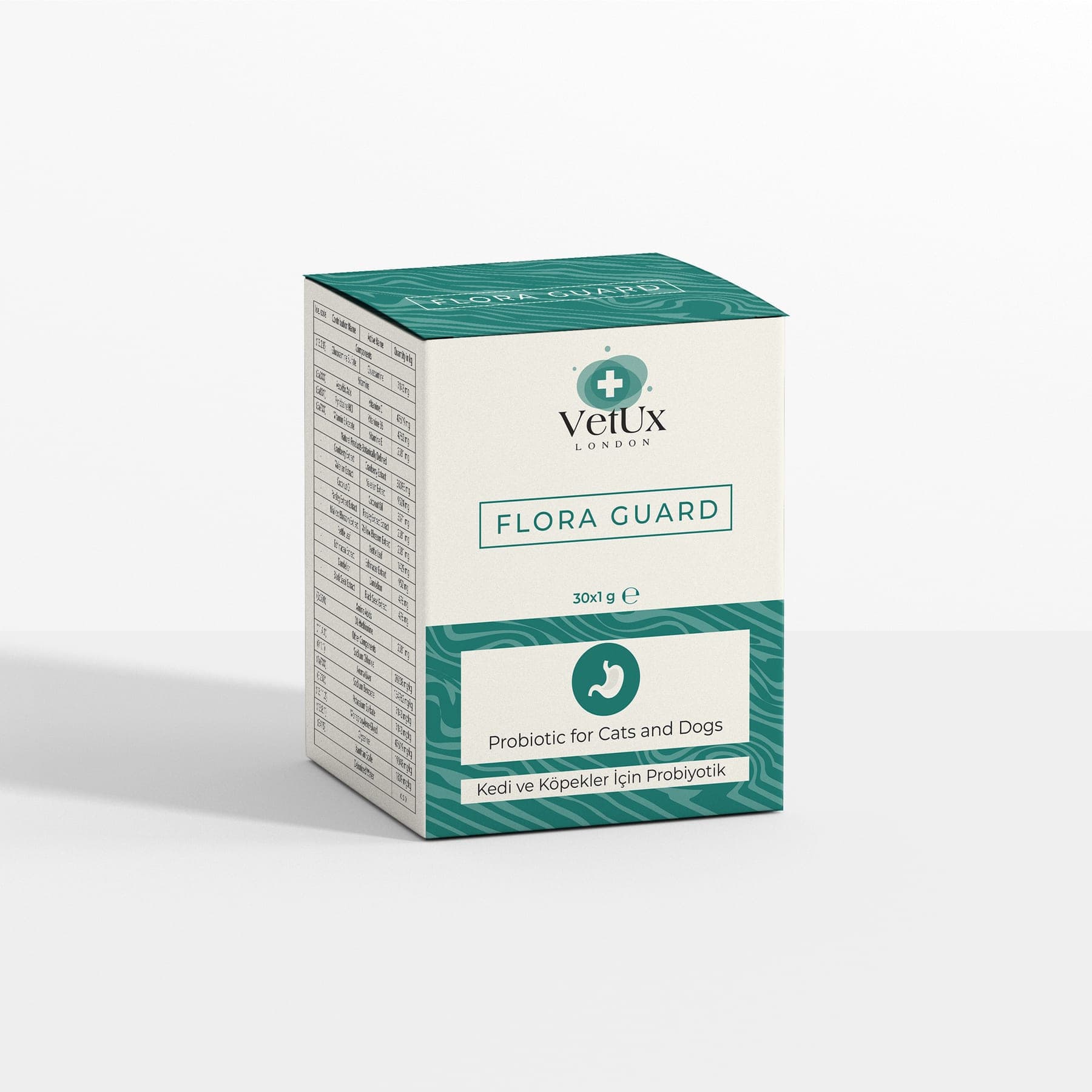
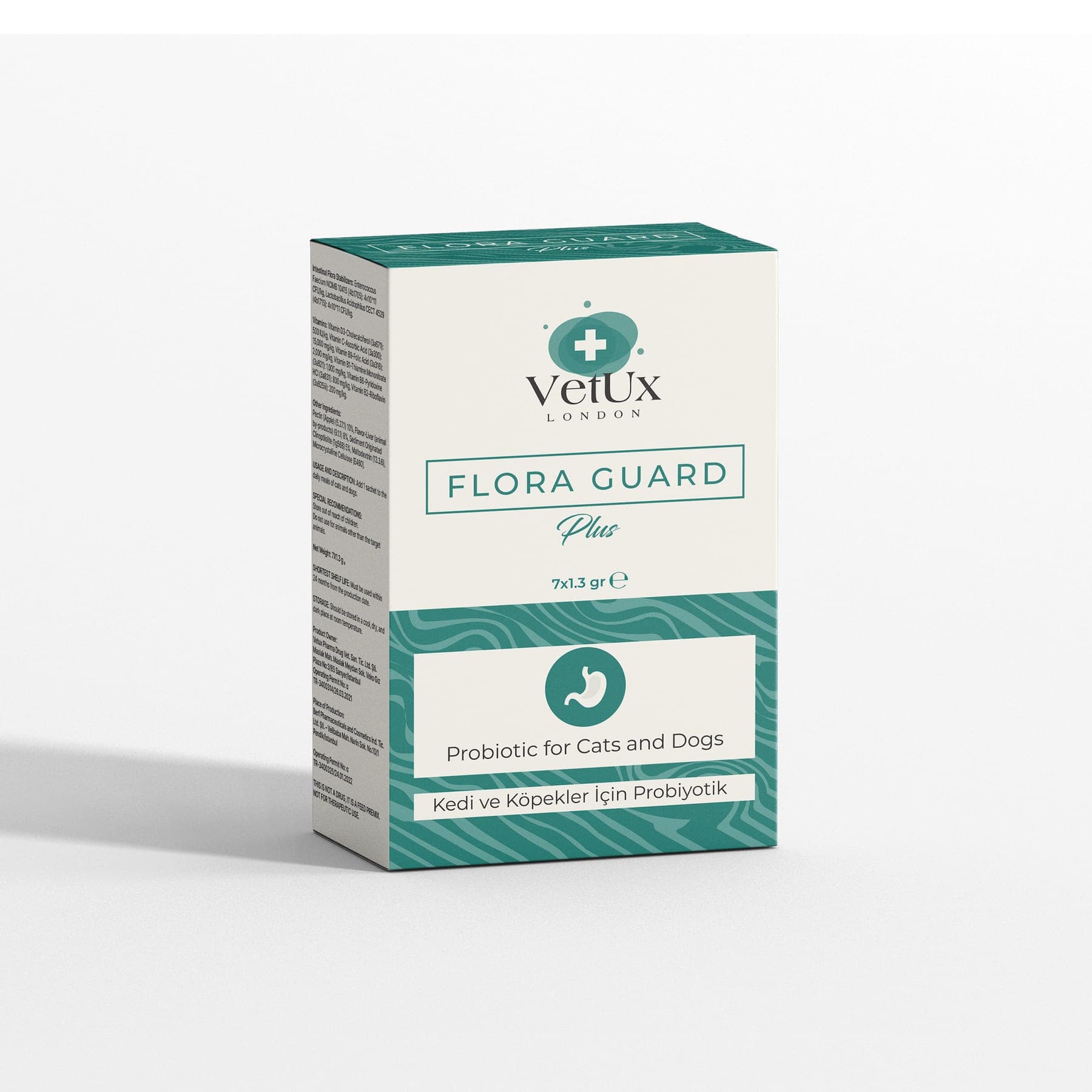
Flora Guard and Flora Guard Plus: what is the difference between the two records?
Both products are complementary feeds; no claim is made that they treat or prevent disease. The composition below is taken directly from the live product records.
| | Flora Guard | Flora Guard Plus | |---|---|---| | Presentation | 30 × 1 g sachets | 7 × 1.3 g sachets | | Probiotic strains | E. faecium NCIMB 10415 and L. acidophilus CECT 4529 (1 × 10¹² CFU/kg each) | E. faecium NCIMB 10415 and L. acidophilus CECT 4529 (4 × 10¹¹ CFU/kg each) + L. reuteri | | Prebiotic / mineral | — | Apple pectin 100,000 mg/kg, zeolite (clinoptilolite) | | Other components | L-lysine 15,000 mg, vitamin C 15,000 mg, D3 100,000 IU, B1 500 mg, B6 400 mg, B2 200 mg (per kg) | Vitamin C 15,000 mg, folic acid 2,000 mg, B1 1,000 mg, B6 800 mg, B2 200 mg, D3 500 IU (per kg) |
The difference comes down to three sentences:
- 1Flora Guard is a thirty-sachet everyday regimen built on two strains with B-group vitamin support.
- 2Flora Guard Plus is a seven-sachet short and concentrated regimen, built with a third strain (L. reuteri), a soluble fibre base (apple pectin) and zeolite.
- 3Which regimen suits which patient is settled by examination, not by comparing products.
One sentence is common to the usage information of both: use in consultation with your veterinary surgeon. This article gives no dosage; dose and duration are the vet's decision.
When is examination, rather than a product, the matter at hand?
- 1Blood in the stool, repeated vomiting, loss of appetite, marked lethargy or weight loss call for a clinic visit without delay.
- 2Fluid loss develops quickly in young and elderly animals; the threshold for waiting is lower.
- 3If signs last longer than three days, the picture is not a matter for a complementary feed.
Frequently asked questions
Do probiotics strengthen immunity? "Strengthen" is not a term that can be used for these products. As complementary feeds, Flora Guard and Flora Guard Plus help maintain the normal balance of the gut flora. Their relationship with immunity is indirect, through the ground that this balance provides.
Do the bacteria given settle permanently in the gut? Usually not. Current knowledge indicates that most strains are present in the lumen for as long as they are given and that the community largely returns to its earlier state once administration stops. The effect arises from presence during passage, not from permanent settlement.
Can they be given during a course of antibiotics? That is the veterinary surgeon's decision. The usage information in the product record states that during a course of antibiotics the product is best given at least two hours after the medicine; the plan for the individual patient, however, is set by the vet. A complementary feed does not replace antibiotic treatment.
How is the choice made between Flora Guard and Flora Guard Plus? The choice is made by assessing the patient, not by comparing ingredient lists. The main differences between the two records are the number of strains, the presence of prebiotic fibre and zeolite, and the sachet regimen; which one is appropriate depends on the examination.
What is the dose and for how long? Dosage and duration fall outside the scope of this article and are not given here. Together with the usage information on the label, the decision for the individual patient is made by your veterinary surgeon.
References
- Hill C, Guarner F, Reid G, et al. The International Scientific Association for Probiotics and Prebiotics consensus statement on the scope and appropriate use of the term probiotic. Nature Reviews Gastroenterology & Hepatology. 2014;11(8):506–514.
- Gibson GR, Hutkins R, Sanders ME, et al. Expert consensus document: The International Scientific Association for Probiotics and Prebiotics (ISAPP) consensus statement on the definition and scope of prebiotics. Nature Reviews Gastroenterology & Hepatology. 2017;14(8):491–502.
- Belkaid Y, Hand TW. Role of the microbiota in immunity and inflammation. Cell. 2014;157(1):121–141.
- Koh A, De Vadder F, Kovatcheva-Datchary P, Bäckhed F. From Dietary Fiber to Host Physiology: Short-Chain Fatty Acids as Key Bacterial Metabolites. Cell. 2016;165(6):1332–1345.
- Pilla R, Suchodolski JS. The Role of the Canine Gut Microbiome and Metabolome in Health and Gastrointestinal Disease. Frontiers in Veterinary Science. 2020;6:498.
- Suchodolski JS. Analysis of the gut microbiome in dogs and cats. Veterinary Clinical Pathology. 2021;50(Suppl 1):6–17.
- Ziese AL, Suchodolski JS. Impact of Changes in Gastrointestinal Microbiota in Canine and Feline Digestive Diseases. Veterinary Clinics of North America: Small Animal Practice. 2021;51(1):155–169.
- VetUx London product records — Flora Guard and Flora Guard Plus (composition and usage information): vetuxlondon.co.uk/urunler/flora-guard · vetuxlondon.co.uk/urunler/flora-guard-plus
This content is for information only and does not replace examination by a veterinary surgeon. Diagnosis and treatment are the decision of the veterinary surgeon alone. Flora Guard and Flora Guard Plus are complementary feeds.
Frequently asked questions
Do probiotics strengthen immunity?
"Strengthen" is not a term that can be used for these products. As complementary feeds, Flora Guard and Flora Guard Plus help maintain the normal balance of the gut flora. Their relationship with immunity is indirect, through the ground that this balance provides.
Do the bacteria given settle permanently in the gut?
Usually not. Current knowledge indicates that most strains are present in the lumen for as long as they are given and that the community largely returns to its earlier state once administration stops. The effect arises from presence during passage, not from permanent settlement.
Can they be given during a course of antibiotics?
That is the veterinary surgeon's decision. The usage information in the product record states that during a course of antibiotics the product is best given at least two hours after the medicine; the plan for the individual patient, however, is set by the vet. A complementary feed does not replace antibiotic treatment.
How is the choice made between Flora Guard and Flora Guard Plus?
The choice is made by assessing the patient, not by comparing ingredient lists. The main differences between the two records are the number of strains, the presence of prebiotic fibre and zeolite, and the sachet regimen; which one is appropriate depends on the examination.
What is the dose and for how long?
Dosage and duration fall outside the scope of this article and are not given here. Together with the usage information on the label, the decision for the individual patient is made by your veterinary surgeon.
This article is for general information only; it does not replace veterinary examination, diagnosis or treatment. VetUx London products are complementary feed. If you have any concern about your companion, please consult your veterinary surgeon.
Share
The formulas matching the nutritional support described above.
Related articles
All articles Clinical Notes
Post-Antibiotic Diarrhoea and Gut Flora Disruption: How Is the Epithelium Protected?
The physiology behind stools that soften during antibiotic treatment: loss of flora balance, falling short-chain fatty acid production, and why the intestinal epithelium is a heading of its own.
 Clinical Notes
Can Two Supplements Be Used Together in Cats and Dogs with Kidney Disease? How the Vet Builds the Plan
Whether two different complementary feeds can sit in the same plan for a patient with reduced kidney function is not a product question — it is a clinical decision. This article sets out, at ingredient level, which separate lines Nephrovet and Azo-Fix occupy, where they overlap when given together, and what a veterinary surgeon actually looks at when building the plan. Dosage and sequencing are deliberately not covered here: that decision belongs to the veterinary surgeon examining the animal.
 Clinical Notes
Removing Uraemic Toxins Through the Gut: The Enteric Dialysis Rationale in Azotaemia Management
A substantial share of uraemic toxins is produced not in the kidney but in the colon. The urea–ammonia cycle, protein-bound solutes and the gut–kidney axis: the basis and limits of the "enteric dialysis" rationale.