
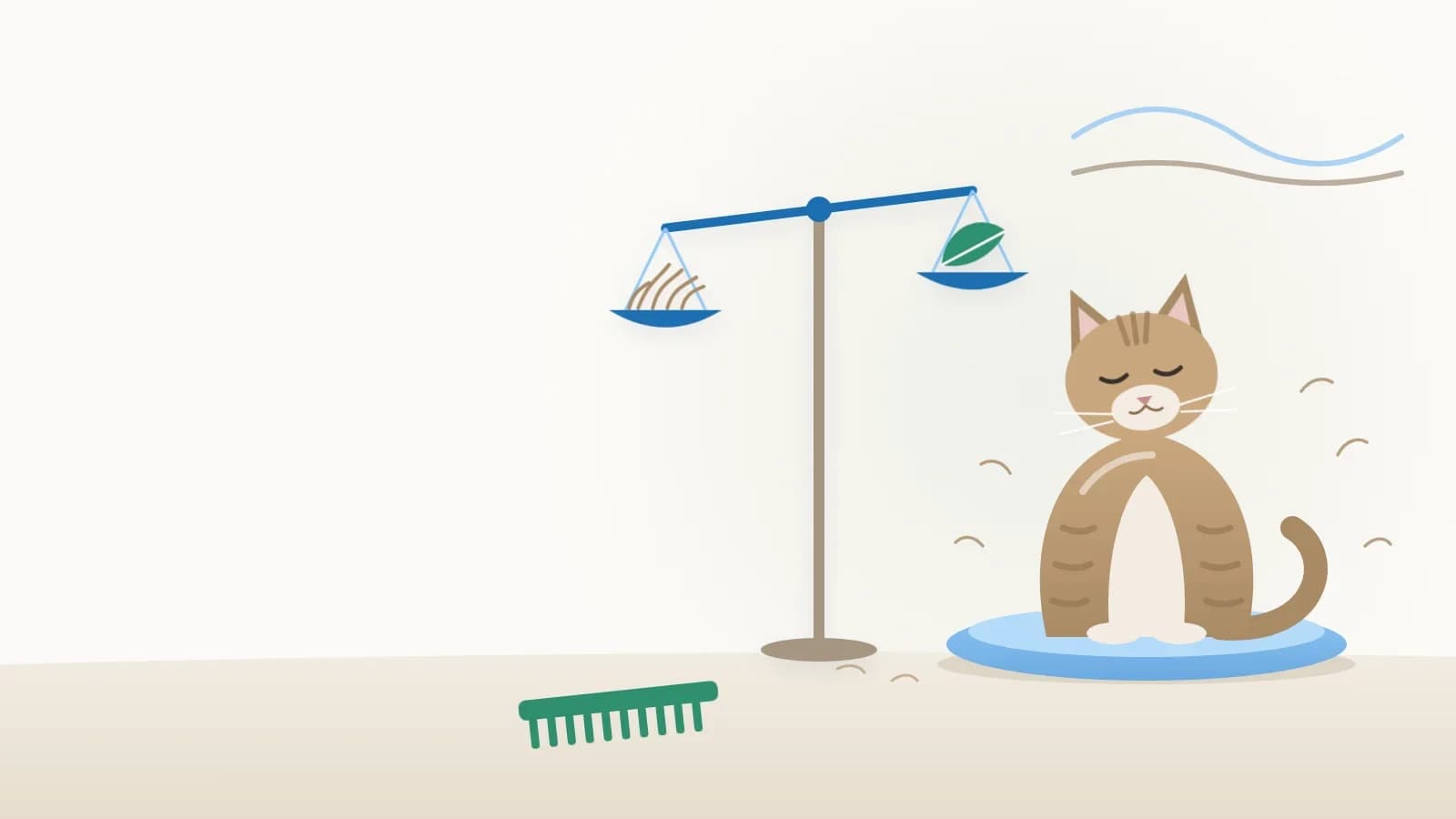
Shedding and Skin Changes in Neutered Cats: The Role of Hormones
Why does your cat's coat change after neutering? How hormones affect sebaceous glands, the hair cycle and weight, what must be ruled out first with a bald patch, and when to see your veterinary surgeon.
Short answer: After neutering, falling sex hormone levels can change sebaceous gland activity, the rhythm of the hair cycle and energy balance, so the texture, oiliness and shedding of the coat may differ. Bald patches, itching or sores, however, should never be put down to "hormones": parasites, ringworm and allergies must first be ruled out by your veterinary surgeon.
A few weeks or months after neutering, many cat owners notice something similar: the coat is not as glossy as it was, dandruff has appeared along the back, the comb is collecting more hair, or the patch of belly clipped for surgery simply will not fill in. This article explains the hormonal and metabolic mechanisms behind these changes and shows which signs should never be dismissed as "just hormones".
You can find how to tell seasonal shedding from problem hair loss in general in our guide to shedding in cats, and care for the first days after surgery in our checklist for the first 10 days after neutering. To be clear from the outset: the person who determines the cause of any change in your cat's skin or coat, and who plans treatment, is your veterinary surgeon.
What does neutering change in a cat's hormonal balance?
Spaying removes the ovaries in female cats; castration removes the testes in males. These organs are the main source of sex hormones: oestrogen and progesterone in females, testosterone in males. After surgery, blood levels of these hormones fall markedly, and hormone-driven processes such as the oestrous cycle and spraying come to an end.
The influence of sex hormones is not confined to the reproductive system. The skin is also an organ that responds to them: sebaceous glands, hair follicles and skin cells all carry sex hormone receptors. Hormones also affect appetite, energy expenditure and body fat. Most of the skin and coat changes seen after neutering are a combination of these two routes: a direct effect on the skin and an indirect effect through metabolism.
How do hormones affect the skin and coat?
Sebaceous glands and sebum
The oily secretion that coats the skin and hair (sebum) is one of the factors that determine coat gloss and the skin's ability to hold moisture. Sebaceous glands are particularly sensitive to male hormones (androgens). This is why a greasy, dirty-looking area on the upper tail ("stud tail", overactivity of the supracaudal gland) is more common in entire tomcats. After castration, as the androgen effect declines, many male cats are seen to have a less greasy coat. This is usually a welcome change, although in some cats the coat may look duller and drier.
The hair cycle
Each hair follicle passes through growth (anagen), transition (catagen) and resting (telogen) phases; shedding happens when a new hair pushes out the old one. The hair follicle is a target tissue for oestrogens and androgens, and laboratory animal studies have shown that an oestrogen receptor pathway regulates the transition from the resting to the growth phase. Direct research on exactly how neutering affects the hair cycle in cats, however, is limited. What is seen in practice varies between individuals: some cats show a slight change in coat texture and density, while many show no noticeable difference.
Energy balance, weight and grooming
The most common and best-documented effect of neutering on the skin and coat is indirect. Studies show that after neutering, cats' energy requirements fall while their appetite may increase; unless food portions are adjusted, weight gain comes easily. An overweight cat struggles to reach the lower back and the base of the tail. In these areas it cannot groom properly, so dead hair builds up, matting and scaling begin, and the coat looks greasy or unkempt. In neutered cats, "dandruff on the back" very often has this mechanism behind it.
Surgical stress and the clipped area
After events that place significant stress on the body, such as anaesthesia and surgery, many hair follicles can enter the resting phase at the same time. The hairs in these follicles are then shed together a few weeks to a few months later; this is called telogen effluvium. The shedding is usually diffuse, the skin looks healthy, and it eases as the hair cycle returns to its own rhythm. Regrowth over the area clipped for surgery can also take months in cats, because feline hair follicles can stay in the resting phase for a long time. If the skin in this area looks clean and healthy, slow regrowth alone is not a cause for concern.
Does neutering directly cause bald patches in cats?
Generally, no. In the past, symmetrical hair loss in cats was attributed to a lack of sex hormones and called "endocrine alopecia". Later studies showed that in most of these cats the hair was not actually falling out on its own: the cat was breaking and pulling it out by licking, because of itching or discomfort. Even in hair loss assumed to be "psychological", most cats were found to have a medical cause such as an adverse food reaction or flea allergy. So a bald patch on a neutered cat is not enough to say "it's hormonal"; the underlying cause needs to be investigated.
Which causes should be ruled out before considering hormones?
When assessing skin and coat problems, veterinary surgeons start with the common causes whose treatment can be planned. The order is the same for a neutered cat:
- 1External parasites: Fleas are the most common cause; in a flea-allergic cat, just a few bites can trigger intense itching. Mites (including the contagious Demodex gatoi), ear mites and Cheyletiella are also investigated. Even cats that never go outdoors can pick up fleas; other pets in the household and the home environment should be assessed too.
- 2Fungal infection (ringworm, dermatophytosis): This may show as ring-shaped or irregular bald areas, broken hairs and scaling. It matters because it can spread to people and other animals.
- 3Allergies: Flea allergy, adverse food reactions and environmental allergies can lead to overgrooming and symmetrical hair loss in cats.
- 4Pain, stress and behaviour: Constant licking of the belly can accompany pain (for example, lower urinary tract problems), stress or changes in the home.
- 5Hormonal and systemic disease: Particularly in middle-aged and older cats, conditions such as an overactive thyroid gland (hyperthyroidism) can be accompanied by an unkempt, scruffy coat and weight loss.
Once these causes have been excluded, the picture may be explained by a physiological change related to neutering, weight gain or telogen effluvium. Making this distinction requires an examination, skin scrapings, microscopic examination of the hairs, fungal tests and, where needed, blood tests. Making the diagnosis and planning treatment is the job of your veterinary surgeon.
What can you monitor at home?
- Weight and body condition: Weigh your cat once a month on the same scales and check whether the ribs can be felt with light pressure.
- Grooming behaviour: Can your cat reach and lick its back and tail base, or are these areas becoming matted?
- Where and how hair is lost: Is there general thinning, or short, broken hairs in one particular area? Broken hairs can point to overgrooming.
- Flea comb: Comb the neck and tail base with a fine-toothed comb. If black specks that fall onto white paper leave a reddish mark when moistened, they may be flea dirt.
- Timeline: Note how long after surgery the change began; this is valuable information for your vet.
When should you see a veterinary surgeon?
Contact your veterinary surgeon without delay if any of the following apply:
- There is an obvious bald patch, redness, crusting, a sore, discharge or odour,
- Your cat is scratching often, licking the same area constantly or biting itself,
- There is swelling, redness, discharge or opening at the surgical site,
- The skin in the clipped area has changed colour or crusted, or your cat licks it constantly,
- Shedding is increasing over the weeks rather than settling,
- Weight is rising quickly or falling unexpectedly, or there are changes in appetite, water intake or behaviour,
- Round, red patches have appeared on another pet in the household or on your own skin.
Where needed, your vet will review the external parasite control programme, investigate the cause with tests and decide on a suitable feeding plan for your cat. Trying home remedies based on information found online, or products made for people, can mask the picture and may be harmful to cats.
How can nutrition support the skin and coat after neutering?
In a neutered cat, skin and coat health rests on two foundations: maintaining an ideal body weight and a complete, balanced diet. Because energy requirements fall, the amount or type of food may need adjusting after neutering; your vet will make this adjustment according to your cat's body condition. While calories are limited, it is important that nutrients essential for the skin and coat, such as protein, essential fatty acids, zinc and B vitamins, remain adequate; keratin structure and the skin barrier depend directly on them. Regular brushing also helps a cat that cannot groom itself fully, by removing dead hair.
On top of this foundation, where your veterinary surgeon considers it appropriate, nutritional support that accompanies the physiological functions of the skin and coat can be considered. Such support does not replace diagnosis or treatment.
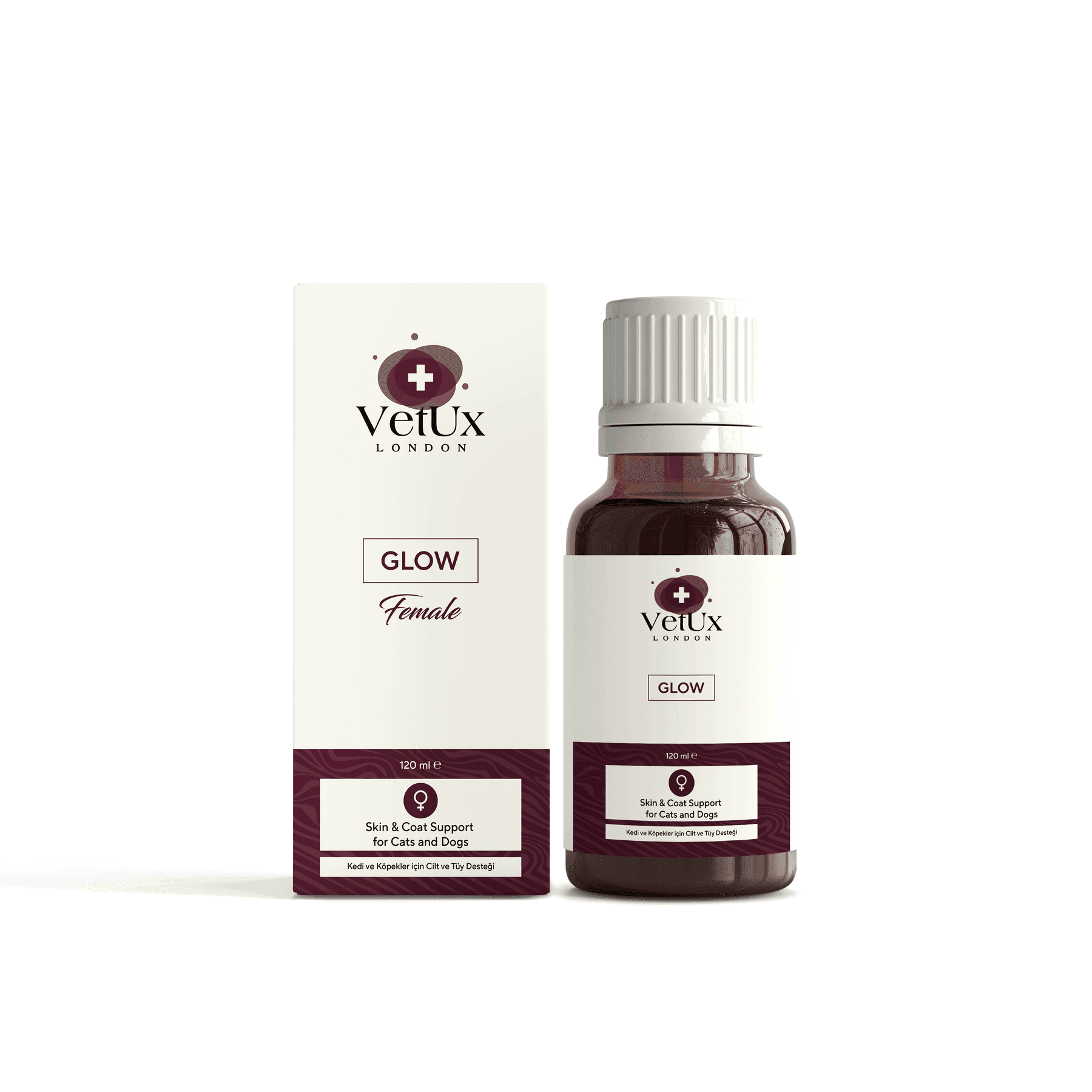
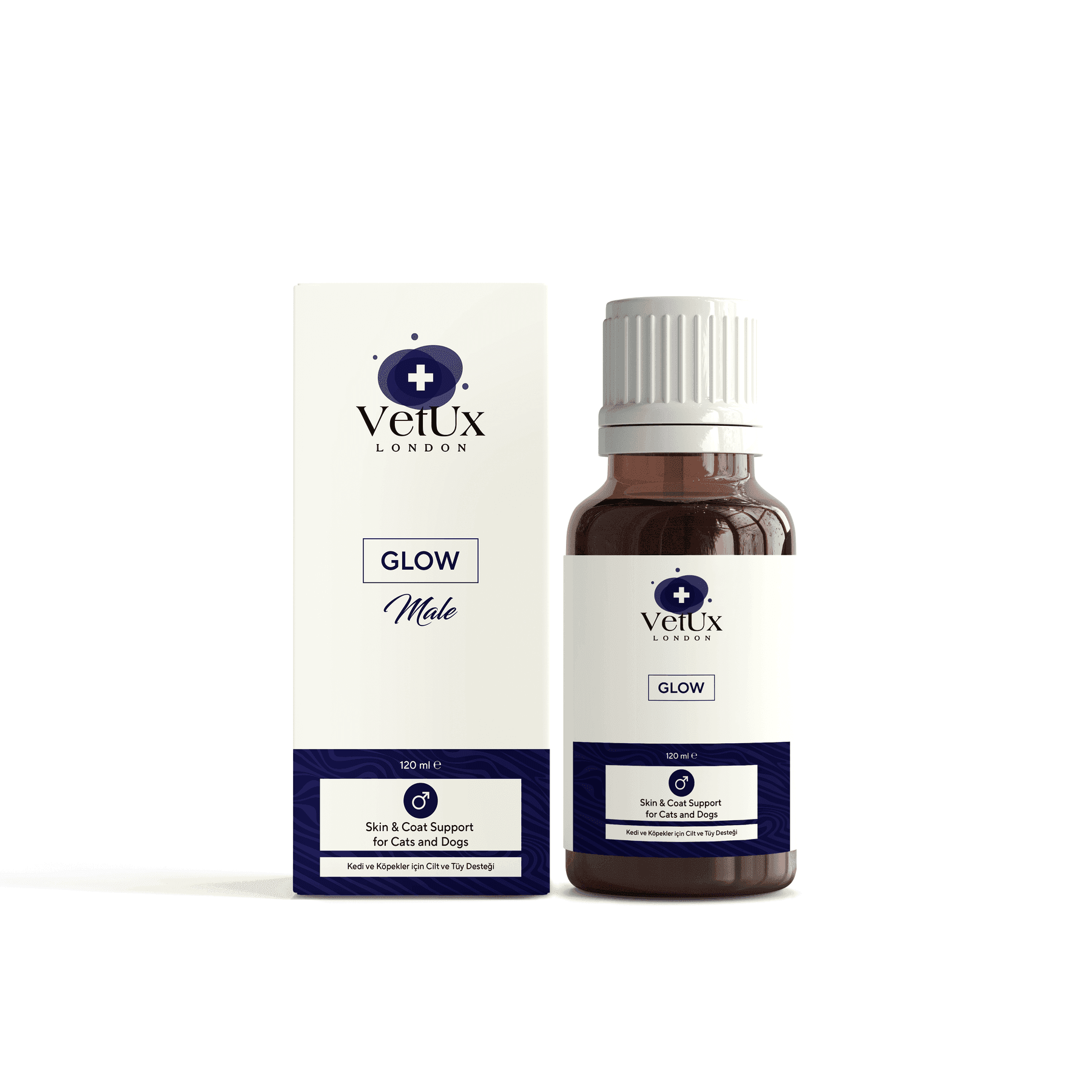
What are Glow Female and Glow Male?
In their web product records, Glow Female and Glow Male are described as liquid complementary feeds that contribute to maintaining skin and coat health in female and male cats and dogs respectively. Both contain nettle (Urtica dioica), burdock (Arctium lappa) and liquorice (Glycyrrhiza glabra) extracts, beta glucan 1,3-1,6, vitamin D3, vitamin B5 (pantothenic acid), vitamin B6 (pyridoxine HCl), zinc and D-biotin; Glow Female adds evening primrose extract (Oenothera biennis) and Glow Male adds saw palmetto extract (Serenoa repens). Biotin, zinc and B vitamins contribute to maintaining keratin structure and normal skin integrity, and the Glow Female product record specifically mentions the period of hormonal change after spaying. These products do not replace a balanced diet or veterinary care: if there is a bald patch, itching or a skin lesion, the cause must first be investigated by your veterinary surgeon. Especially for cats with a chronic condition or on regular medication, decide together with your vet whether the product is suitable and how it should be used. For product details, see the Glow Female and Glow Male pages.
Frequently asked questions
When does shedding start after neutering, and how long does it last?
Diffuse shedding linked to surgical stress (telogen effluvium) is usually noticed a few weeks to a few months after the event and eases on its own as the hair cycle recovers. Dandruff and matting linked to weight gain develop more slowly, over months. If shedding keeps increasing, or is accompanied by a bald patch, redness or itching, contact your veterinary surgeon.
Why does my neutered cat have dandruff on its back?
One common reason is weight gain: an overweight cat cannot reach the lower back and tail base, so it cannot groom these areas properly. However, dandruff can also be linked to fleas, mites (such as Cheyletiella), fungal infection or nutritional deficiency. Your vet will establish the cause, and if weight management is needed you can build the plan together.
Why is my male cat's coat less greasy after castration?
Sebaceous glands are sensitive to male hormones. After castration, as the androgen effect declines, many male cats have a less greasy coat, especially over the upper tail. This is usually an expected change. If the coat becomes markedly dry, scaly or starts to shed, consult your veterinary surgeon.
Could a bald patch on my neutered cat be hormonal?
It is possible but uncommon. Most symmetrical hair loss in cats comes from hair being licked out because of itching or discomfort; fleas, allergies and ringworm are among the most common causes. Attributing a bald patch to hormones before your vet has ruled these out would not be right.
Can I start Glow Female or Glow Male without asking my vet?
This is not recommended. Complementary feeds accompany a balanced diet and veterinary care, but they do not replace a diagnosis. If a parasitic, fungal or allergic cause lies behind the skin and coat change, it needs to be addressed first. Decide together with your veterinary surgeon whether and how to use the product.
Final word
Neutering is a valuable step for your cat's health and quality of life. Mild coat changes afterwards are often expected physiological consequences and can be supported with weight management, a balanced diet and regular brushing. Changes that are marked, persistent or accompanied by skin problems, however, should not be left in the hope that "it's hormones and it will pass"; the cause should be investigated by a veterinary surgeon.
References
- 1Miller WH Jr, Griffin CE, Campbell KL. Muller & Kirk's Small Animal Dermatology. 7th ed. St. Louis: Elsevier Mosby; 2013.
- 2Ohnemus U, Uenalan M, Inzunza J, Gustafsson JÅ, Paus R. The hair follicle as an estrogen target and source. Endocr Rev. 2006;27(6):677-706.
- 3Oh HS, Smart RC. An estrogen receptor pathway regulates the telogen-anagen hair follicle transition and influences epidermal cell proliferation. Proc Natl Acad Sci USA. 1996;93(22):12525-12530.
- 4Fettman MJ, Stanton CA, Banks LL, et al. Effects of neutering on bodyweight, metabolic rate and glucose tolerance of domestic cats. Res Vet Sci. 1997;62(2):131-136.
- 5Belsito KR, Vester BM, Keel T, Graves TK, Swanson KS. Impact of ovariohysterectomy and food intake on body composition, physical activity, and adipose gene expression in cats. J Anim Sci. 2009;87(2):594-602.
- 6Waisglass SE, Landsberg GM, Yager JA, Hall JA. Underlying medical conditions in cats with presumptive psychogenic alopecia. J Am Vet Med Assoc. 2006;228(11):1705-1709.
- 7Hobi S, Linek M, Marignac G, et al. Clinical characteristics and causes of pruritus in cats: a multicentre study on feline hypersensitivity-associated dermatoses. Vet Dermatol. 2011;22(5):406-413.
- 8Moriello KA, Coyner K, Paterson S, Mignon B. Diagnosis and treatment of dermatophytosis in dogs and cats: Clinical Consensus Guidelines of the World Association for Veterinary Dermatology. Vet Dermatol. 2017;28(3):266-e68.
- 9ESCCAP. Guideline 03: Control of Ectoparasites in Dogs and Cats. European Scientific Counsel Companion Animal Parasites; current edition (esccap.org).
- 10Brooks D, Churchill J, Fein K, et al. 2014 AAHA Weight Management Guidelines for Dogs and Cats. J Am Anim Hosp Assoc. 2014;50(1):1-11.
- 11Watson TDG. Diet and skin disease in dogs and cats. J Nutr. 1998;128(12 Suppl):2783S-2789S.
Every cat's hormonal response, weight and skin type are different; this article is for general information. For any change you notice in your cat's coat or skin, consult your veterinary surgeon.
Frequently asked questions
When does shedding start after neutering, and how long does it last?
Diffuse shedding linked to surgical stress (telogen effluvium) is usually noticed a few weeks to a few months after the event and eases on its own as the hair cycle recovers. Dandruff and matting linked to weight gain develop more slowly, over months. If shedding keeps increasing, or is accompanied by a bald patch, redness or itching, contact your veterinary surgeon.
Why does my neutered cat have dandruff on its back?
One common reason is weight gain: an overweight cat cannot reach the lower back and tail base, so it cannot groom these areas properly. However, dandruff can also be linked to fleas, mites (such as Cheyletiella), fungal infection or nutritional deficiency. Your vet will establish the cause, and if weight management is needed you can build the plan together.
Why is my male cat's coat less greasy after castration?
Sebaceous glands are sensitive to male hormones. After castration, as the androgen effect declines, many male cats have a less greasy coat, especially over the upper tail. This is usually an expected change. If the coat becomes markedly dry, scaly or starts to shed, consult your veterinary surgeon.
Could a bald patch on my neutered cat be hormonal?
It is possible but uncommon. Most symmetrical hair loss in cats comes from hair being licked out because of itching or discomfort; fleas, allergies and ringworm are among the most common causes. Attributing a bald patch to hormones before your vet has ruled these out would not be right.
Can I start Glow Female or Glow Male without asking my vet?
This is not recommended. Complementary feeds accompany a balanced diet and veterinary care, but they do not replace a diagnosis. If a parasitic, fungal or allergic cause lies behind the skin and coat change, it needs to be addressed first. Decide together with your veterinary surgeon whether and how to use the product.
This article is for general information only; it does not replace veterinary examination, diagnosis or treatment. VetUx London products are complementary feed. If you have any concern about your companion, please consult your veterinary surgeon.
Share
The formulas matching the nutritional support described above.
Related articles
All articles Clinical Notes
How to Choose a Probiotic for Cats and Dogs: Strain, Colony Count and Storage Conditions
What should you look for on the label when choosing a probiotic for your cat or dog? Why the strain name and code matter, how to read the colony count (CFU), how storage affects viability and why human probiotics should not be given, with references.
 Clinical Notes
Diarrhoea in Dogs: What to Check in the First 24 Hours, and Which Signs Are an Emergency?
What to watch in the first 24 hours after your dog's diarrhoea starts, the signs of fluid loss, why bloody diarrhoea in a puppy is an emergency and the role of the gut flora, with references.
 Clinical Notes
My Cat Keeps Going to the Litter Box: Lower Urinary Tract Signs and Emergencies
Frequent litter box trips, straining and bloody urine are lower urinary tract signs in cats, and a male cat that cannot urinate is an emergency. We explain the signs, the role of stress and water intake, and when to see your vet.